



US shoots down Iranian drone near aircraft carrier amid ongoing talks
- In Reports
- 04:41 PM, Feb 04, 2026
- Myind Staff
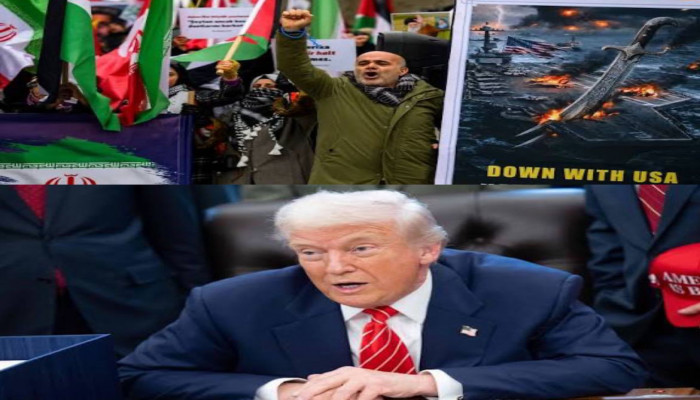
United States President Donald Trump has said that talks with Iran are continuing in an effort to reduce tensions in the Gulf region, even as the US military announced that it shot down an Iranian drone that approached an American aircraft carrier in the Arabian Sea.
Speaking to reporters at the White House on Tuesday, Trump said Washington was negotiating with Iran “right now”, but he did not reveal where the talks were being held. “[The talks] are all over. But they are negotiating. They’d like to do something, and we’ll see if something is going to be done,” Trump said.
He also referred to a previous opportunity for diplomacy, saying, “They had a chance to do something a while ago, and it didn’t work out. And we did ‘Midnight Hammer’, I don’t think they want that happening again,” Trump added. He was referring to the operation last June when the US Air Force and Navy struck three Iranian nuclear facilities.
Trump has been pushing Iran to agree to talks regarding its nuclear programme. At the same time, he has repeatedly threatened to attack Iran again over a recent crackdown on anti-government protests.
Last week, the US sent the USS Abraham Lincoln to the Gulf, raising concerns of a possible military confrontation. The carrier strike group brought around 5,700 additional US troops and joined three destroyers and three littoral combat ships that were already deployed in the region.
However, tensions have eased slightly in recent days as regional powers have increased efforts to push for a resolution.
Earlier on Tuesday, Iranian President Masoud Pezeshkian said he had instructed Iran’s foreign minister to move forward with talks under certain conditions. “Pursue fair and equitable negotiations, guided by the principles of dignity, prudence, and expediency,” Pezeshkian said, adding that talks would proceed only if a “suitable environment exists”. He further stated, “These negotiations shall be conducted within the framework of our national interests.”
The Iranian president’s statement came on the same day that the US military reported shooting down an Iranian drone. US Central Command (CENTCOM) said that a US fighter jet from the USS Abraham Lincoln “shot down the Iranian drone in self-defence and to protect the aircraft carrier and personnel on board”.
According to CENTCOM, the Shahed-139 drone “aggressively approached” the carrier, which was operating about 800km (500 miles) from Iran’s southern coast. The military said the drone had “unclear intent” and continued flying toward the ship despite US efforts to prevent escalation. CENTCOM said the US forces were operating in international waters when the incident occurred.
Iran did not immediately issue an official response.
Iran’s Tasnim news agency, quoting an unnamed source familiar with the matter, reported that communication was lost with a drone in international waters. The source said the drone had “successfully” sent data back to the Islamic Revolutionary Guard Corps (IRGC) before the connection was lost. Tasnim said an investigation was ongoing to determine the reason behind the disconnection.
Following the shoot-down, CENTCOM also reported another incident involving an oil tanker in the Strait of Hormuz. CENTCOM said IRGC forces harassed a US-flagged and US-crewed merchant vessel in the area. “Two IRGC boats and an Iranian Mohajer drone approached M/V Stena Imperative at high speeds and threatened to board and seize the tanker,” CENTCOM said.
Iran’s Fars news agency later quoted unnamed Iranian officials saying that a vessel had entered Iranian territorial waters without the required legal permits. The officials said the ship was warned and then left the area “without any special security event taking place”.
Despite these incidents, preparations for talks reportedly remain unchanged. The talks are expected to happen on Friday.
In an interview with Fox News on Tuesday, White House Press Secretary Karoline Leavitt said Trump’s special envoy Steve Witkoff “is set to have conversations with the Iranians later this week”. She added, “Those are still scheduled as of right now.”
Tasnim quoted a Foreign Ministry spokesperson saying that discussions were continuing to decide the location for the meeting. Turkiye, Oman, and several other regional countries have offered to host.
The Associated Press, citing an unnamed Turkish official, reported that foreign ministers from Oman, Pakistan, Qatar, Saudi Arabia, and the United Arab Emirates have also been invited to attend if the talks go ahead.
Qatar’s Foreign Ministry said it was working with Iranian contacts at the highest levels to reduce tensions. “All of us in the region collectively… are making the right connections and contacts to make sure we are playing a positive role,” said Majed Al Ansari, a spokesperson for the ministry. He added, “Qatar is not standing alone on this; we are working together in tandem to make sure we de-escalate and protect our region and make sure there are not more escalations.”
Reuters reported that Iran is demanding that the talks be held in Oman instead of Turkiye and that the agenda should focus only on nuclear issues. The report cited an unnamed regional source.
Last year, US and Iranian officials held five rounds of talks in Oman. However, discussions were suspended due to Israel’s 12-day war with Iran, which the US later joined.
Al Jazeera’s Tohid Asadi, reporting from Tehran, said Iranian officials were “looking for a pragmatic approach”, but the exact topics remain unclear. Iranian officials want the talks limited to the nuclear programme, while Washington reportedly wants broader discussions, including Iran’s links to armed groups and its ballistic missile and defence programmes.
Asadi also said trust remains a major issue, pointing out that talks were underway in June when Iran was attacked. “Of course, we’ve also got a trust issue, and we have to remember that there were talks in June, when the US and Israel attacked Iran, targeting its nuclear facilities, nuclear scientists, military headquarters, as well as civilian infrastructure,” he said.
Analysts say the talks may not lead to progress. Alex Vatanka, a senior fellow at the Middle East Institute, said neither side appears ready to change its position. “The question is, will this lead to anything? I have not seen any signals from Washington or Tehran suggesting that either side is willing to, if you will, soften their red lines,” Vatanka said. He added, “So, unless that changes, unless there is a last-minute surprise by either the American or Iranian side, then I can’t really see how holding diplomatic talks might take this crisis in a peaceful direction.”
Vatanka also said the US is “flexing muscle” and “posturing” more strongly this time. “The question is, is the US deploying all of these military assets to really get the Iranian attention on the need for a deal soon rather than later? Or is it perhaps preparing for something protracted, in terms of a political project that looks like regime change in the Islamic Republic?” he said.



 Loading...please wait
Comments