



US shares declassified data on alleged 2020 Chinese nuclear test, calls for greater transparency
- In Reports
- 01:22 PM, Feb 25, 2026
- Myind Staff
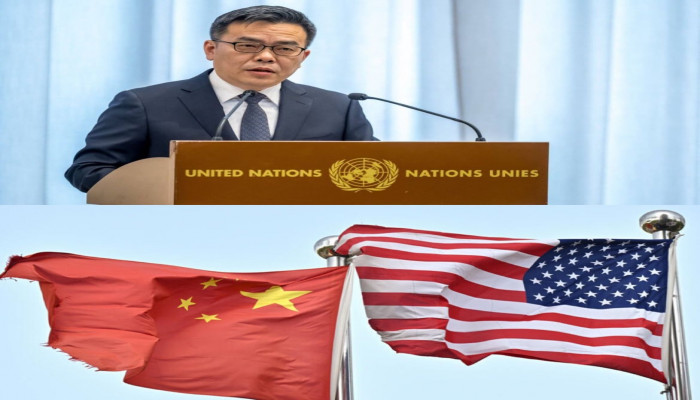
The United States has released newly declassified intelligence about a suspected Chinese nuclear test that allegedly took place in 2020. The disclosure was presented by Christopher Yeaw, the US Assistant Secretary of State for Arms Control and Non-Proliferation, at the UN-backed Conference on Disarmament in Geneva. The move is part of Washington’s broader effort to push China and Russia towards greater transparency and renewed commitments to nuclear arms control.
The timing of this disclosure is significant. It comes shortly after the expiry of the New START treaty between the US and Russia. The treaty had placed limits on the strategic nuclear arsenals of the two largest nuclear powers. With its expiration earlier this month, those limits no longer apply, increasing fears of a new global arms race.
During his address, Yeaw pointed out what he described as weaknesses in the New START agreement. He said the treaty failed to limit Russia’s stockpile of up to 2,000 non-strategic nuclear warheads. He also argued that the agreement did not address China’s rapid and secretive expansion of its nuclear forces.
According to US assessments, China has significantly expanded its nuclear arsenal in recent years. American officials believe China could reach nuclear parity with the United States within four to five years. Yeaw described China’s build-up as deliberate and without constraints, which he said stands in contrast to Beijing’s public statements that it is acting with restraint.
At the centre of the US claims is a seismic event recorded on 22 June 2020 at China’s Lop Nur nuclear test site in Xinjiang. The event was detected by an international monitoring station located in Kazakhstan. It measured magnitude 2.75. US officials believe the tremor showed characteristics of a single-point explosion rather than a natural earthquake or a mining blast.
Yeaw also raised concerns about China’s lack of cooperation in verification efforts. He said China has refused to allow seismic monitoring stations near Lop Nur at distances similar to those permitted by the US around its Nevada test site. He argued that this lack of transparency weakens global non-proliferation efforts and makes it harder to build trust.
China has strongly denied the allegations. Ambassador Jian Shen rejected the US claims and described them as baseless. He accused Washington of trying to create excuses to resume its own nuclear testing. Beijing maintains that it follows a voluntary moratorium on nuclear testing, in line with commitments made by the five recognised nuclear powers.
Shen also argued that China’s nuclear arsenal is much smaller than that of the United States or Russia. He said that trilateral arms control talks between the three countries would be premature and unfair. According to him, the strategic situations of the countries are very different, and the US demands for such talks are unreasonable.
Independent experts have weighed in on the issue as well. Tong Zhao from the Carnegie Endowment said if it were confirmed that China carried out yield-producing nuclear tests, it could damage Beijing’s image as a responsible nuclear power. He warned that such confirmation might encourage those in the United States who want to restart nuclear testing to ensure the reliability of America’s ageing nuclear stockpile.
Recent statements from US leaders have added to global concern. President Donald Trump has indicated that he might consider restarting US nuclear testing, which has not taken place since 1992. However, Energy Secretary Chris Wright clarified that there are currently no plans to conduct explosive tests. Yeaw stated that the US would respond on an “equal basis” to the actions of its peers, clearly referring to China and Russia.
Secretary of State Marco Rubio also addressed the issue. He reaffirmed that the United States supports multilateral disarmament efforts. At the same time, he stressed that Washington will not allow rival nations to expand their nuclear arsenals without limits. Rubio cited estimates showing that China’s nuclear warheads have increased from around 200 in 2020 to more than 600 today. He added that projections suggest China could have over 1,000 warheads by 2030.
Yeaw urged the 65-nation Conference on Disarmament to press China and Russia to increase transparency and engage in serious arms control discussions. The United States has already begun bilateral talks with Russian representatives and is planning meetings with Chinese officials. Washington is also consulting with allies such as France and Britain on the issue.
Earlier attempts by President Trump to negotiate a trilateral arms control agreement between the US, Russia, and China did not succeed. The US is now exploring different formats for discussions, including both bilateral and multilateral approaches, in an effort to limit nuclear proliferation. Yeaw’s remarks reflect a broader US strategy to build international support and apply collective pressure on countries that it believes are not complying with responsible nuclear practices.
The situation highlights the weakening of the global arms control system after the end of New START. China has been expanding its missile silos, developing hypersonic weapons, and strengthening its sea-based nuclear capabilities. At the same time, Russia’s focus on tactical nuclear weapons adds further complexity to the security environment.
For India, these developments are closely watched. As a country that maintains a nuclear triad and faces regional tensions with China, India pays careful attention to shifts in global nuclear policy. Greater transparency from major powers could support India’s efforts to promote a Fissile Material Cut-off Treaty at the Conference on Disarmament.
China continues to defend its position by pointing to its no-first-use policy and its claim of maintaining only a minimal deterrent. However, satellite imagery and data from SIPRI indicate that its nuclear arsenal is growing. If the Lop Nur event is eventually confirmed as a nuclear test, it could raise serious questions about China’s adherence to the Comprehensive Nuclear-Test-Ban Treaty and increase diplomatic pressure on Beijing.
Overall, Yeaw’s disclosure is intended to rally international support against what the US sees as unchecked nuclear expansion by China and Russia. However, China’s strong response shows that disagreements remain deep. Rebuilding a stable and verifiable arms control system will require significant compromises and renewed commitment from all major nuclear powers.



 Loading...please wait
Comments