



US plans to bring 4500 white Africans per month as refugees: Report
- In Reports
- 02:59 PM, Feb 27, 2026
- Myind Staff
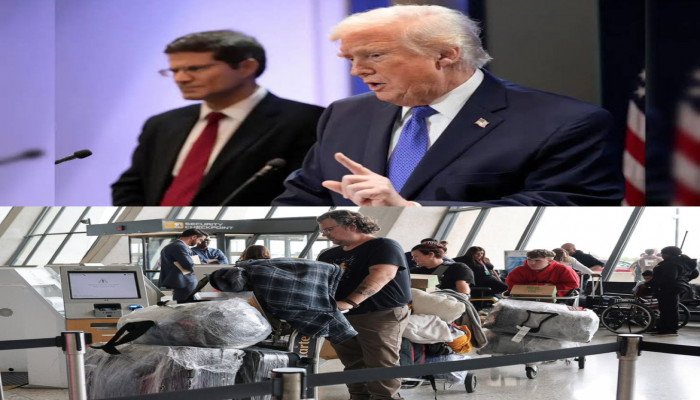
According to a US government document, the United States government is planning to process 4,500 refugee applications from white South Africans each month, a pace that greatly exceeds the official annual limit on refugees. President Trump is believed to have an announcement on the refugee issue. The target was revealed in a previously unpublished U.S. State Department contracting document dated January 27, which shows Washington is preparing to ramp up admissions from South Africa even as refugee intake from most other regions has been sharply restricted. The document says the monthly goal was communicated to the refugee division of the State Department from the White House and implies that failing to reach this goal would mean not meeting a “Presidential priority.”
Under the plan, the U.S. has started to install trailers and modular facilities on the grounds of the American Embassy in Pretoria, South Africa’s capital, to help handle the volume of applications. Contractors have been hired to set up these prefabricated buildings, described in the document as a “temporary modular village,” and the work was awarded without a competitive bidding process because officials said there was an urgent need for a secure site. Officials began moving operations to the embassy property after South African authorities raided a previous processing location on commercial property in Johannesburg, disrupting work there.
The plan represents a sharp contrast with Trump’s stated refugee policy. For the fiscal year 2026, the president has said the United States will admit only 7,500 refugees worldwide, one of the lowest annual targets in decades, while much higher total ceilings — between 40,000 and 60,000 refugees — were considered internally last year. Yet the new document shows that the White House wants to process 4,500 South African cases every month, a figure that would add up to far more than the stated annual total if it were maintained.
As of January 31, only about 2,000 white South Africans had entered the United States as refugees under this program, which was launched in May 2025. Officials say the pace of arrivals has increased in recent months, with around 1,500 admitted in December and January, compared with about 500 in the six and a half months before that. But the ambitious monthly target remains far above what has so far been achieved, and it is unclear whether it can be met.
Part of the reason for this uncertainty is administrative delays in Washington, where processing of all refugees, including white South Africans, has been temporarily paused. According to a U.S. official familiar with the matter who spoke on condition of anonymity, recent weeks saw a halt to all refugee travel to the United States due to operational issues, with the State Department cancelling refugee travel from February 23 to March 9 in an email to applicants. This pause has compounded by the existing backlogs and slowed approvals by the Department of Homeland Security (DHS).
The refugee initiative for white South Africans has been controversial. The Trump administration has justified giving priority to white South Africans, particularly those of Afrikaner ethnicity, by saying they face violent persecution and racial discrimination in South Africa, a country majority-led by Black citizens. However, that reasoning has been firmly rejected by the South African government, which says there is no evidence of “systemic persecution” of Afrikaners.
Chrispin Phiri, a spokesperson for South Africa’s Foreign Ministry, said that while South Africa would not interfere with the U.S. program if it operates within legal boundaries, the core claim behind it is unfounded. “The assertion that Afrikaners face systemic persecution is fundamentally unsubstantiated,” he said.
Some refugee advocates have also criticised the policy, saying that prioritising one group in this way is inconsistent with how the refugee system is meant to work. Others note that the program’s potential to admit tens of thousands of South Africans each year — while global refugee intake from other regions remains low — raises questions about fairness and the overall logic of U.S. refugee policy.
The refugee plan has also strained relations between Washington and Pretoria at times. In mid-December, South African authorities raided a building in Johannesburg where U.S. staff and contractors were working on refugee cases. Seven Kenyan workers for a U.S. refugee agency were arrested for alleged visa violations, and two U.S. refugee officers were briefly detained. After those events, U.S. and South African officials held closed-door discussions and reached an agreement allowing processing to continue.
While the modular processing site at the embassy property is now becoming operational, with reports from applicants of interviews being held in trailers, the monthly goal of 4,500 cases remains a challenging target. The outcome will depend on whether bureaucratic delays can be reduced and whether the demand among potential refugees can be matched with processing capacity under the current U.S. refugee system.



 Loading...please wait
Comments