




US Navy turns to AI firm Domino for mine detection in Strait of Hormuz
- In Reports
- 05:56 PM, May 01, 2026
- Myind Staff
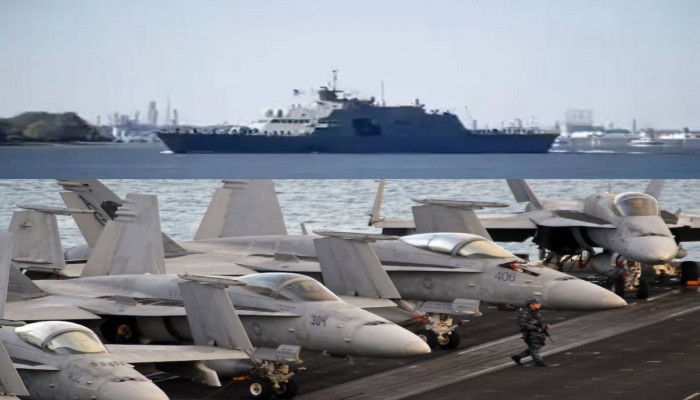
The U.S. Navy is strengthening its use of artificial intelligence to detect and clear Iranian mines in the Strait of Hormuz, one of the world’s most important oil shipping routes. A new contract highlights this shift towards faster and more efficient mine-hunting operations.
The development comes as President Donald Trump stated that the Navy is already working to remove Iranian mines from the strait. This route is crucial for global oil transport, and any disruption can impact the global economy. Even with a fragile ceasefire between the U.S. and Iran after weeks of conflict, clearing underwater explosives remains a slow and risky process that could take months.
To address this challenge, the Navy has awarded a contract worth up to $99.7 million to San Francisco-based AI company Domino Data Lab. The goal is to speed up mine detection using advanced software that can train underwater drones to identify new types of mines within days.
"Mine-hunting used to be a job for ships," Thomas Robinson, Domino's chief operating officer, said in an interview with Reuters. "It's becoming a job for AI. The Navy is paying for the platform that lets it train, govern, and field that AI at a speed required for contested waters that block global trade and imperil sailors."
The contract expands Domino’s role in Project AMMO, which stands for Accelerated Machine Learning for Maritime Operations. This program aims to improve how quickly and accurately the Navy can detect underwater mines while reducing reliance on human involvement.
Domino’s software combines data from multiple sources, such as side-scan sonar and visual imaging systems. It also helps the Navy track how well different AI models perform in real conditions. If any model fails or shows weak results, the system allows quick updates and corrections to improve performance.
Speed is the main advantage of this new approach. Earlier, updating AI models used in unmanned underwater vehicles (UUVs) could take up to six months. Domino claims that its technology reduces this time to just a few days, allowing the Navy to respond quickly to new threats.
Robinson explained how this can be useful in real situations. "If there were UUVs in the Baltic Sea trained on Russian mines, and then they needed to be deployed to the Strait of Hormuz to detect Iranian mines, with Domino's technology, the Navy could be ready in a week rather than a year."
This capability is especially important in regions like the Middle East, where conditions and threats can change rapidly. Faster adaptation means better protection for ships, sailors, and global trade routes.
The Navy’s investment in AI reflects a broader shift in modern warfare, where technology plays a key role in improving speed, accuracy, and safety. By reducing the time needed to train systems and respond to threats, the Navy aims to stay prepared in high-risk maritime zones.



 Loading...please wait
Comments