




US mulls suspending Spain from NATO, reviews UK’s claim over Falkland Islands: Report
- In Reports
- 07:08 PM, Apr 24, 2026
- Myind Staff
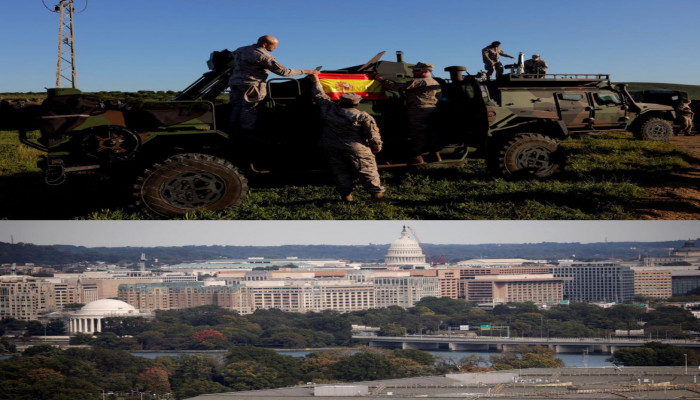
An internal email from the Pentagon has revealed that the United States is exploring possible actions against some NATO allies over what it sees as a lack of support during its conflict with Iran. According to a U.S. official who spoke to Reuters on condition of anonymity, the email outlines several policy options, including suspending Spain from NATO and reviewing the U.S. stance on United Kingdom’s claim over the Falkland Islands.
The email reflects frustration within the U.S. administration over certain allies not providing access, basing, and overflight rights, known as ABO, during the ongoing war with Iran. According to the official, the note describes ABO as "just the absolute baseline for NATO," and indicates that these discussions are taking place at senior levels within the Pentagon.
One of the proposals mentioned involves removing or sidelining countries seen as “difficult” from key or prestigious roles within NATO. While the idea of suspending a member state like Spain has been raised, a NATO official clarified that “NATO’s Founding Treaty does not foresee any provision for suspension of NATO membership,” making such a move legally unclear.
The tensions come amid strong criticism from U.S. President Donald Trump, who has openly expressed dissatisfaction with NATO allies. He has accused them of not supporting U.S. efforts to reopen the Strait of Hormuz after it was shut following the start of the air war on February 28. Speaking to Reuters, Trump said, "Wouldn't you if you were me?" when asked whether he was considering withdrawing the U.S. from NATO.
Despite such remarks, the internal email does not suggest that the United States should leave the alliance. It also does not include any recommendation to shut down U.S. military bases in Europe. However, the official did not confirm whether a reduction of U.S. forces in Europe is being considered.
Responding to the report, Pentagon Press Secretary Kingsley Wilson reiterated the administration’s stance. "As President Trump has said, despite everything that the United States has done for our NATO allies, they were not there for us." He added, "The War Department will ensure that the President has credible options to ensure that our allies are no longer a paper tiger and instead do their part. We have no further comment on any internal deliberations to that effect."
The ongoing U.S.-Israeli conflict with Iran has raised serious concerns about the future of NATO, which has existed for 76 years. Analysts and diplomats have warned that the situation is creating doubts about whether the United States would defend European allies if they were attacked. Countries such as Britain and France have argued that joining a U.S.-led naval blockade would mean directly entering the war. However, they have expressed willingness to help maintain open shipping routes once a ceasefire is reached.
The U.S. administration has also shown particular frustration with Spain. Apart from its stance during the Iran conflict, Spain has resisted increasing its defence spending to 5% of GDP, arguing that it can meet NATO commitments with lower spending. The United States operates two major military bases in Spain, Naval Station Rota and Morón Air Base, making the relationship strategically important.
According to the email, the proposed actions are meant to send a strong signal to European allies and reduce what the administration sees as a “sense of entitlement.” While suspending Spain may have limited operational impact, the document suggests it would carry strong symbolic weight. Spanish Prime Minister Pedro Sanchez dismissed the report, stating, "We do not work off emails. We work off official documents and government positions, in this case of the United States," and emphasised that Spain remains a “loyal partner” to NATO.
Experts have warned that even discussing such measures could harm the alliance. Sven Biscop, a professor of European defence policy, said that a public threat like this would be “gravely damaging” and further weaken trust between Europe and the United States. He noted that many European leaders are already uncertain about U.S. support in times of crisis.
Another option mentioned in the memo involves reconsidering U.S. diplomatic backing for European-controlled territories such as the Falkland Islands. The islands, administered by the United Kingdom but claimed by Argentina, were the focus of a brief war in 1982. During that conflict, around 650 Argentine and 255 British personnel were killed before Argentina surrendered.
President Trump has also criticised British Prime Minister Keir Starmer, calling him cowardly for not joining the U.S. campaign against Iran. He said Starmer was “not Winston Churchill” and dismissed Britain’s aircraft carriers as “toys.” Initially, Britain refused to allow U.S. strikes on Iran from its bases but later permitted defensive operations to protect people in the region.
Speaking earlier this month, U.S. Defense Secretary Pete Hegseth highlighted the strategic risks, noting that Iran’s long-range missiles can reach Europe even if they cannot strike the United States. He said, "We get questions, or roadblocks, or hesitations ... You don't have much of an alliance if you have countries that are not willing to stand with you when you need them."



 Loading...please wait
Comments