




US, Indonesia sign major defence cooperation agreement
- In Reports
- 06:23 PM, Apr 14, 2026
- Myind Staff
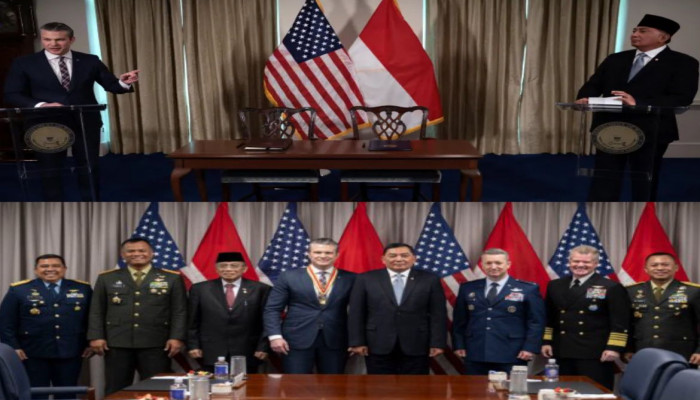
The United States and Indonesia have signed a significant defence cooperation agreement, marking a new phase in their security relationship. The partnership was formalised during a meeting at the Pentagon, where US Secretary of Defence Pete Hegseth hosted Indonesia’s Defence Minister Sjafrie Sjamsoeddin. The agreement reflects growing ties between the two countries as they aim to strengthen stability in the Asia-Pacific region.
Hegseth described the agreement as a major step forward in bilateral relations. He said, “This [partnership] signifies the strength and potential of our security relationship… bolsters regional deterrence, and advances our shared commitment to peace through strength,” according to a statement from the US Department of Defence. He also highlighted that the defence relationship between Washington and Jakarta is “active and growing,” pointing out that their armed forces take part in more than 170 joint military exercises every year.
The newly signed partnership focuses on advancing defence capabilities and improving coordination between the two nations. According to a joint statement, both sides have agreed to collaborate on developing “sophisticated asymmetric capabilities” and to work on next-generation defence technologies. These efforts will mainly focus on maritime, subsurface, and autonomous systems. The agreement also aims to strengthen operational readiness, ensuring both countries are better prepared to respond to regional challenges.
Indonesia expressed strong support for the partnership and emphasised its long-term importance. Sjafrie Sjamsoeddin said, “We are here as Indonesian delegates… with very great enthusiasm to continue to develop our defence relationship, [which] should be enduring for our next generation in Indonesia and the United States of America.” He further added, “We’re working on behalf of mutual respect and mutual benefit to enhance [the] value of our national interests.” His remarks underline Indonesia’s intention to maintain a balanced and mutually beneficial relationship with the United States.
The agreement comes at a time when discussions are ongoing about granting US military aircraft access to Indonesian airspace. Reports in Indonesian media suggested that Washington is seeking “blanket” overflight rights. These reports also claimed that President Prabowo Subianto had approved the proposal. However, Indonesia’s Ministry of Defence clarified that the matter is still under discussion and no final decision has been made.
The ministry stated that both countries are currently working on a “Letter of Intent,” and that the proposal remains in its early stages. Officials stressed that the draft is neither final nor legally binding. They made it clear that any future arrangement would fully respect Indonesia’s sovereignty. A spokesperson for Defence Minister Sjafrie reiterated this position, saying that control over Indonesian airspace remains entirely with the country.
Rico Ricardo Sirait, the minister’s spokesman, addressed the issue directly. He said, “The deal is not final. It is not legally binding. It cannot be used as a basis for official government policy.” He further added, “Authority, control, and oversight over Indonesian airspace rest entirely in our country. Any potential regulation shall guarantee Indonesia’s full authority to approve or reject any activity in national airspace.” These statements reflect Indonesia’s cautious approach to balancing cooperation with national interests.
The development also comes amid active diplomatic engagements by President Prabowo Subianto. He is scheduled to meet French President Emmanuel Macron in Paris, just a day after holding talks with Russian President Vladimir Putin on energy-related issues. These meetings highlight Indonesia’s broader effort to strengthen ties with multiple global powers.
At the same time, Indonesia is dealing with economic pressures linked to rising global energy prices. Last month, the government introduced fuel rationing measures and asked civil servants to work from home one day a week. These steps aim to conserve energy as prices surge due to tensions linked to the US-Israel conflict with Iran.
Overall, the new defence agreement between the United States and Indonesia signals closer strategic cooperation while also reflecting Indonesia’s careful approach to safeguarding its sovereignty. The ongoing discussions on airspace access show that while ties are deepening, key decisions are still being handled with caution.



 Loading...please wait
Comments