




U.S. hosts G7 Ministers meeting on rare earths amid China–Japan trade tensions
- In Reports
- 06:26 PM, Jan 12, 2026
- Myind Staff
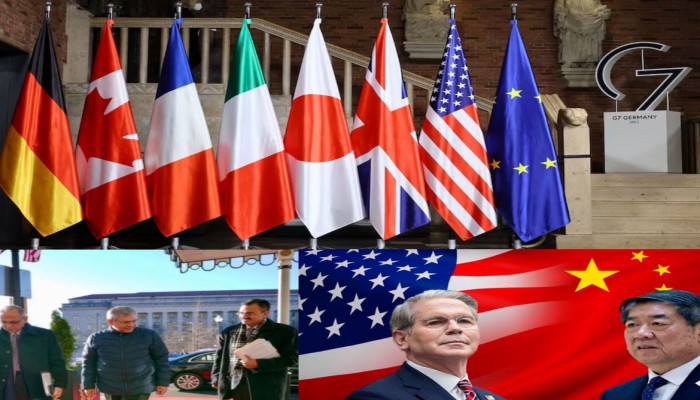
The United States is hosting a key international meeting this week to discuss rare earths and critical minerals, highlighting growing concerns among major economies over supply chains dominated by China.
The meeting will be hosted in Washington by U.S. Treasury Secretary Scott Bessent and will bring together ministers from the Group of Seven (G7). Canadian Finance Minister Francois-Philippe Champagne will attend the discussions on Sunday and Monday. In a statement, Canada said the talks would be held “to discuss global supply chains for critical minerals.”
Along with the G7 countries — Canada, France, Germany, Italy, Japan, the United Kingdom, the United States, and the European Union — officials from Australia, South Korea, India, Mexico, and the EU are also expected to participate. The discussions will focus on critical raw materials and the security of global supply chains.
The meeting comes at a sensitive time as tensions rise between China and Japan. Japan has increased outreach to its G7 partners following concerns over new export restrictions imposed by China. These restrictions followed a dispute over comments made by Japanese Prime Minister Sanae Takaichi about Taiwan.
Japanese Finance Minister Satsuki Katayama said she would meet counterparts from other industrialised democracies during her U.S. visit starting Sunday to discuss minerals that are vital for military production and the technology industry.
According to a Nikkei Asia report, China has expanded curbs on rare earth shipments to Japan, including products meant for civilian use. The report said Chinese officials are refusing permissions for some shipments, while in other cases, reviews are taking longer than usual. China’s Foreign Ministry did not immediately respond to requests for comment on both the Washington meeting and the Nikkei report.
China has rejected Japan’s claims that it is “weaponising” rare earths. Lu Yaodong, deputy director of the Institute of Japanese Studies at the Chinese Academy of Social Sciences, said such claims are misleading. He stated that China’s actions are a response to Japan’s “remilitarisation,” as quoted in the Global Times.
China remains the world’s dominant supplier of rare earths. Last year, Beijing used export restrictions to counter punitive tariffs imposed by the administration of U.S. President Donald Trump. Although Trump and Chinese President Xi Jinping reached a trade truce in October that included ending rare earth export restrictions, the U.S. has continued efforts to reduce dependence on Chinese supplies, especially for rare earth magnets used in automobiles, electronics, and other consumer products.
Last week, White House trade adviser Peter Navarro said American industrial advances would help increase domestic production and “eliminate China’s market dominance.”
Germany has also shown interest in playing a larger role in developing alternative supply chains. German Vice Chancellor and Finance Minister Lars Klingbeil said before leaving for the U.S. meeting that Germany was open to taking “joint action” with international partners to strengthen supply chains and ensure access to materials critical for manufacturing.
India has also joined high-level discussions in Washington, signalling closer alignment with the U.S. and G7 economies. Minister for Electronics and Information Technology Ashwini Vaishnaw arrived in Washington DC to attend the Critical Minerals Ministerial Meeting.
“Arrived in Washington, DC. Will participate in the Critical Minerals Ministerial Meeting tomorrow. Secure critical mineral supply chains are vital for our goal of Viksit Bharat,” Vaishnaw said in a social media post.
The meeting is taking place alongside a broader gathering of G7 finance ministers. Scott Bessent said on Saturday that India, Australia, and other countries were invited to widen cooperation beyond advanced economies. He said he had been advocating for a dedicated G7 discussion on critical minerals since last summer’s leaders’ summit, citing what he described as China’s “weaponisation of supply chains.” He also noted that G7 finance ministers had already held a virtual meeting on the issue in December.
According to the International Energy Agency, China leads global refining of major critical minerals such as copper, lithium, nickel, cobalt, graphite, and rare earth elements, holding an average market share of about 70 per cent. The agency also highlighted China’s control over downstream components like manganese sulphate and phosphoric acid, which are essential for batteries and advanced manufacturing.
This heavy concentration has raised concerns among Western economies, especially as demand grows due to the energy transition and the expansion of AI-driven data centres.
Beyond the Quad framework, India is set to join the U.S.-led Pax Silica initiative ahead of an artificial intelligence summit in New Delhi. India was not initially part of Pax Silica, which includes the U.S., Japan, South Korea, Singapore, the Netherlands, the UK, Israel, the UAE, and Australia. India will also attend another U.S. meeting on critical minerals before the Artificial Intelligence Impact Summit scheduled in New Delhi on February 19–20, according to the Economic Times.
Separately, the U.S. continues a distinct critical minerals engagement with Pakistan, an initiative that has helped strengthen political ties between Washington and Islamabad.



 Loading...please wait
Comments