



US expands travel ban to over 35 countries, citing security concerns
- In Reports
- 07:36 PM, Dec 17, 2025
- Myind Staff
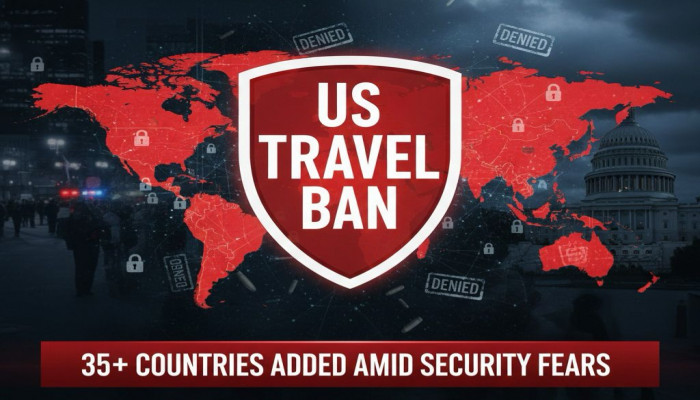
The United States will impose expanded travel restrictions on citizens from 20 additional countries starting January 1, significantly widening the scope of its immigration controls under President Donald Trump. With the latest expansion, the total number of countries facing full or partial U.S. travel restrictions has crossed 35, making it one of the most extensive travel bans implemented by the administration.
The decision follows the arrest of an Afghan national accused of shooting two National Guard troops near the White House last month, an incident that officials say raised serious national security concerns. One of the soldiers later died from injuries sustained in the attack. The administration said the incident accelerated the rollout of stricter immigration measures.
Under the updated executive order, full travel bans will apply to individuals from Syria, South Sudan, Niger, Mali and Burkina Faso, along with people holding documents issued by the Palestinian Authority. In addition to the full bans, partial travel restrictions will be imposed on citizens from 15 other countries, largely across Africa and the Pacific region. These include Angola, Benin, Nigeria, Senegal, Tanzania, Tonga, Zambia and Zimbabwe, among others. The partial restrictions limit certain categories of travel, including immigration visas, student visas, and family-based entry.
With these additions, the United States now restricts entry — either fully or partially — for nationals from more than 35 countries, marking a major escalation of Trump’s immigration agenda.
Officials said the expanded travel policy represents one of the broadest efforts by the Trump administration to limit legal entry into the United States. The new rules block or severely restrict nearly all forms of travel from the affected countries.
The restrictions also extend beyond first-time applicants. Relatives of U.S. citizens, international students, and holders of Afghan Special Immigrant Visas (SIVs) are now included under the tightened rules. This marks a significant shift, as SIV holders were previously granted exceptions due to their service alongside U.S. forces during the war in Afghanistan. Homeland Security Secretary Kristi Noem, who recommended stronger measures after last month’s shooting, defended the policy and confirmed that she personally urged the president to adopt a tougher stance.
She said she advised President Trump to impose “a full travel ban on every damn country that's been flooding our nation with killers, leeches, and entitlement junkies.” President Trump has long advocated for strict immigration limits and had earlier pledged to “permanently pause migration from all third world countries.” The latest order appears to reflect that position.
The new rules also introduce tighter restrictions on family-based immigration. Spouses, children, and parents of U.S. citizens now face additional barriers. Siblings and adult children of U.S. citizens are completely barred from applying under the updated policy.
Afghan nationals face particularly severe consequences. The order places an indefinite halt on Afghan immigration applications, even for individuals who arrived under U.S. government programs designed to protect Afghan allies who assisted American forces during the Afghanistan war.
Many of these applicants had already completed security checks and were in the final stages of processing before the freeze. Doug Rand, a former senior official at the Department of Homeland Security, told The New York Times that the policy leaves little room for entry. “This policy really slams the door on nearly all noncitizens from the listed countries,” Rand said.
Supporters of the travel restrictions argue the move is necessary to protect the country. Gene Hamilton of America First Legal defended the administration’s stance, saying, “This is common
sense: if you don't know who someone is, or if there are risks associated with their presence in the United States, you shouldn't let them in.”
Backers of the policy say stricter controls are essential to prevent potential security threats from entering the country.
Critics of the expanded travel ban argue that the measures reflect discriminatory intent and revive controversies from Trump’s first term. Civil rights advocates say the policy unfairly targets certain regions and communities while punishing people who pose no security threat. Opponents also note that many affected countries have no direct connection to recent attacks in the United States.
The effects of the new order go beyond those seeking to enter the country. The expanded ban also affects nationals already living in the United States. Earlier this month, the administration blocked applications from immigrants in the 12 original travel ban countries, along with seven additional countries under partial restrictions. As a result, citizenship ceremonies were postponed nationwide, leaving thousands of applicants in uncertainty.
Immigration advocates say the delays have caused anxiety and confusion among families who were expecting to complete their naturalisation process.
The travel ban expansion builds on a policy originally introduced during Trump’s first term in office. It was revived in June after an Egyptian man in Colorado was charged with attacking a group holding a vigil for hostages in Gaza. Last month’s shooting near the White House further intensified the administration’s response. The accused gunman, Rahmanullah Lakanwal, an Afghan national, had entered the United States in 2021 under a program established by the Biden administration for Afghan allies. Following the attack, the administration has taken several additional steps. These include pausing asylum decisions, reviewing green cards issued to people from 19 countries, and reassessing previous asylum approvals. The government has also moved to block Afghan nationals from entering the United States entirely, citing security concerns.
With the expanded travel ban set to take effect on January 1, the Trump administration has signalled a renewed push for stricter immigration enforcement. While supporters view the move as necessary for national security, critics argue it unfairly targets vulnerable populations and revives divisive immigration policies. As legal challenges and political debate continue, the new restrictions are expected to affect thousands of families, students, and immigrants around the world.



 Loading...please wait
Comments