




US deploys over 50 fighter jets, sends carrier strike group toward Middle East amid Iran nuclear talks
- In Reports
- 06:41 PM, Feb 18, 2026
- Myind Staff
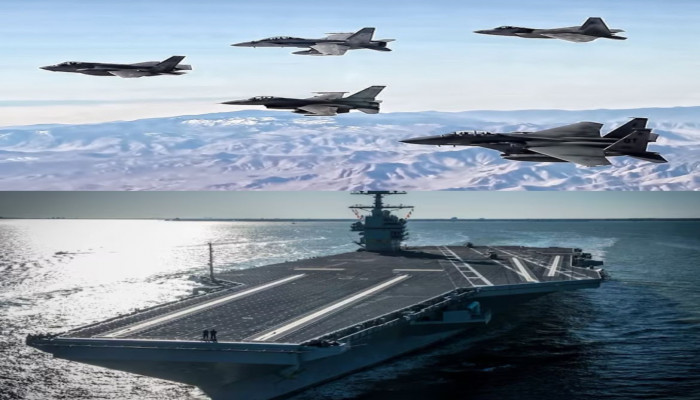
The United States has sharply increased its military presence in the Middle East by deploying more than 50 fighter jets in just 24 hours. This large movement of air power coincides with the resumption of indirect nuclear talks between the US and Iran, showing that Washington is adopting both diplomacy and military preparedness side by side.
According to US officials, this deployment includes advanced fighter aircraft such as the F-22 Raptor, F-35 Lightning II, and F-16 Fighting Falcon. Along with these jets, several aerial refuelling tankers were also seen moving toward the region. These tankers allow fighter jets to stay in the air longer and travel longer distances, indicating that the aircraft may be prepared for extended missions if needed.
The buildup was first reported by Axios, which quoted a US official confirming the large-scale movement of aircraft. Independent flight-tracking information and military aviation watchers also recorded multiple fighter jets flying toward the Middle East. The data matched the report, supporting claims that the deployment is real and significant.
A US official told Axios that “more than 50 fighter jets have been moved to the region in the past 24 hours.” This statement highlights both the speed and size of the deployment, suggesting that the US is acting quickly to strengthen its position in the region.
Along with the air deployment, the US Navy has also begun moving a major naval force toward the Middle East. A Navy official confirmed on Tuesday that the USS Gerald R. Ford aircraft carrier strike group has left the Caribbean Sea and is currently sailing in the mid-Atlantic Ocean. The group is now heading in the direction of the Middle East.
According to the Associated Press, the official shared details under the condition of anonymity because of the sensitivity of ship movement information. The carrier strike group is travelling with three guided-missile destroyers: the USS Mahan, the USS Bainbridge, and the USS Winston Churchill.
Based on the ship’s current location, it is expected that the USS Gerald R. Ford group may take more than a week to reach waters near Iran. Even though it is still far away, the movement of such a powerful carrier group sends a strong message.
Aircraft carriers are among the most important military assets for the United States because they can carry large numbers of fighter aircraft and support combat operations across wide areas. When combined with guided-missile destroyers, they provide a strong defensive and offensive capability.
This new deployment adds to the already large US military presence in the Middle East. Earlier this year, the USS Abraham Lincoln and other major US naval and air assets were already stationed in the region. With additional fighter jets now arriving and another carrier strike group heading toward the area, Washington’s military footprint is growing even more.
The move comes during a period of increased tension, as Iran’s nuclear programme continues to be a major concern for the US and its allies. By increasing its military strength while also engaging in talks, the US appears to be preparing for multiple outcomes.
While military forces are being reinforced, diplomatic talks are also moving forward. American and Iranian officials have started a second round of indirect nuclear negotiations in Geneva. These discussions are being held through intermediaries rather than direct face-to-face meetings.
Officials from both sides have shown cautious optimism about the progress made so far. US officials said the Geneva talks “made progress,” but they also said that “there are still a lot of details to discuss.” This indicates that while some agreement may be forming, many important issues remain unresolved.
After the meetings involving Trump’s envoys Jared Kushner and Steve Witkoff, Iranian representatives reportedly said they would return within two weeks with more detailed proposals. According to a US official, Iran plans to address remaining disagreements and fill in the gaps between the two sides’ positions.
Iran’s Foreign Minister Abbas Araghchi also spoke about the negotiations and described them as “serious, constructive and positive.” Speaking to Iranian state television, he said that the discussions showed improvement compared to the previous meeting.
He stated that “good progress was made compared to the previous meeting, and we now have a clearer path ahead.” He added that the talks helped both sides reach a general understanding on key guiding principles.
However, Araghchi also warned that progress does not mean an agreement will come quickly. He said this understanding does not guarantee a rapid deal, but at least the direction of the talks is now clearer.
“This does not mean that we can reach an agreement quickly, but at least the path has begun,” he said, signalling a mix of hope and realism.
Omani Foreign Minister Badr Albusaidi, who has been acting as a mediator in the negotiations, also commented on the outcome. He said the talks ended “with good progress towards identifying common goals and relevant technical issues.”
His statement suggests that both sides may be slowly moving toward discussing specific technical details, which are often the most difficult part of nuclear negotiations.
The US deployment of jets and the movement of a carrier strike group show a strong military signal at a time when diplomacy is also active. The situation reflects a dual approach: keeping pressure through military strength while keeping negotiations alive through diplomatic channels.
As talks continue, the growing military presence may be intended to discourage any aggressive actions and strengthen the US position. At the same time, both Washington and Tehran appear interested in keeping discussions going to explore a possible agreement.



 Loading...please wait
Comments