



US deploys Marines as Strait of Hormuz crisis deepens and oil prices surge
- In Reports
- 02:06 PM, Mar 21, 2026
- Myind Staff
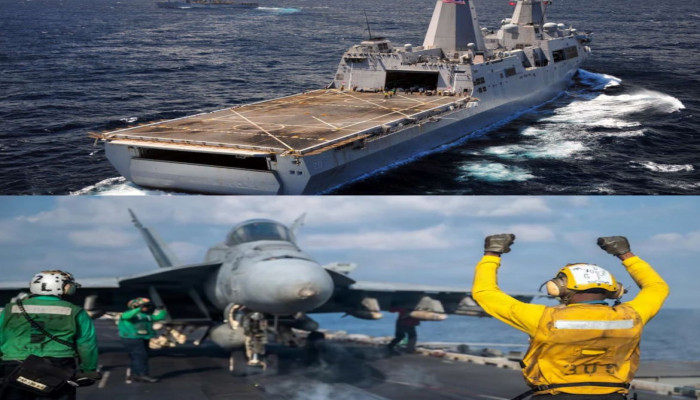
The United States is sending thousands of additional Marines to the Middle East as tensions in the region continue to rise. According to officials who spoke to Reuters, around 2,500 Marines will be deployed along with the amphibious assault ship USS Boxer and other warships. The move comes amid an ongoing conflict involving the U.S., Israel, and Iran, which has already disrupted global energy supplies and raised fears of a wider war.
The situation has escalated significantly over the past three weeks since the United States and Israel launched military action against Iran. One of the most critical consequences has been the near closure of the Strait of Hormuz, a narrow but vital route through which nearly one-fifth of the world’s oil and liquefied natural gas passes. With shipping severely affected, global energy markets have reacted sharply, and oil prices have surged by nearly 50% since the conflict began on February 28.
In response to the rising prices and supply concerns, the administration of Donald Trump announced it would temporarily waive sanctions on Iran. This step will allow the sale of about 140 million barrels of oil that have remained stuck on tankers since the war started. Earlier, the administration had also eased sanctions on a similar quantity of Russian oil to stabilize supply.
The human cost of the conflict continues to rise. More than 2,000 people have been killed so far, mostly in Iran and Lebanon. At the same time, concerns are growing within the United States. A Reuters/Ipsos poll shows that nearly two-thirds of Americans believe Trump may order a full-scale ground invasion, although only 7% support such a move.
On the battlefield, Israel has intensified its operations. The Israeli military reported carrying out two major waves of air strikes targeting weapons production facilities and missile storage sites in Tehran and central Iran. In response, Iran launched multiple missile attacks, setting off air raid sirens in cities such as Tel Aviv and Jerusalem. One missile fragment landed just outside Jerusalem’s Old City, an area sacred to multiple religions. No injuries were reported.
The conflict has also begun to directly hit energy infrastructure across the region. In Kuwait, the Mina Al-Ahmadi refinery was struck by drone attacks, causing fires in several units. Iran has carried out similar strikes in recent days, targeting key facilities in neighboring Gulf states. These attacks have further tightened global supply and added to market uncertainty.
Despite the growing military presence, U.S. officials have not clarified the exact role of the newly deployed Marines. Two officials said no decision has been made about sending troops into Iran itself, though earlier discussions included possible targets such as Iran’s coastline or the Kharg Island oil export hub. Meanwhile, Trump indicated that the U.S. may soon reduce its military operations, stating that the country is close to achieving its objectives of weakening Iran’s military and stopping its nuclear ambitions.
Trump also criticized NATO allies for their reluctance to join efforts to secure the Strait of Hormuz. He called them "cowards" for refusing to participate in a conflict they were not consulted on beforehand. While some allies have expressed willingness to support safe passage operations, countries like Germany and France have insisted that fighting must stop first. German Chancellor Friedrich Merz is expected to discuss the situation with Trump soon. The United Kingdom has allowed the U.S. to use its bases to target Iranian missile sites threatening ships in the strait.
Amid the conflict, regional and cultural events have been overshadowed. As Muslims marked Eid al-Fitr and Iranians celebrated Nowruz, Iran’s new Supreme Leader MojtabaKhamenei issued a strong message. He said Iranians had responded with unity and resistance and "dealt a disorienting blow to the enemy". His absence from public view since the death of his father, Ali Khamenei, has raised questions about his condition and leadership.
Even after weeks of intense bombing, U.S. and Israeli officials believe Iran still has the ability to retaliate. Iran’s Revolutionary Guards claimed they launched multi-warhead missile attacks on Israeli cities and used drones to target U.S. military bases, including one in Bahrain. There has been no immediate confirmation from U.S. forces.
The conflict has also seen targeted killings of key Iranian figures. The semi-official Tasnim news agency reported that intelligence minister Esmail Ahmadi was killed, adding to a growing list of senior officials eliminated during the war. Trump remarked on the lack of communication with Iran, saying, "We have nobody to talk to," and added, "And you know what? We like it that way."
Back home, rising fuel prices are becoming a political concern for Trump and his party as they prepare for upcoming congressional elections. Brent crude oil prices have climbed to around $110 per barrel, reflecting fears of a major global energy disruption. Current estimates suggest that around 12 million barrels per day, roughly 12% of global demand, have been cut off due to halted exports and reduced production in the Gulf.
The impact is expected to last for months, if not years. A major gas field in Qatar has already been disrupted by Iranian strikes, and Iraq has declared force majeure on oilfields operated by foreign companies. With limited alternatives available, the global economy now faces the risk of a prolonged energy crisis.



 Loading...please wait
Comments