




US deploys high-altitude Triton drone near Cuba targeting China’s oil routes
- In Reports
- 06:37 PM, Apr 17, 2026
- Myind Staff
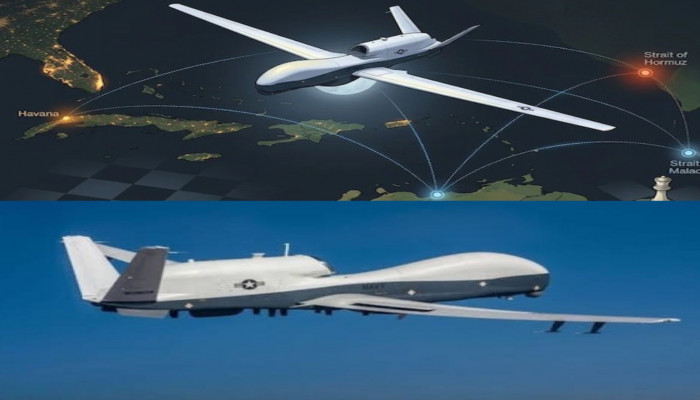
Far above the Caribbean Sea, at heights unreachable by commercial aircraft, a large unmanned aircraft traced slow, steady paths across the night sky. The aircraft, comparable in size to a Boeing 737, was not armed, yet its presence alone carried strategic weight. This was the US Navy’s MQ-4C Triton surveillance drone, a highly advanced system valued at $240 million, capable of staying airborne for more than 24 hours and operating at altitudes above 55,000 feet.
Earlier this week, the drone—identified by the callsign BLKCAT6—conducted surveillance missions near Cuba’s northwestern and southern coasts. Flight tracking data shared by an open-source intelligence group showed the drone lingering near Havana on Wednesday evening. Before that, it had monitored the Jamaica Channel, a roughly 200-kilometre-wide stretch of water between Cuba and Jamaica. This passage is a crucial shipping route that connects the Panama Canal to the Atlantic Ocean.
The visibility of the drone’s flight path on open-source tracking systems appears intentional. Analysts suggest it was meant to send a clear message: the United States is closely watching activity in the region. Given the Triton’s route, it likely also observed nearby strategic passages such as the Windward Passage and the Yucatán Channel. These waterways are key maritime corridors in the Caribbean, though their importance goes beyond just oil transport volume.
This deployment is seen as part of a broader geopolitical strategy involving multiple regions linked to global oil supply chains. Recent developments have significantly affected China’s access to crude oil. Oil shipments from Venezuela to China have sharply declined following a major shift in control over Venezuela’s oil reserves earlier this year. The United States has effectively taken control of the country’s vast reserves, estimated at over 303 billion barrels. In a dramatic turn, President Nicolas Maduro was removed in a special forces operation, and his deputy, Delcy Rodriguez, assumed leadership and opened the reserves to private US companies.
As a result, China has turned to Russia to meet its energy needs. Data from January and February 2026 shows that Chinese oil imports from Russia increased by 40.9 percent year-on-year. At the same time, tensions in the Middle East have further complicated supply routes. The US has increased its involvement in Iran, particularly around the Strait of Hormuz, where disruptions have affected between 40 and 45 per cent of China’s daily crude imports. While the flow has not completely stopped, it has become unstable.
In Southeast Asia, the US has also stepped up its presence near the Strait of Malacca, a critical route that carries about 80 per cent of China’s seaborne crude oil. This move highlights China’s long-standing concern known as the “Malacca dilemma,” which refers to its dependence on this narrow and vulnerable passage for energy imports.
Taken together, these developments suggest a coordinated effort by the United States to build pressure points around China’s oil supply network. Although China has large reserves and multiple suppliers, including pipeline connections through Russia, Central Asia, and Pakistan, these measures only provide temporary relief in a worst-case scenario involving major disruptions at key chokepoints.
China has responded by strengthening ties with countries affected by US actions. In Cuba, which has been struggling with an energy crisis after losing Venezuelan oil supplies, China has stepped in to provide fuel support. Beijing has also publicly criticised US actions in the region. “China expresses its deep concern and opposition to the US' actions on Cuba,” its foreign ministry said back in January.
The Caribbean now appears to be the latest focus in this strategic contest. By increasing surveillance in this region, the United States can monitor and potentially deter Chinese-linked shipping activity, including so-called “shadow tankers” that may be used to bypass restrictions. The presence of the Triton drone also allows the US to expand its surveillance coverage close to its own coastline, particularly near Florida.
Another point of interest is Bejucal, a town located about 30 kilometres from Havana. It is believed to host a Chinese electronic intelligence facility. The drone’s surveillance mission may have included monitoring this site as well. While drones offer strong observational capabilities, the establishment of a permanent US base in the region would represent a more direct military presence and a stronger deterrent.
Former US President Donald Trump had hinted at such ambitions earlier this year, stating, “I could do anything I want with it.” While that statement reflects confidence, the situation on the ground remains complex. Cuba is facing increasing pressure due to the US blockade, but continued Chinese support has prevented a complete collapse.
This suggests that the role of the MQ-4C Triton may evolve further. Beyond tracking general maritime activity, it could be tasked with closely monitoring vessels carrying fuel to Cuba. The unfolding situation indicates that the Caribbean is becoming a key front in a wider geopolitical struggle over energy routes and influence.



 Loading...please wait
Comments