




US Defence Secretary announces review of troop deployments across Europe
- In Reports
- 09:43 PM, Jun 18, 2026
- Myind Staff
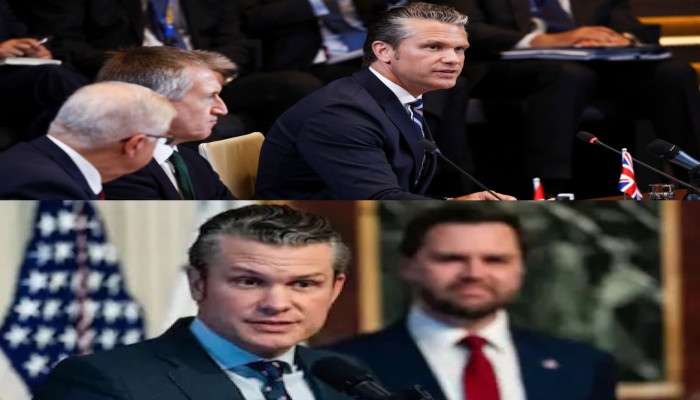
U.S. Defence Secretary Pete Hegseth has announced a new review of American troop deployments across Europe, signalling a possible shift in Washington’s military commitments on the continent. Speaking at NATO headquarters in Brussels on Thursday, Hegseth also warned that the United States could withhold some of its NATO dues if member nations fail to meet their defence spending commitments.
The review will take place over the next six months and will include consultations with the U.S. Congress, which has set a minimum requirement for the number of American troops stationed in Europe. Although Hegseth did not directly state that troop reductions would follow, he made it clear that the purpose of the review is to encourage European countries to take greater responsibility for their own defence while allowing the United States to maintain readiness for global security challenges.
Addressing defence ministers from NATO member states, Hegseth said, “Make no mistake about it, this will be a real review. It will be designed to ensure that NATO is moving fast and irreversibly toward Europe leading, stepping up to take primary responsibility for the defence of Europe.”
He stressed that Europe must take the lead in defending the continent and that NATO should become a stronger military alliance capable of responding independently to conventional threats. According to Hegseth, the alliance must move beyond its post-Cold War structure and become more capable of handling security challenges in Europe.
Hegseth also criticised some NATO allies for not supporting the United States during its recent conflict with Iran. He said several countries refused to provide basing and overflight rights for American military operations related to the war. He noted that the ongoing review would also examine how to ensure that such rights are available when required in the future.
The announcement comes at a time when NATO countries are trying to address capability gaps in the alliance’s crisis forces. These forces consist of military assets that member countries commit to NATO for use during emergencies. Last month, the United States informed allies that it would reduce the pool of American military capabilities available to NATO during a crisis. The decision has raised concerns among member states ahead of the NATO summit scheduled to take place in Ankara on July 7 and 8.
The move is part of a broader effort by Washington to reduce what military leaders describe as an excessive dependence on American forces. NATO’s top commander, U.S. Air Force General Alexus Grynkewich, said the aim is to gradually end an “unhealthy co-dependence” on U.S. military support. He explained that the United States must also prepare for the possibility of dealing with simultaneous conflicts in different parts of the world.
Before the meeting in Brussels, Hegseth reiterated that the United States would continue to openly discuss which allies are not doing enough to meet their defence obligations. He emphasised the importance of transparency among allies.
“(There are) some that still need to do more, and we will be candid about that, both in private and in public. I think that's important, friends being honest with friends,” Hegseth said.
He further added, “NATO 3.0 is post-Cold War recognition that it needs to go back to a real hardline military alliance that has real military capabilities capable of deterring right here on the continent and taking the lead for the conventional defence of Europe.”
NATO Secretary General Mark Rutte confirmed that the reduction in U.S. contributions to NATO’s crisis forces has already come into effect. Speaking to reporters, he acknowledged that the changes are no longer part of future planning but are being implemented now.
“The question yesterday came up: Is this immediate or not? It is immediate,” he said.
Rutte, however, sought to reassure allies by noting that NATO planning tools do not necessarily reflect what would happen during an actual conflict. He said, “However, why I'm a little bit reluctant to say this is because it is a planning tool. So, what would happen in reality? If war would break out ... all allies, including the U.S., will max out what they can do to make sure we can fight the war.”
As NATO members prepare to adjust to the reduced American role, several countries have already offered additional contributions. Belgian Defence Minister Theo Francken said Belgium would increase its support to NATO’s crisis forces. The country plans to contribute assets such as F-16 fighter jets and MQ-9B SkyGuardian drones to help fill some of the gaps left by the United States.
“There will be heavy discussions on who is doing what, but I can say that Belgium is contributing,” Francken said.
Despite these commitments, some European officials warned that replacing certain U.S. capabilities will not be easy. German Defence Minister Boris Pistorius said Europe still lacks important military systems, including deep-strike missile capabilities. He called for a coordinated transition process to prevent weaknesses in NATO’s defences.
“It is difficult and dangerous for the security of NATO's territory in Europe if capabilities are withdrawn very quickly without having clarity when they can be compensated for,” Pistorius said.
He identified deep-strike capabilities as one of the most difficult areas to replace and suggested that temporary solutions may be needed. “There, we will need either stop-gap solutions or time before their withdrawal. This will need to be negotiated with our American partners. Generally, we will be able to compensate much but we will need some more time,” Pistorius added.
The United States has not publicly released complete details of the planned reductions. However, figures provided to Reuters by a military source indicate that the cuts will affect a range of military assets. These include refuelling aircraft, fighter jets, drones and naval vessels assigned to NATO operations.
According to the source, the number of U.S. F-15 and F-15E fighter jets available to NATO will be reduced by one-third, bringing the total down to 99 aircraft. The number of MQ-4 and MQ-9 Reaper drones assigned to NATO missions will also be cut by half, leaving only 12 available to the alliance. The reductions have intensified discussions among NATO members as they work to strengthen European defence capabilities and prepare for a future with a smaller American military footprint.



 Loading...please wait
Comments