




US-China disagreement at G20 finance chiefs meeting largely came down to one phrase
- In Reports
- 07:17 PM, Sep 03, 2026
- Myind Staff
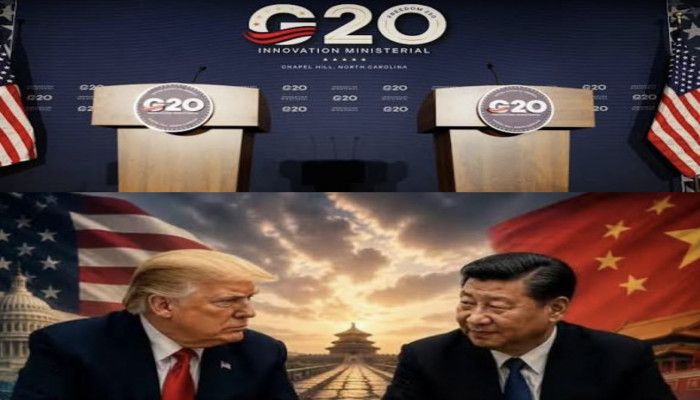
A disagreement between the United States and China at the G20 meeting of finance chiefs in Asheville, North Carolina, came down largely to one phrase: “non-market.” The dispute prevented the group from reaching a joint communique after two days of talks. US officials said disagreements covered issues including critical minerals, debt restructuring and global trade imbalances. However, people familiar with the discussions said the biggest obstacle was the use of the term “non-market” in a section on trade imbalances.
Chinese officials viewed the term as an indirect criticism of the country’s state-owned enterprises (SOEs), which play a major role in China’s economy. US negotiators wanted the phrase to remain in the document. Chinese negotiators proposed alternative wording that would address trade imbalances without directly pointing at the role of SOEs. Some countries privately backed China’s suggestion, but the two sides failed to reach an agreement.
The final statement issued by the US, which chaired the meeting, included a line calling on countries to “eliminate non-market policies and practices that exacerbate imbalances.” The wording reflected the position pushed by Washington during the talks. The dispute also showed how sensitive trade-related language remains between the two economic powers.
The disagreement comes just weeks before Chinese President Xi Jinping is expected to travel to Washington for a major meeting with US President Donald Trump. US Treasury Secretary Scott Bessent has become an important figure in managing Washington’s economic relationship with Beijing. He is leading trade discussions with China and is also expected to take part in bilateral talks on artificial intelligence in the coming weeks.
Bessent openly blamed China for the failure to reach a joint G20 communique. “It’s unfortunate the Chinese didn’t want to come along,” Bessent told Fox News in an interview on Wednesday. He was referring to Beijing’s objections to the proposed wording in the statement. The Chinese delegation at the Asheville meeting was led by People’s Bank of China Governor Pan Gongsheng and Vice Finance Minister Liao Min. Liao was also part of China’s negotiating team during Trump’s tariff conflict with Beijing last year.
The US government uses the term “non-market” to describe policies and practices involving government intervention that can distort global trade and support domestic industries. This includes actions by state-owned or state-controlled companies. Washington has used similar language in its criticism of China for years. The US Trade Representative described China’s economy as a “non-market economic system” during a 2017 investigation. The inclusion of the phrase in a G20 document could therefore have been interpreted as an indirect reference to China without naming it, according to people familiar with the discussions.
The US Treasury said references to “non-market” policies appeared in two of the four paragraphs that China objected to. The other disputed sections focused on critical minerals and the functioning of important global value chains. They also included provisions related to debt restructuring. These issues have become increasingly important as countries seek to secure supplies of key materials and address growing debt pressures in developing economies.
China’s Finance Ministry did not directly respond to Bessent’s remarks in a statement issued on Wednesday. It said, “All parties should take a comprehensive, objective, and balanced view of the issue of global imbalances, and should fundamentally resolve the debt problems of developing countries by promoting development.” Pan also blamed broader economic and policy trends for worsening global imbalances. In a statement on Wednesday, he said rising protectionism, an expanded focus on national security and unpredictable policies had contributed to the problem.
Pan called on countries with trade deficits to reduce fiscal shortfalls and increase savings. He also said countries with trade surpluses should increase consumption and investment. “All countries should formulate medium- and long-term policy plans, make clear commitments and implement them resolutely,” he said.
China’s large export sector remains one of the biggest sources of tension with Washington. China registered a record trade surplus of $1.2 trillion in 2025, marking a 20% increase from the previous year. Bessent made China’s export-driven growth a major issue during the G20 discussions. US Bureau of Economic Analysis data showed that the US recorded a trade deficit of about $200 billion with China last year.
Bessent renewed his criticism of China’s economic policies on Wednesday. He argued that Beijing’s policies weaken domestic demand and make exports a major source of growth. He estimated that industrial subsidies account for about 4% of China’s GDP. He also pointed to Chinese electric vehicle maker BYD Co. as an example of a company benefiting from state support.
“Anyone here ever seen a BYD car,” Bessent said at a Charlotte Economics Club event in North Carolina. “It is the best $70,000 car that $35,000 can buy — it is heavily subsidised.”
A Rhodium Group report released earlier this year found that direct government grants to BYD amounted to about $292 per vehicle. The grants accounted for around 5% of the $4,700 cost difference between BYD and Tesla vehicles in China. The report said most of BYD’s cost advantage came from its ability to produce many components itself and benefit from large-scale production.
China has rejected US and European accusations that state support helped create its record trade surplus. In July, China’s Commerce Ministry released a white paper titled “China’s Position on the So-called Excess Capacity Issue.” It argued that the US and European Union also provide subsidies to industries including electric vehicles and artificial intelligence.
The paper said, “Accusing China of ‘unfair competition’ and ‘non-market policies and practices’ is a typical case of ‘double standards’ and genuine unfairness.” The dispute over a single phrase at the G20 meeting has therefore exposed much wider differences between Washington and Beijing over subsidies, trade, industrial policy and the global economic balance.



 Loading...please wait
Comments