



US begins second phase of Gaza plan, sets up Palestinian Technocratic Committee
- In Reports
- 04:04 PM, Jan 15, 2026
- Myind Staff
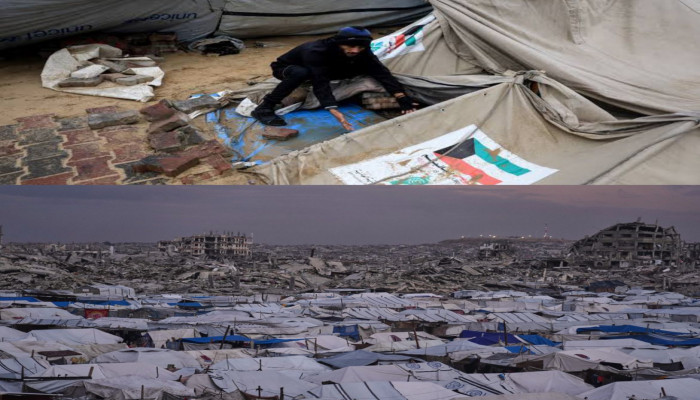
The United States has announced the launch of the second phase of its plan to end the Gaza war, even though several key parts of the first phase have not yet been fully implemented. The announcement was made on January 14, as fighting and political uncertainty continue to surround Gaza.
According to the United States, the first phase of the plan faced serious difficulties. These included ongoing Israeli airstrikes that killed hundreds of people in Gaza, delays by Israel in reopening Gaza’s border crossing with Egypt, and the failure to retrieve the remains of one last Israeli hostage. Despite these unresolved issues, Washington has decided to move forward with the next stage of the plan.
The second phase brings more complex challenges. These include the disarmament of the Palestinian militant group Hamas, which has clearly refused to give up its weapons, and the deployment of an international peacekeeping force in Gaza.
US President Donald Trump’s special envoy, Steve Witkoff, announced the start of phase two through a post on social media. He said the new phase “establishes a transitional technocratic Palestinian administration in Gaza” and would begin the process of disarmament and reconstruction.
As part of this phase, a new Palestinian technocratic committee has been formed. According to a joint statement by mediators Egypt, Qatar, and Turkey, the committee will have 15 members and will be led by Ali Shaath. Shaath is a former deputy minister in the Western-backed Palestinian Authority and had earlier worked on developing industrial zones.
Israel and Hamas had signed off on Trump’s Gaza plan in October. The plan states that the Palestinian technocratic body will operate under the supervision of an international group known as the “Board of Peace,” which is meant to govern Gaza during a transitional period.
Reuters reported that other members of the committee were chosen by Nickolay Mladenov, the former United Nations Middle East envoy. Mladenov is expected to represent the Board of Peace on the ground in Gaza. The list of names obtained by Reuters includes individuals from the private sector and non-governmental organisations. However, Witkoff did not name all the members or confirm the final number.
A European diplomat said that another announcement related to the Board of Peace was expected to be made at the Davos meeting next week. Meanwhile, a US official, who spoke to reporters on condition of anonymity, said that invitations were sent out on Wednesday to potential Board of Peace members who were “personally selected by Trump.”
Ali Shaath explained the immediate priorities of the committee in a radio interview. He said the focus would be on providing urgent relief to Gaza, especially housing for displaced Palestinians who are currently living in tents among the rubble. Shaath said, “If I bring bulldozers and push the rubble into the sea, and make new islands, new land, I can win new land for Gaza and at the same time clear the rubble. This won’t take more than three years.”
However, rebuilding Gaza is expected to take much longer. A 2024 United Nations report said that rebuilding destroyed homes in Gaza could take until at least 2040 and might extend for several decades.
Witkoff also said that the second phase would begin “the full demilitarisation and reconstruction of Gaza, primarily the disarmament of all unauthorised personnel.” Hamas, which still refuses to lay down its arms, had agreed in October to hand over governance to the technocratic committee. Even so, it remains unclear how Hamas will actually be disarmed.
A US official said Washington would try to bridge the gap between the two sides. The official added that the Israelis “remain sceptical that Hamas will disarm and that the Palestinian people want peace.” The official further said, “The goal here is to create an alternative to Hamas that wants that peace, figure out how to empower them.” Referring to the technocratic committee as a new “government” for Gaza, the official said, “And obviously, now that we have this government, we will be engaging in conversations: with Hamas on the next phase, which is demilitarisation; with Israel, on what amnesty program can be given to Hamas if they do this.”
In the West Bank, the Palestinian Authority welcomed Trump’s move to advance the Gaza plan. Palestinian Vice President Hussein Al-Sheikh posted a statement on X supporting the committee. He said Gaza’s institutions should be linked with those of the Palestinian Authority in the West Bank, “upholding the principle of one system, one law and one legitimate weapon.”
Hamas leaders and other Palestinian factions are currently in Cairo for talks on the second phase, according to the group. Members of the technocratic committee are also expected to meet Mladenov there. Egyptian sources said the discussions with Hamas would now focus on disarmament.
Further Israeli withdrawals from Gaza are linked to disarming Hamas, though Hamas has said it will only give up its weapons once a Palestinian state is established. Egyptian and Palestinian sources said both Hamas and its rival Fatah group, have approved the list of committee members.
The committee will reportedly include Ayed Abu Ramadan, head of the Gaza Chamber of Commerce, and Omar Shamali, who has worked with the Palestine Telecommunications Company, Paltel. It will also include Sami Nasman, a retired senior Palestinian Authority security officer and a long-time critic of Hamas. Nasman, a member of President Mahmoud Abbas’s Fatah movement, is originally from Gaza but has lived in the West Bank since 2007.
Israeli officials did not immediately respond to requests for comment.



 Loading...please wait
Comments