




US approves sale of Nvidia’s H200 AI to 10 Chinese firms: Report
- In Reports
- 01:07 PM, May 15, 2026
- Myind Staff
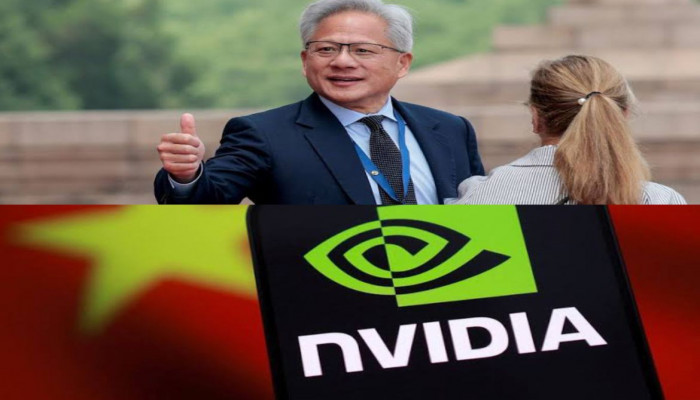
The United States has approved the sale of Nvidia’s H200 AI chips to nearly 10 Chinese companies, but no deliveries have taken place yet, according to sources familiar with the matter. The delay has left a major technology deal hanging even as Nvidia CEO Jensen Huang travels to China this week, hoping to push discussions forward.
Huang joined US President Donald Trump on a trip to Beijing after reportedly receiving an invitation from Trump. A source said Trump picked him up in Alaska while travelling for a summit with Chinese President Xi Jinping. The visit has raised expectations that stalled chip negotiations could finally move ahead.
The issue highlights the growing tension in the US-China technology rivalry. Even approved business deals are facing roadblocks because of political and strategic concerns from both countries. Nvidia, currently the world’s most valuable chipmaker, is caught between Washington’s export restrictions and Beijing’s push to build its own semiconductor industry.
Before the tightening of US export controls, Nvidia held nearly 95% of China’s advanced AI chip market. China once contributed around 13% of the company’s total revenue. Huang had earlier estimated that China’s AI market alone could reach $50 billion this year.
Sources said the US Commerce Department approved purchases of Nvidia’s H200 chips for several Chinese companies, including Alibaba, Tencent, ByteDance and JD.com. A few distributors, such as Lenovo and Foxconn, were also cleared to sell the chips in China.
The approved customers can reportedly buy the chips directly from Nvidia or through the authorised distributors. Under the licence terms, each approved buyer is allowed to purchase up to 75,000 H200 chips.
The identities of the approved buyers and the details of their agreements with Nvidia had not been reported earlier. The US Commerce Department, which oversees export controls, declined to comment on the matter. China’s Ministry of Industry and Information Technology and the National Development and Reform Commission also did not respond to requests for comment.
Lenovo confirmed the development in a statement to Reuters. The company said it “is one of several companies approved to sell H200 in China as part of Nvidia's export license.”
Nvidia, Alibaba, Tencent, ByteDance, JD.com and Foxconn did not respond to requests for comment.
During an interview with Chinese state broadcaster CCTV, Huang said he hoped Trump and Xi would continue building on their relationship during talks in Beijing to improve ties between the two countries.
Despite receiving US approval, the chip deals have not moved forward because several Chinese companies have become cautious after instructions from Beijing, according to one source. The person added that the shift partly happened because of changes from the US side, although it remains unclear what exactly changed.
Another source said pressure is increasing in Beijing to either block the purchases completely or place them under strict review.
US Commerce Secretary Howard Lutnick reflected a similar concern during a Senate hearing last month. He said, “the Chinese central government has not let them, as of yet, buy the chips, because they're trying to keep their investment focused on their own domestic industry.”
China’s hesitation is linked to its long-term strategy of reducing dependence on foreign technology. Chinese companies are increasingly promoting locally made AI chips, especially products developed by Huawei. Firms such as DeepSeek have publicly highlighted their use of domestic chips instead of relying on Nvidia products.
The shift towards Huawei-backed technology shows how difficult the Chinese market has become for Nvidia. Huang has repeatedly warned that US export restrictions are weakening Nvidia’s position in China. He recently said the company’s share in China’s AI accelerator market had effectively dropped to zero.
The sales process has also become complicated because of multiple conditions imposed by both governments. US rules introduced in January require Chinese buyers to prove that they have installed “sufficient security procedures” and that the chips will not be used for military purposes.
Nvidia is also required to confirm that enough inventory exists inside the United States before the products can be exported.
Another major issue is a special arrangement negotiated by Trump. Under the deal, the US government would receive 25% of the revenue from the chip sales. To make this legally possible, the chips would first have to pass through US territory before being shipped to China because US law does not allow direct export fees.
This arrangement has reportedly created concern in Beijing. Chinese officials worry that the chips could be tampered with or contain hidden vulnerabilities. However, sources familiar with the discussions described the arrangement mainly as a legal workaround.
China has also increased scrutiny after the State Council introduced two new supply chain security regulations. According to a source, the new rules have started a wider government effort to identify and reduce dependence on foreign technology in critical infrastructure.
The continuing delay has pleased China hardliners in Washington who oppose any expansion of Nvidia’s business in China. Critics argue that allowing more chip sales could reduce America’s technological advantage in artificial intelligence.
Chris McGuire, senior fellow for China and emerging technologies at the Council on Foreign Relations, criticised the possible sales. He said, “Any deal that allows Nvidia to sell more chips to China means fewer Nvidia chips for U.S. firms, and a smaller U.S. lead in AI over China.”
“It is remarkable that President Trump keeps getting convinced to put Nvidia’s interest ahead of America’s.”



 Loading...please wait
Comments