



US accuses China of conducting secret nuclear tests after Galwan clash, raises fresh concerns for India
- In Reports
- 07:23 PM, Feb 09, 2026
- Myind Staff
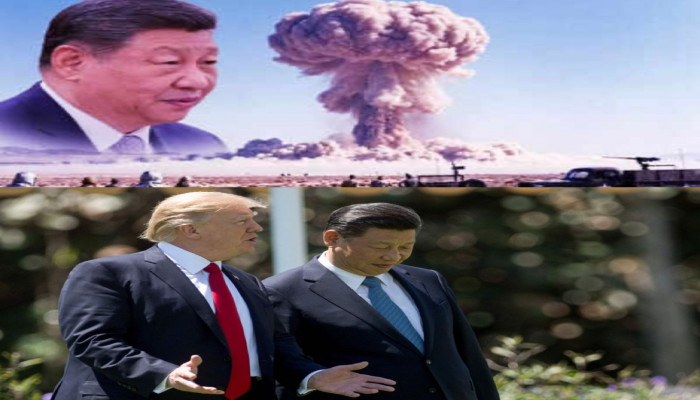
The United States has accused China of carrying out a covert nuclear explosive test in June 2020, just days after the deadly Galwan Valley clash in eastern Ladakh. The Galwan confrontation led to the deaths of 20 Indian soldiers, while intelligence assessments suggested that more than 30 Chinese troops were also killed, according to an NBC News report.
The allegation has added to India’s concerns about China’s military approach, especially since the claimed nuclear test took place during one of the most tense periods in the India-China border crisis in decades.
The claim was revealed by the U.S. at a global disarmament forum, where U.S. Under Secretary of State for Arms Control and International Security Thomas DiNanno stated that Washington has evidence of Chinese nuclear explosive testing. DiNanno said the U.S. government had information that China had been preparing nuclear explosive yields in the “hundreds of tons.” He further claimed that China carried out a “yield-producing test” on 22 June 2020.
DiNanno also accused the Chinese military of hiding these explosions by using “decoupling” techniques. He said such techniques reduce the ability of seismic monitoring systems to detect nuclear blasts properly, making it harder to verify whether such tests have taken place. According to him, these actions violate international commitments related to the test ban agreements.
China rejected the allegations. China’s ambassador on disarmament, Shen Jian, dismissed the U.S. claims but did not directly respond to the specific charge about the alleged June 2020 test. Shen said Beijing has always acted “prudently and responsibly” in nuclear matters. He also accused the U.S. of exaggerating what he called the “China nuclear threat” in order to justify its own actions. Shen argued that Washington is using such claims to support its own arms race, and he described the United States as the main driver of rising global nuclear tensions.
The issue comes at a major turning point in global arms control discussions. It also coincides with the expiry of the 2010 New START treaty between the United States and Russia. With this treaty ending, the two biggest nuclear powers will, for the first time in more than 50 years, operate without binding restrictions on strategic missile and warhead deployments. This has raised global fears of a fresh nuclear arms race.
DiNanno said that agreements like New START will become outdated in 2026 because the global nuclear threat now comes from multiple nuclear-armed nations rather than only two. He argued that the current security environment requires a different approach as more countries modernise their arsenals.
The U.S. has predicted that China’s nuclear arsenal may expand beyond 1,000 warheads by 2030. This estimate differs sharply from China’s own claim that it has around 600 warheads. Beijing has also insisted that its stockpile is still far below the approximately 4,000 nuclear warheads held by both the United States and Russia. China has so far refused to join trilateral nuclear arms control talks.
Security analysts have warned that the absence of a new arms control treaty could create a dangerous strategic gap similar to the early Cold War era. They believe that without limits or agreements, nuclear powers could begin increasing their stockpiles based on worst-case assumptions, raising the chances of miscalculations. These concerns are also linked to what analysts describe as China’s rapid nuclear modernisation.
Russia has reportedly shown a willingness to hold talks with Washington on future arms control. Meanwhile, Britain and France have supported the idea of a wider multilateral framework that would include China, especially as global nuclear norms continue to weaken.
For India, the timing of the alleged test is significant because it is linked to the Galwan Valley clash. The Galwan incident was the first time in 45 years that combat deaths occurred on the India-China border. It led to prolonged standoffs, rapid troop build-ups, and long-term damage to bilateral relations between New Delhi and Beijing.
The U.S. allegation, if true, could further underline India’s need to closely monitor China’s military and strategic developments, especially given Beijing’s secrecy in defence-related matters.



 Loading...please wait
Comments