




Urea imports may get 50% cheaper before Kharif season as China eases supplies
- In Reports
- 07:09 PM, Jun 11, 2026
- Myind Staff
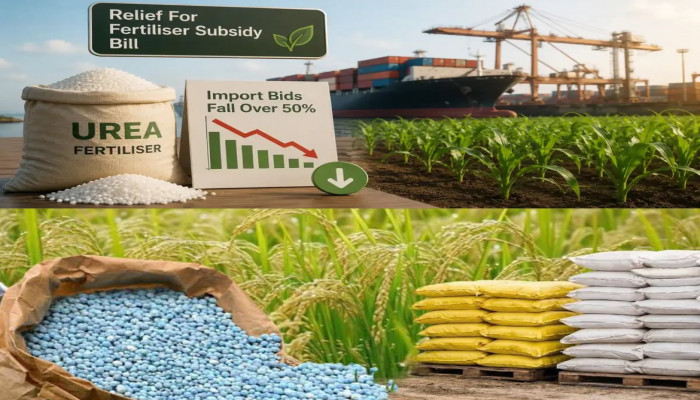
Amid growing concerns over India’s fertiliser subsidy burden for 2026-27 (FY27), there is some positive news for policymakers. India’s latest urea import tender has received bids at significantly lower prices, offering relief at a time when rising global energy costs and geopolitical tensions have put pressure on government finances.
State-run National Fertilisers Limited (NFL) recently floated a tender to import 1.7 million tonnes of urea. The bids received were quoted at around $445-449 per tonne (CFR) for deliveries on both the East and West Coasts of India. These rates are more than 50 per cent lower than the prices finalised in the previous international tender held in April.
In the April tender floated by Indian Potash Limited (IPL), urea prices were settled at $935 per tonne for supplies on the West Coast and $959 per tonne for supplies on the East Coast. The tender was meant for the import of 2.5 million tonnes of urea.
Industry sources attributed the sharp decline in prices to China’s decision to ease restrictions on urea exports. China had maintained tight controls on exports since March, limiting global supplies and elevating prices.
“At least on the East Coast of India, a large chunk of the supplies will be coming from China due to geographical proximity,” a senior industry official said.
The response to the latest tender was strong. Against the requirement of 1.7 million tonnes, bids for approximately 3.17 million tonnes were received for supplies to the East Coast. For the West Coast, bids covering another 3.07 million tonnes were submitted.
Overall, bids amounting to nearly 6.24 million tonnes were received from around 34 firms, far exceeding the quantity sought by NFL. The high level of participation reflects improved availability in the global market and increased competition among suppliers.
Industry experts pointed out that a similar trend was witnessed in 2022. During that period, the Russia-Ukraine war had disrupted global fertiliser markets and pushed urea prices close to $1,000 per tonne. Prices later declined as supplies improved.
“A similar thing also happened in 2022 when the landed price of urea touched almost $1000 per tonne due to the Russia-Ukraine war. Then, there was a sudden fall in rates due to enhanced supplies,” the official added.
The same official believes that market conditions could remain favourable for the next few months. However, the situation may change later in the year if China decides to tighten export controls again.
He said the situation may remain comfortable until August 2026 after which China could again start imposing stringent curbs on imports.
The sharp decline in urea prices is expected to provide major relief to the central government. India’s fertiliser subsidy bill has been under pressure due to rising urea import costs and a sharp increase in liquefied natural gas (LNG) prices. The rise in LNG costs has largely been linked to the ongoing conflict in West Asia.
India depends heavily on West Asia for both urea and LNG imports. According to industry estimates, around 30 per cent of India’s annual urea imports come from countries in the region. Additionally, nearly 50-60 per cent of the country’s LNG imports are sourced from West Asia.
An Indian Council for Research on International Economic Relations (ICRIER) report stated that India imported around 5.6 million tonnes of urea in 2024-25. This accounted for nearly 15 per cent of domestic consumption. Major suppliers included Oman, Russia, Saudi Arabia, Qatar and the United Arab Emirates (UAE).
The report also highlighted the fertiliser sector’s dependence on natural gas. Domestic production of nitrogen-based fertilisers relies heavily on gas as the primary feedstock. The fertiliser industry accounts for nearly 29 per cent of India’s total natural gas consumption. More than half of the country’s gas requirement is met through imports.
In 2024-25, India imported about 27 million tonnes of LNG. Around 61 per cent of these imports came from West Asia, mainly from Qatar, the UAE and Oman. The report further noted that nearly 85 per cent of the gas used in India’s urea production is imported and largely sourced from this region.
The importance of these imports has increased because of the recent rise in energy prices linked to tensions in West Asia. On Tuesday, a senior official from the Ministry of Finance warned that the government’s fertiliser subsidy bill could rise sharply if current conditions continue.
The official said that the fertiliser subsidy allocation of ₹1.7 trillion provided in the Union Budget for FY27 is likely to double and exceed ₹3.4 trillion due to the impact of the West Asia conflict.
If that happens, it would surpass previous subsidy records. The highest fertiliser subsidy expenditure so far was ₹2.5 trillion in FY23, when global commodity and fertiliser prices surged following the outbreak of the Russia-Ukraine war.
For now, the sharp correction in international urea prices offers some relief to India. Lower import costs could help reduce subsidy pressure in the short term. However, uncertainty over China’s export policy and continuing geopolitical tensions mean the situation will require close monitoring in the months ahead.



 Loading...please wait
Comments