




UP government removes Lakshagraha from Waqf list after Bhagpat court verdict
- In Reports
- 06:57 PM, May 13, 2026
- Myind Staff
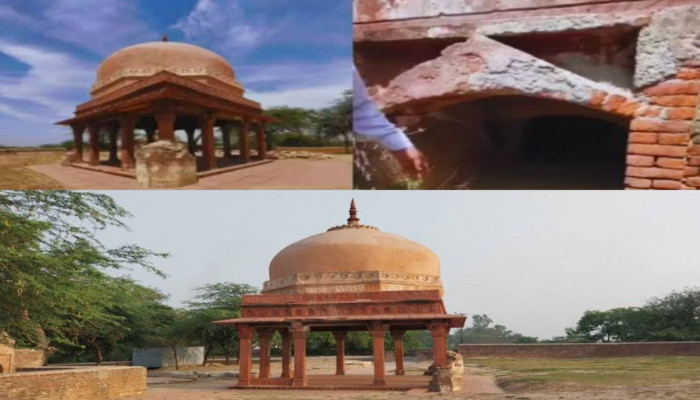
The Uttar Pradesh government has removed the ancient Lakshagraha site in Baghpat from the list of Waqf properties following a court ruling that identified the site as the historic Lakshagraha linked to the Mahabharata era. The decision came after a February 5, 2024 judgment by a Baghpat civil court, which rejected claims that the land functioned as a dargah, mazar, or Muslim graveyard.
The issue gained attention after the Lakshagraha site was listed as a dargah on the UMEED portal in late 2025. The portal, launched by the Ministry of Minority Affairs, was created to digitise and geo-tag Waqf properties across India. UMEED stands for Unified Waqf Management, Empowerment, Efficiency, and Development. The platform aims to improve transparency and management of Waqf properties. However, the Lakshagraha case raised concerns over how disputed or historically sensitive sites are entered into official records without proper scrutiny.
The controversy led to protests from local groups and people associated with the Lakshagraha Gurukul. They argued that the site has long been recognised as an ancient historical structure connected to early Indian civilisation and should not have been categorised as a religious property under Waqf records.
The matter had already been decided by the court months before the portal listing. In its February 2024 verdict, the Baghpat civil court ruled that the site is Lakshagraha and not a dargah or graveyard. The court rejected the claims made by the Muslim side regarding the existence of a religious structure on the land.
Following the judgment, district authorities submitted a report to the Uttar Pradesh government. Baghpat District Minority Welfare Officer Kailashchand Tiwari clarified that the administration’s role was limited to implementing the court’s order. Acting on the report and legal findings, the state government removed the site from the Waqf property list on the UMEED portal.
The legal dispute surrounding the site is decades old. The case began in 1970 when a resident of Barnawa, Mukim Khan, filed a petition in a Meerut court. The petition claimed that around 36 bighas of land under Khasra number 3377 contained a dargah, the tomb of Badruddin, and a graveyard.
These claims were challenged by the Lakshagraha Gurukul through its founder, Brahmachari Krishnadutt Maharaj. After Baghpat became a separate district in 1977, the case was transferred there. Over the years, both sides presented documentary and oral evidence to support their claims.
Both Hindu and Muslim parties presented evidence in support of their claims. In this case, the Civil Judge (Junior Division), First, delivered a verdict on February 5, 2024, recognising the ancient mound as Lakshagraha. The court rejected the claims of the Muslim side.
The Muslim side later challenged the ruling. The appeal is currently being heard in the Court of the Additional District and Sessions Judge. Even while the appeal was pending, the site was listed as a dargah on the UMEED portal in December 2025 during the nationwide registration process of Waqf properties.
After the listing became public, objections were raised immediately. Rajpal Tyagi, minister of Shri Gandhi Dham Samiti Gurukul Lakshagraha, filed an official objection against the classification. This triggered the administrative process that eventually led to the removal of Lakshagraha from the Waqf list.
The case has also renewed discussions around the importance of accurate identification of Waqf properties. Under Islamic law, a Waqf property is permanently dedicated for religious or charitable purposes. Once designated as Waqf, the property cannot be sold, transferred, or inherited. Because of this, proper verification and documentation become extremely important, especially in cases involving heritage or archaeological sites.
The Lakshagraha site in Barnawa is currently recognised as a protected mound by the Archaeological Survey of India. Its importance comes not only from references in the Mahabharata but also from archaeological findings and local historical recognition. The structure is traditionally believed to have been built using highly flammable materials such as lac, resin, and bamboo. Historians and archaeologists consider this an example of advanced planning and construction methods in ancient India.
Excavations and surveys conducted in the region have pointed towards the existence of an early settlement. Experts believe the site’s significance is supported by geography, archaeological remains, and long-standing historical associations rather than only literary references.
Baghpat itself holds historical importance. In ancient times, the region was known as Vyaghraprastha, which translates to the “land of tigers.” Another interpretation of the name, Vakyaprastha, suggests it was a centre for discussions and assemblies. During the Mughal era, the area came to be known as Baghpat, likely because of its gardens and agricultural landscape.
The region also finds mention in the Mahabharata. According to popular belief, the Pandavas had asked Duryodhana for five villages to avoid the Kurukshetra war. These places included Indraprastha, Swarnaprastha, Panaprastha, Vyaghraprastha, and Tilaprastha. Present-day Baghpat is widely identified with Vyaghraprastha.
The Lakshagraha case highlights the complicated intersection of law, history, religion, and governance in India. It also raises questions about the verification process used during large-scale digitisation drives such as the UMEED portal project.
For now, the Uttar Pradesh government’s stand is based on the 2024 court ruling, which identifies Lakshagraha as a historical and archaeological site rather than a Waqf property. However, since the appeal is still pending before a higher court, the final legal outcome of the dispute is yet to be decided.



 Loading...please wait
Comments