



UNSC holds emergency meeting on deadly protests in Iran amid US–Iran tensions
- In Reports
- 02:39 PM, Jan 16, 2026
- Myind Staff
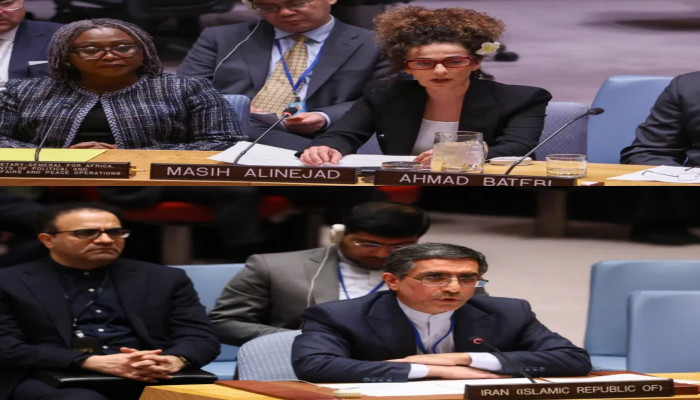
The United Nations Security Council (UNSC) held an emergency meeting to discuss the deadly protests unfolding across Iran, amid rising tensions between Tehran and Washington and repeated threats of military intervention by United States President Donald Trump.
The closed-door meeting, held on Thursday, brought together representatives of the 15-member council, senior UN officials, Iranian authorities, US officials, and members of Iranian civil society. The discussions focused on the growing unrest in Iran, the government’s response to the protests, and concerns over human rights violations.
Iran’s Deputy Permanent Representative to the United Nations, Gholamhossein Darzi, addressed the council and warned against any form of external aggression. He said that Iran had no intention of escalating the situation but would defend itself if provoked.
“Iran seeks neither escalation nor confrontation,” Darzi said. “However, any act of aggression, direct or indirect, will be met with a decisive, proportionate, and lawful response under Article 51 of the UN Charter.”
He added, “This is not a threat; it is a statement of legal reality. Responsibility for all consequences will rest solely with those who initiate such unlawful acts.”
Darzi also accused the United States of playing a role in the unrest inside Iran, claiming that Washington was directly involved in influencing the protests. He stated that Iranians did not want a confrontation but would respond firmly to any aggression.
On the other side, US representative Mike Waltz strongly criticised the Iranian government’s handling of the protests. In his prepared remarks, Waltz highlighted the ongoing internet shutdown in Iran, saying it made it difficult to confirm the true scale of the government’s crackdown on demonstrators.
“The people of Iran are demanding their freedom like never before in the Islamic Republic’s brutal history,” Waltz told the council.
He also dismissed Tehran’s claims that the protests were the result of foreign interference. According to Waltz, Iran’s argument that the unrest was “a foreign plot to give a precursor to military action” showed that the leadership was “afraid of their own people.”
Waltz did not directly mention President Trump’s recent threats of military intervention, although Trump had repeatedly warned of possible action over the past week before softening his language in the last day.
The UNSC was also briefed by UN Assistant Secretary-General Martha Pobee, who described the scale and seriousness of the protests. She said the demonstrations had spread rapidly across the country and resulted in significant loss of life.
“The popular protests in Iran have rapidly evolved into nationwide upheaval, resulting in significant loss of life,” Pobee said.
She explained that the protests began nearly three weeks ago, on 28 December 2025. “Demonstrations started on 28 December 2025, as a group of shopkeepers in Tehran’s Grand Bazaar gathered to protest the sharp collapse of the currency and soaring inflation, amid a wider economic downturn and worsening living conditions,” she told the council.
Pobee also raised serious concerns about mass arrests linked to the protests. She said human rights groups had reported widespread detentions across Iran.
“Human rights monitors have reported mass arrests, with estimates exceeding 18,000 detainees as of mid-January 2026,” Pobee said, while adding that “the UN cannot verify these figures.”
She urged Iranian authorities to respect international law and human rights standards. “All deaths should be promptly, independently, and transparently investigated,” Pobee said. “Those responsible for any violations must be held to account in line with international norms and standards.”
She also called on Iran “to halt any executions linked to protest-related cases” and to ensure detainees are treated humanely.
Earlier this week, Iranian Foreign Minister Abbas Araghchi denied allegations that the government planned to execute protesters. Speaking in an interview with Fox News, Araghchi rejected the claims.
“There is no plan for hanging at all,” he said when asked about possible executions. “Hanging is out of the question,” he added.
The council also heard emotional testimony from representatives of Iranian civil society. Among them was Iranian-American journalist and outspoken government critic Masih Alinejad. She called for immediate international action to hold Iranian officials accountable.
“Real and concrete action is needed now to bring justice to those who order massacres in Iran,” Alinejad told the council.
Directly addressing Darzi and the Iranian government, she said, “You have tried to kill me three times … My crime? Simply echoing the voice of innocent people that you kill.”
The emergency meeting came as the United States announced additional sanctions on Iran’s leadership. The new measures target several senior officials, including Ali Larijani, the secretary of Iran’s Supreme National Security Council (SNSC). US authorities described those sanctioned as the “architects” of what they called Tehran’s “brutal” response to the demonstrations.
Iran has already faced years of heavy international sanctions, which have deepened the country’s economic crisis. The worsening economy, high inflation, and declining living conditions are widely seen as key factors behind the latest wave of protests.



 Loading...please wait
Comments