



UN chief raises alarm over possible instability in Venezuela after US military action
- In Reports
- 01:21 PM, Jan 06, 2026
- Myind Staff
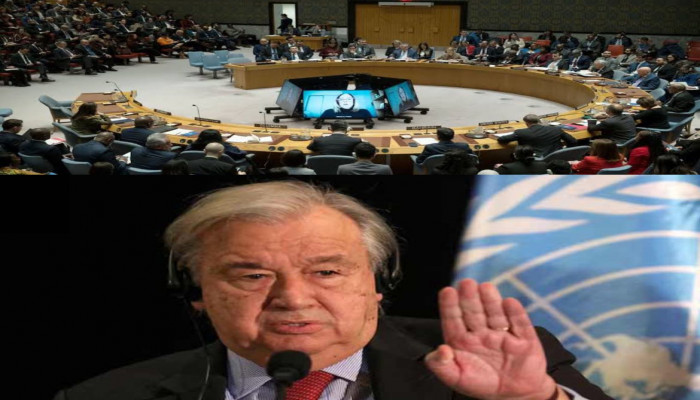
United Nations Secretary-General António Guterres has expressed deep concern over what he described as a possible worsening of instability in Venezuela following recent military action by the United States and the seizure of Venezuelan President Nicolás Maduro.
Speaking to the UN Security Council on Monday, the Secretary-General stressed the importance of respecting the United Nations Charter, particularly the principle that prohibits the use of force against the territorial integrity and political independence of any country. His remarks were delivered in a statement by Under-Secretary-General for Political Affairs Rosemary DiCarlo.
The UN chief said the Security Council was meeting “at a grave time” after the US military operation carried out in Venezuela on 3 January. The action, which involved US forces operating in several parts of the country, has raised serious concerns at the international level.
According to reports, the military operation took place across Caracas and the northern states of Miranda, Aragua and La Guaira. While the overall outline of the operation has been widely reported, the number of casualties remains unclear.
US President Donald Trump announced on Saturday that the United States had carried out a “large-scale strike” and had taken President Nicolás Maduro into custody. He later said that the US would now “run the country” until a political transition could be achieved.
Venezuela has strongly condemned the operation, calling it an act of open military aggression. The Venezuelan government has described the action as a clear violation of the UN Charter and warned that it poses a serious threat to both regional and international peace and security.
President Maduro is currently being held in New York and is expected to appear in court on Monday. The court is located just a few miles south of the UN Headquarters in Manhattan. US authorities have accused him, along with his wife Cilia Flores, of serious drug-related and weapons offences.
Addressing the Security Council, the Secretary-General said, “What is less certain is the immediate future of Venezuela.” He warned that the current situation carries the risk of increasing instability within the country, creating regional consequences, and setting a dangerous precedent in relations between States.
He stressed that international law must remain the guiding principle in such situations. The Secretary-General said he was concerned that the rules governing the use of force “have not been respected” during the military action carried out on 3 January.
Recalling the UN Charter, he emphasised that it clearly prohibits both the threat and the use of force against the territorial integrity or political independence of any State.
“The maintenance of international peace and security depends on the continued commitment of all Member States to adhere to all the provisions of the Charter,” he said.
The UN chief noted that Venezuela has already faced many years of internal instability, along with serious social and economic challenges. He said that democratic institutions have been weakened and that millions of people have been forced to flee the country as a result of the ongoing crisis.
While describing the current situation as critical, he said there was still a chance to prevent the crisis from turning into a much larger conflict. He warned against the risk of a “wider and more destructive conflagration.”
The Secretary-General urged all political and social actors in Venezuela to take part in an inclusive dialogue. He said such dialogue must allow all sectors of Venezuelan society to decide their future freely and peacefully. This process, he added, must be based on respect for human rights, the rule of law and the sovereign will of the people.
“In situations as confused and complex as the one we now face, it is important to stick to principles,” the Secretary-General said. He underlined the need to respect the UN Charter, sovereignty, political independence and territorial integrity, as well as the prohibition on the use of force.
“The power of the law must prevail,” he said.
He further noted that international law offers proper mechanisms to deal with a wide range of issues, including human rights violations, illegal trafficking and disputes over natural resources. He emphasised that these legal tools, rather than military action, are “the route we need to take.”
The Secretary-General concluded by reiterating that respect for international law and the UN Charter remains essential to maintaining global peace and security, especially at a time when tensions are rising, and the future of Venezuela remains uncertain.



 Loading...please wait
Comments