




UK to deploy HMS Prince of Wales carrier group in Arctic to deter Russia, says Starmer
- In Reports
- 07:11 PM, Feb 14, 2026
- Myind Staff
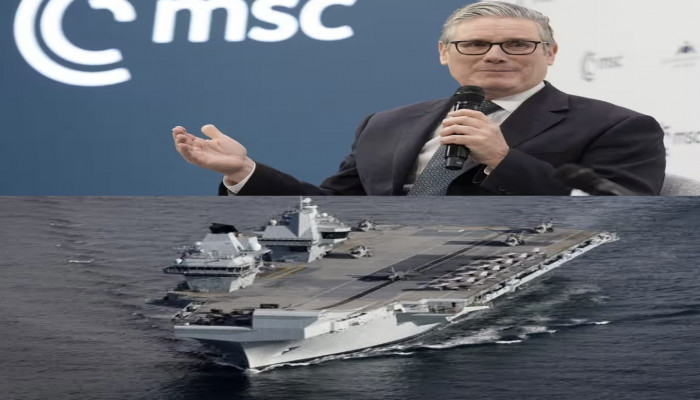
British Prime Minister Sir Keir Starmer has announced that the United Kingdom will deploy its aircraft carrier strike group to the North Atlantic and Arctic region later this year. The move comes as concerns grow over increased Russian naval activity and rising security risks in northern Europe.
Speaking at the Munich Security Conference on Saturday, Starmer said the UK will send its carrier strike group, led by HMS Prince of Wales, to operate alongside the United States, Canada, and other NATO allies. He described the deployment as a strong message of the UK’s commitment to protecting Euro-Atlantic security.
“I can announce today that the UK will deploy our carrier strike group to the North Atlantic and the High North this year,” Starmer said. He added that the mission will act as a “powerful show” of unity and strength among NATO partners.
According to the UK Ministry of Defence, the deployment is being called Operation Firecrest. It will include several Royal Navy warships, F-35 fighter jets, and helicopters. The ministry said the purpose is to strengthen defence efforts and help deter possible threats, especially from Russia.
The Ministry of Defence also explained that the operation is meant to protect key undersea infrastructure, such as cables and pipelines, which are important for communication and energy. The government believes these areas have become more vulnerable due to growing military activity in the region.
HMS Prince of Wales, which will lead the mission, is the largest warship in the Royal Navy. The aircraft carrier is expected to host not only British aircraft but also US aircraft, which may operate from its deck during the deployment. This highlights the close defence cooperation between the UK and the US.
The defence ministry said the mission will involve thousands of personnel from all three branches of the UK Armed Forces — the Royal Navy, the British Army, and the Royal Air Force. The operation will be one of the major military deployments planned by Britain this year.
The UK deployment will also be linked to NATO’s Arctic Sentry mission, which was launched recently. This mission aims to increase NATO’s presence in the Arctic as melting sea ice opens new sea routes. With these routes becoming easier to access, the region is gaining more strategic importance, leading to increased interest from major powers.
The Ministry of Defence said climate change is making the Arctic more active and risky. As sea ice melts, shipping lanes that were once blocked are opening up, which may lead to greater competition and more hostile actions by certain countries.
The UK government also stated that Russian naval activity has increased sharply. The defence ministry claimed that in the past two years, there has been a 30 per cent rise in Russian navy vessels that could threaten UK waters. This has added urgency to NATO’s plans to strengthen defence in northern areas.
France has also shown interest in increasing its military presence in the region. It has announced that it will deploy its own aircraft carrier group in the Arctic area in 2026, adding to NATO’s long-term planning.
During his speech, Starmer stressed that the UK and its allies must take security threats seriously. He warned leaders not to delay important decisions, saying Russia has already shown that it is willing to act aggressively.
He repeated that the UK must be prepared for difficult situations. “We must build our hard power,” he said, calling it the “currency of the age.” He also stated that the UK must be able to stop threats before they grow bigger and must be ready to respond if needed.
Starmer’s comments come at a time when Europe is facing growing uncertainty. US President Donald Trump has recently caused concern among European countries by saying that Greenland, an Arctic territory linked to Denmark, should come under US control. This has increased anxiety about Arctic politics and future conflicts in the region.
At the Munich conference, Starmer also said Europe must take more responsibility for its own security. He stated that Europe must “stand on our own two feet” and be prepared to protect its people, values, and way of life.
The carrier deployment is expected to be one of the strongest signals yet of NATO’s focus on the Arctic, as global tensions continue to rise.



 Loading...please wait
Comments