




UK, EU sign landmark post-Brexit deal on trade, youth mobility, carbon emissions, security
- In Reports
- 06:08 PM, Nov 21, 2026
- Myind Staff
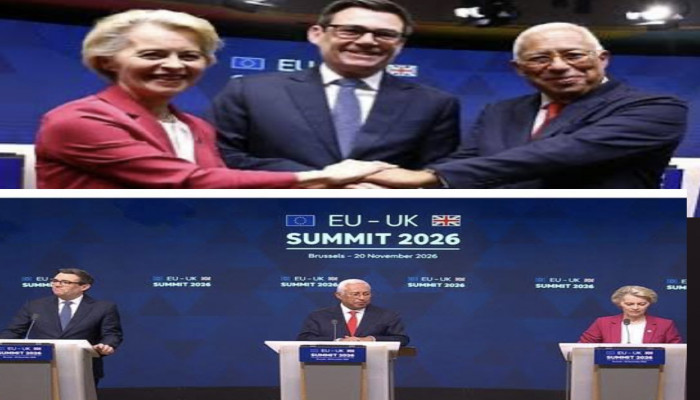
The United Kingdom and the European Union have agreed on a major post-Brexit deal covering trade, carbon emissions, youth mobility and security cooperation. The agreement includes a new scheme allowing up to 100,000 young people from each side to live, work, study and travel in the other jurisdiction for up to three years.
The agreements were announced after a summit in Brussels on Friday between UK Prime Minister Andy Burnham, European Commission President Ursula von der Leyen and European Council President António Costa. The leaders described the package as an effort to end a “decade of drift and division”. Burnham called it a “good day for Britain” and Europe, saying the existing relationship was not working.
Under the agreement, both sides will establish a common Sanitary and Phytosanitary (SPS) area to remove most checks and certification requirements on animal and plant products moving between Great Britain, Northern Ireland and the EU. The arrangement is expected to take effect from March 1, 2028.
The UK and EU will also link their emissions trading systems from 2028. This will exempt goods traded between them from carbon border adjustment measures once the systems are connected. They have also agreed to extend the energy provisions under the Trade and Cooperation Agreement until March 2028. Negotiations on Britain's participation in the EU internal electricity market are expected to conclude in 2027.
The package also includes a Digital Partnership covering artificial intelligence and quantum technology. A separate Dialogue on Economic Security will focus on supply chains, electric vehicles and steel. Burnham said the agreement could increase Britain's GDP by 0.5%, equivalent to £17 billion ($22 billion), according to a UK Treasury estimate.
Under the Youth Experience Scheme (YES), up to 100,000 young people from each side will be allowed to live, work, study, volunteer and travel in the other jurisdiction for up to three years. Applications are expected to open by 2028, with the scheme scheduled for rollout by January 2030. The UK will also rejoin the EU's Erasmus+ student exchange programme in 2027. Both sides will negotiate a reciprocal arrangement on student tuition fees over the next six months.
On migration and security, the agreement provides for a Structured Dialogue on Migration, stronger cooperation with Frontex and the EU Agency for Asylum, and UK observer status in the European Migration Network. It also includes a Europol liaison arrangement and automated vehicle registration data sharing.
The UK and EU will establish a Framework Participation Agreement to allow British involvement in EU civilian Common Security and Defence Policy missions. They will also strengthen military mobility cooperation and coordinate efforts against Russia's “shadow fleet” and hybrid threats.
The joint statement reaffirmed support for Ukraine and backed a two-state solution in the Middle East. It called for unimpeded humanitarian aid in Gaza, urged Hamas to disarm and condemned attacks by Iran and the Houthis on regional shipping lanes.
The deal has triggered fresh political debate over Brexit. In the 2016 referendum, 52% of voters backed leaving the EU. Burnham recently called it an “obvious truth” that Britain had lost more than it gained from Brexit.
Reform UK leader Nigel Farage criticised the agreement, accusing Burnham of betraying Brexit. He argued that Britain could trade and maintain good relations with its neighbours without political integration with the EU. He said the Brexit debate had “just started again”.
Critics have also raised concerns about Britain aligning with EU rules without having a direct role in setting them. Burnham said the package probably represents the limit of what the government can achieve during the current Parliament. He indicated that further moves towards closer ties are unlikely before 2029. The government plans to introduce legislation to implement the agreements in Parliament next week.


 Loading...please wait
Comments