



UK deploys military to track Russian submarines near critical undersea infrastructure
- In Reports
- 07:12 PM, Apr 09, 2026
- Myind Staff
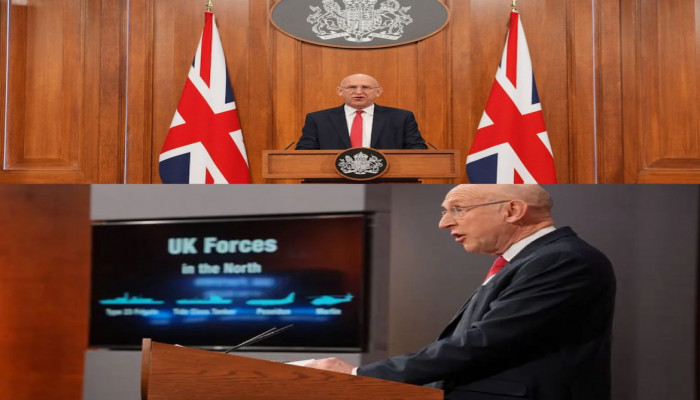
The United Kingdom revealed that it had deployed military assets earlier this year to monitor and deter Russian submarines operating near vital undersea cables and pipelines around British waters. Defence Secretary John Healey confirmed that the operation lasted for over a month and involved close coordination with allied forces. The move came amid concerns that Russia could be attempting covert activities targeting critical infrastructure beneath the sea.
According to British officials, Russian submarines were detected moving through the High North maritime region. This area is strategically important as it hosts major shipping routes along with essential underwater communication cables and energy pipelines. The UK government believes that Russia may have used ongoing tensions in the Middle East as a distraction to carry out these operations without drawing attention.
Healey stated that British forces, along with allies such as Norway, actively tracked the movements of the Russian vessels. He added that their presence was closely monitored until they eventually left the area. Officials also confirmed that there was no evidence of any damage to undersea infrastructure during this period, which provided some reassurance despite the seriousness of the situation.
Speaking at a press conference, Healey made it clear that the UK wanted to send a strong message to Russian President Vladimir Putin. He said, "To President Putin, I say, 'We see you. We see your activity over our cables and our pipelines, and you should know that any attempt to damage them will not be tolerated and will have serious consequences." He further added, "Our armed forces left them in no doubt that they were being monitored, that their movements were not covert, as President Putin planned, and that their attempted secret operation had been exposed."
The Russian embassy in London did not immediately respond to these claims. In the past, Moscow has denied involvement in incidents where undersea cables and infrastructure across Europe were damaged. These denials continue even as Western countries raise concerns about repeated disruptions.
Healey explained that the Russian mission involved a highly capable Akula-class attack submarine, along with two specialised submarines operated by Moscow’s Main Directorate for Deep Sea Research (GUGI). He noted that these submarines are built for underwater surveillance during peacetime and can carry out sabotage operations during conflict situations. Their presence near critical infrastructure raised serious concerns among British defence authorities.
Once the submarines were detected in international waters, the UK responded by deploying a frigate, a support tanker, and a maritime patrol aircraft. These assets were used to track and monitor the vessels closely. At the same time, Norway contributed to the effort by sending a P-8 maritime patrol aircraft and a frigate to support the operation. This joint response highlighted the level of cooperation among allied nations in addressing potential threats.
Healey clarified that the Russian submarines did not enter British territorial waters. However, they operated within the UK’s Exclusive Economic Zone and nearby waters belonging to allied countries. This zone allows Britain certain rights over resources and economic activities, making it an area of strategic importance even if it is not strictly territorial waters.
The incident comes at a time when Britain’s naval strength has faced criticism. U.S. President Donald Trump recently questioned the UK’s military response in the context of tensions involving Iran and dismissed British aircraft carriers as "toys." Addressing this criticism, Healey defended the UK’s strategy. He said it was not necessary to deploy all military resources in one region, as threats can emerge in different forms and locations.
He emphasised the importance of focusing on less visible threats, particularly those under the sea. Healey stated, "The greatest threats are often unseen and silent. And as demands on defence rise, we must deploy our resources to best effect." His remarks underlined the need for careful planning and efficient use of defence capabilities.
Since Russia’s invasion of Ukraine in 2022, NATO allies have increased their presence in the North Atlantic and the Baltic Sea. This comes after several incidents involving damage to power cables, telecom lines, and gas pipelines. Investigations have shown that many of these incidents were caused by civilian ships dragging anchors. However, concerns remain about the possibility of deliberate sabotage.
While no damage was reported, the episode highlights the strategic importance of undersea networks and the need to protect them from both accidental and intentional harm.



 Loading...please wait
Comments