



Uddhav Thackeray, Raj Thackeray reunite after 20 years ahead of Mumbai civic polls
- In Reports
- 05:49 PM, Dec 24, 2025
- Myind Staff
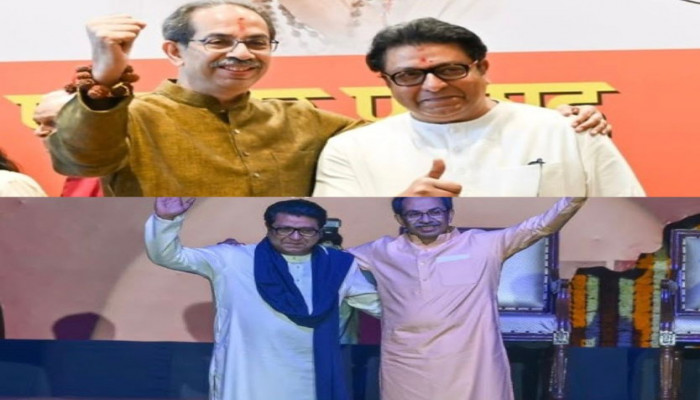
After two decades of political separation, Shiv Sena (UBT) chief Uddhav Thackeray and Maharashtra Navnirman Sena (MNS) chief Raj Thackeray have announced an alliance for the upcoming municipal elections in Maharashtra. The announcement was made on Wednesday, marking a major moment in Maharashtra politics, especially in Mumbai, where the Brihanmumbai Municipal Corporation (BMC) elections are due to be held on January 15.
Raj Thackeray had quit the undivided Shiv Sena nearly 20 years ago after differences with his cousin Uddhav Thackeray and later formed the MNS. Since then, the two leaders have followed separate political paths. Their reunion now comes at a time when civic elections are approaching across the state, including polls in 29 municipal corporations.
The announcement event saw both leaders come together, accompanied by their families, highlighting the symbolic nature of the reunion. Senior Shiv Sena leader Sanjay Raut described the moment as significant and hopeful. Calling it an “auspicious beginning,” Raut said, “This is an auspicious beginning to ensure the saffron flag keeps unfolding on BMC and other municipal corporations. And this can only be done by the Thackeray brothers.”
Addressing the gathering, Uddhav Thackeray said the two leaders were standing together not just as politicians, but “as Thackeray brothers.” He referred to the legacy of their family and the roots of the Shiv Sena. “Our grandfather Prabodhankar Thackeray was the one who led the fight for Maharashtra. After we got Mumbai in Maharashtra, the Shiv Sena Pramukh formed the party,” he said. He also noted that the Shiv Sena is nearing a milestone, saying, “It will be 60 years since the formation of the Shiv Sena.”
Uddhav Thackeray also spoke strongly about Mumbai and Marathi identity. He accused certain forces of attempting to “destroy Mumbai” and warned against internal conflicts. “If we keep fighting, it will be an insult to Hutatma,” he said, referring to martyrs of the Maharashtra movement. Emphasising Marathi pride, he added, “No one can ever take Mumbai away from Marathi Manus.” Referring to a BJP slogan, he said, “BJP then said ‘Batenge toh Katenge’. Now, I am calling the Marathi Manus—if they falter now, then they will be divided.”
Raj Thackeray, speaking after Uddhav, echoed the message of unity and reconciliation. Stressing that past disputes should not come in the way of larger interests, he said, “Maharashtra is bigger than any misunderstanding or fight.” He made it clear that the alliance was not being announced to discuss seat numbers or individual strategies. “That’s where we have begun. We are not here to convey who will fight how many seats,” Raj Thackeray said.
Clarifying the scope of the alliance, Raj Thackeray confirmed that the tie-up would apply not only to Mumbai but also to Nashik. “We will announce for other corporations after our meeting today,” he said. However, he was firm about their aim in Mumbai, stating, “Mumbai’s mayor will be a Maharashtrian and it will be from our party.”
The alliance follows several weeks of negotiations between the two sides. According to sources, discussions focused on finalising a seat-sharing arrangement for municipal elections across Maharashtra. These include elections to 29 municipal corporations, with the BMC being the most important and politically influential.
Politically, the reunion is seen as an attempt to bring together a divided Marathi nationalist vote base. Over the years, vote splits between different Shiv Sena factions and the MNS have benefited rival parties in many urban areas. Uddhav Thackeray’s Shiv Sena (UBT) continues to have a strong organisational presence, particularly in Mumbai and parts of the Konkan region. On the other hand, while the MNS has not had major electoral success in recent years, it still enjoys emotional support and street-level appeal, especially among urban Marathi youth.
Together, the two parties could consolidate Marathi-speaking voters in key regions such as Mumbai, Thane, Pune, Nashik, and other parts of the Mumbai Metropolitan Region (MMR). These are areas where divided votes in the past have weakened their political influence and allowed opponents to gain an advantage.
The alliance may also challenge the claim of the Eknath Shinde-led faction as the true political heir of Bal Thackeray’s legacy. By coming together, Uddhav and Raj Thackeray aim to reclaim the original ideological space of the Shiv Sena, rooted in Marathi pride and regional identity. This development could also make the political contest tougher for the BJP, which has been trying to attract Marathi pride voters in recent years.
At the civic level, the reunion could significantly change the dynamics of municipal elections. By preventing vote division in crucial wards, the alliance may help the Thackeray-led parties re-establish themselves as a dominant force in city-level politics. As a result, the upcoming municipal polls are expected to be more competitive and unpredictable.
Overall, the coming together of Uddhav Thackeray and Raj Thackeray after 20 years marks a major political moment in Maharashtra. While the alliance is focused on civic polls for now, its impact could reshape the political landscape, especially in Mumbai, where control of the BMC carries both administrative power and symbolic importance.



 Loading...please wait
Comments