




Two Indian MPs attend oath-taking ceremony of CTA’s Penpa Tsering
- In Reports
- 05:55 PM, May 27, 2026
- Myind Staff
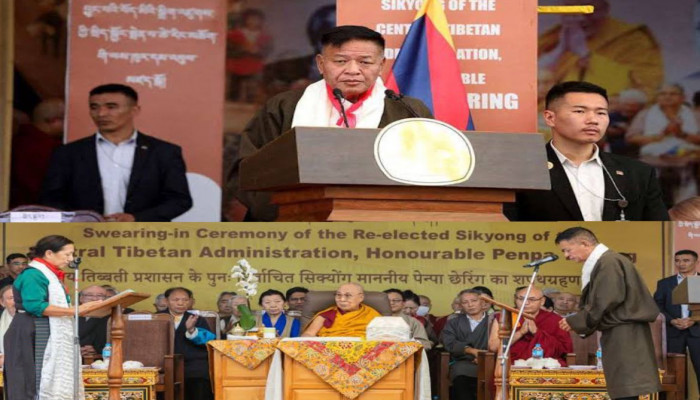
Penpa Tsering was officially sworn in as the Sikyong of the 17th Kashag of the Central Tibetan Administration (CTA) on Wednesday morning at the Tsuglagkhang courtyard in Dharamshala. The oath-taking ceremony took place in the presence of His Holiness the 14th Dalai Lama after Penpa Tsering secured re-election for a second term.
Penpa Tsering became the 6th directly elected Sikyong, a position earlier known as Kalon Tripa. He was declared elected after receiving 61.025 per cent of the total votes in the preliminary round of the recently held Tibetan general election. Under the Election Rules and Regulations, he did not have to contest the final round because of the clear majority he secured in the preliminary voting.
The new 17th Kashag will continue the long-standing Kashag system, which has existed for more than 275 years. The Central Tibetan Administration, earlier known as the Tibetan Government in Exile, was formed after Tibet came under the occupation of the People’s Liberation Army. The administration continues to function as the political and administrative body representing Tibetans in exile.
The ceremony was attended by two Indian MPs -Tapir Gao, Lok Sabha MP and Co-Convenor of the All-Party Indian Parliamentary Forum for Tibet, Rajya Sabha MP Sujeet Kumar and Atya Nanda, Joint Secretary of the National Commission for Minorities.
Several international dignitaries and political representatives attended the swearing-in ceremony. A cross-party parliamentary delegation from the United Kingdom was present at the event. The delegation included MP Chris Law of the Scottish National Party (SNP) and Chair of the APPG Tibet, MP Kerry McCarthy of the Labour Party and former Government Minister, MP Wera Hobhouse of the Liberal Democrats and APPG Tibet Member, and MP Alicia Kearns of the Conservative Party and former Chair of the Foreign Affairs Committee.
Representatives from Latin America also attended the event. Deputy Luis Fabian Mala of Chile and Deputy Jose Francisc of El Salvador were among the distinguished guests present during the ceremony.
Ahead of the event, China, which does not recognise the CTA, voiced strong opposition towards the Dalai Lama and exile structures as separatist threats. In a statement, Chinese Embassy spokesperson Yu Jing in Delhi said, “The issue of the Dalai Lama’s reincarnation is purely an internal matter of China and should not be subject to external interference. The so-called ‘Central Tibetan Administration’ is not recognised by any sovereign country, and its leadership has neither the legitimacy to represent the Tibetan people nor the authority to make claims regarding the reincarnation process.”
Yu added, “India has made clear commitments on issues relating to Tibet. It is sincerely hoped that India will continue to honour these commitments, refrain from providing any platform for activities advocating ‘Tibetan independence,’ and avoid interference in the reincarnation of the Dalai Lama. Such an approach would contribute positively to the overall stability and constructive development of our bilateral ties.”
In April, Chinese Ambassador to Nepal Zhang Maoming met the then Home Minister Sudan Gurung and cautioned against any official Nepali government participation in the oath-taking ceremony, according to Nepal media.
The ceremony formally began with the arrival of His Holiness the Dalai Lama. Tibetan and Indian national anthems were performed at the start of the programme. Monks from Namgyal Monastery then recited auspicious prayers to mark the beginning of the proceedings. Tibetan Chief Justice Commissioner Yeshi Wangmo administered the oath of office and secrecy to Penpa Tsering before the gathering.



 Loading...please wait
Comments