




Turkish products excluded from reciprocal benefits under India-EU FTA
- In Reports
- 02:30 PM, Jan 29, 2026
- Myind Staff
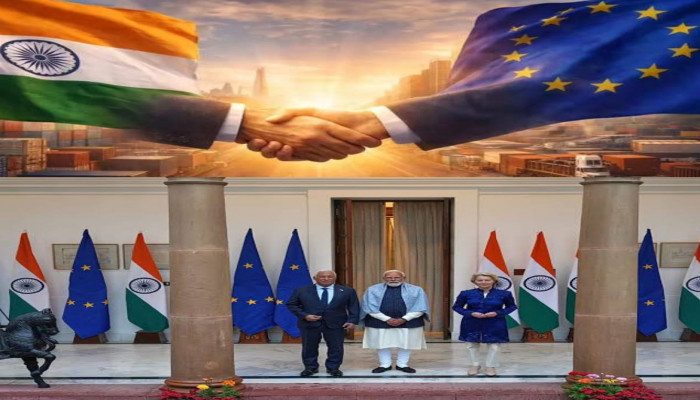
India and the European Union have reached a major Free Trade Agreement (FTA) that will provide preferential market access on nearly 97% of tariff lines. This agreement is being seen as a significant step in global trade relations between India and the EU. However, despite Turkey’s customs union with the EU, it will not receive reciprocal benefits under this pact. This has created a structural imbalance that could affect Turkey’s trade flows and economic position.
The main reason behind Turkey’s exclusion lies in the nature of its Customs Union with the European Union. Established in 1996, the EU–Turkey Customs Union requires Turkey to align with the EU’s common external tariffs and commercial policies when dealing with third countries. This means Turkey must follow the EU’s trade decisions but cannot automatically benefit from the EU’s free trade agreements unless it is a direct signatory.
As a result, Indian goods can enter Turkey with reduced tariffs through EU trade arrangements, but Turkish exports will not receive similar preferential access to the Indian market under the India–EU FTA. This asymmetry has exposed a long-standing weakness in the EU–Turkey Customs Union structure. While the arrangement was originally designed to promote trade in industrial goods and some processed agricultural products, it does not cover key areas such as services, agriculture, and digital trade, making it less relevant in today’s global trade environment.
The conclusion of the India–EU FTA highlights these limitations more clearly. The agreement aims to provide duty-free access for 99.5% of India’s exports by volume and 90.7% by value to the EU. It also includes strict rules of origin, requiring substantial processing in either India or the EU to qualify for preferential treatment. An institutional framework has been established under the agreement, comprising a Joint Committee to oversee its implementation and a Rapid Reaction Mechanism to address trade concerns promptly. The scale and depth of this agreement underscore the benefits that Turkey cannot directly access under its current customs arrangement.
For Turkey, the implications are significant. The EU remains Turkey’s largest trade partner, accounting for around 41% of its exports and 32.1% of its imports. However, the rigid nature of the Customs Union restricts Turkey’s ability to negotiate independent free trade agreements with major economies. Instead, Turkey is forced to follow the EU’s trade policies and later seek separate agreements with countries that have already signed FTAs with the EU. These agreements are often delayed and less favourable, putting Turkish exporters at a competitive disadvantage and increasing the risk of trade deflection.
This situation reflects the growing mismatch between the decades-old EU–Turkey Customs Union and the realities of modern global trade. Analysts have described the arrangement as outdated and structurally asymmetric, as Turkey must adopt EU tariff reductions without having a role in negotiations or enjoying reciprocal market access. Efforts to modernise the Customs Union have stalled due to political tensions, leaving Turkey bound to an arrangement that limits its economic autonomy.
The broader geopolitical context further complicates Turkey’s position. Strained diplomatic relations between India and Turkey, along with recent declines in bilateral trade, make it even more difficult for Ankara to secure independent preferential access to the Indian market. At the same time, Turkey is attempting to diversify its economic partnerships beyond Europe, but its dependence on the EU’s trade framework continues to shape its options.
The India–EU FTA, therefore, represents both an opportunity and a challenge in global trade. While it strengthens economic ties between India and the EU, it also exposes the vulnerabilities of Turkey’s current trade structure. As global trade becomes more fragmented and competitive, Turkey’s long-term strategy will depend on whether it can modernise its Customs Union with the EU or successfully negotiate independent free trade agreements. Until then, Turkey remains in a position where it must align with EU trade policies without fully sharing the benefits of its agreements with third countries.



 Loading...please wait
Comments