




Turkey passes law offering conditional relief to PKK with amnesty subject to full disarmament
- In Reports
- 01:59 PM, Aug 11, 2026
- Myind Staff
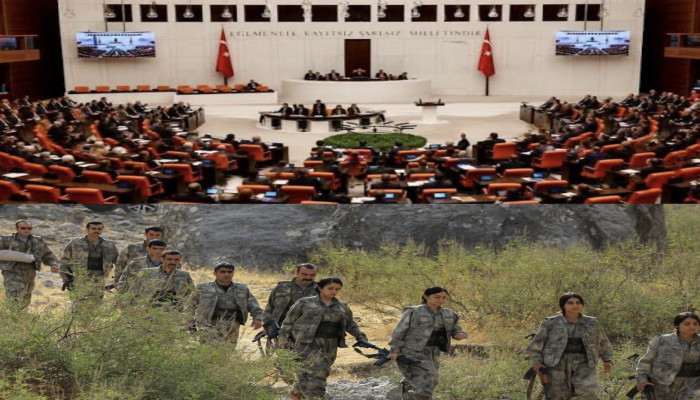
Turkey’s parliament has passed a conditional law offering legal relief to thousands of Kurdish militants linked to the Kurdistan Workers’ Party (PKK). The measure passed with 468 votes in favour and 88 against. It will take effect only after Turkish authorities confirm that the PKK has fully disarmed and dissolved. The move is part of the government’s latest effort to end a conflict that has killed tens of thousands of people over several decades.
The 12-article law sets out a process for the disarmament and rehabilitation of PKK members. It will suspend certain prison sentences for convicted members. It will also delay ongoing investigations and trials against others for five or 10 years, based on the seriousness of the alleged offences. If those covered by the measure do not commit terror-related crimes during the specified period, their cases will be dropped.
The law excludes PKK members convicted of intentional killings. It also excludes those who received life sentences before 2005. This includes jailed PKK leader Abdullah Ocalan and other senior figures. The legislation also establishes ministerial and parliamentary committees to oversee the disarmament and rehabilitation process.
The measures will come into force only after Turkey’s National Security Council confirms that the PKK has disbanded and handed over all its weapons. Those seeking benefits under the law will have six months to apply once the council’s decision appears in the official gazette. Media reports said PKK members living in exile and those based in Iraq and Syria are expected to be among the beneficiaries.
The legislation follows major developments in the PKK’s long-running conflict with the Turkish state. The group announced last year that it would end its decades-long armed campaign and dissolve itself as part of a peace effort. The decision came after a call from Ocalan, who has been imprisoned since 1999. The PKK later held a symbolic disarmament ceremony in northern Iraq, where it has maintained bases. It also said it was withdrawing fighters from key areas in Turkey and moving them to Iraq.
The new law could have effects beyond the disarmament process. It may help Turkey strengthen ties with Iraq. It could also support efforts by the Syrian government to integrate areas previously controlled by the Kurdish-led Syrian Democratic Forces, which Turkey considers affiliated with the PKK. The legislation could also influence Turkey’s domestic politics.
President Recep Tayyip Erdogan could seek support from the pro-Kurdish Peoples’ Equality and Democracy Party, or DEM, if he wants to remain in office beyond the current two-term presidential limit. Erdogan could run for another term if parliament calls an early election during his current term. The opposition Good Party has criticised the legislation and linked it directly to Erdogan’s political future.
Musavat Dervisoglu, leader of the centre-right nationalist Good Party, said the law "would pave the way" for Erdogan to stay in power. The party has opposed the bill and argued that the measure could serve Erdogan’s political interests.
The PKK has also criticised the legislation. In a statement carried by the PKK-linked ANF news outlet, the group described the law as a "beginning" to resolving outstanding issues but said it had "serious shortcomings and deficiencies". The group called for Ocalan’s release and said the peace process could move forward only if he "lives and works freely".
The PKK also said its fighters would not surrender their weapons and return to Turkey "if, upon returning to Turkey, they are unable to engage in democratic politics on the basis of freedom of thought and freedom of association, and if they are prosecuted and imprisoned because of their views or the organisations they establish." The statement shows that the group wants wider political guarantees alongside the disarmament process.
DEM has pushed for Ocalan to receive an official role in coordinating the transition. Such a role could potentially have opened the way for his release. The new legislation does not mention his status or any possible release. Media reports have suggested that authorities could ease his conditions at the island prison near Istanbul. These changes could include broader visiting rights and better communication with people outside the prison.
Speaking in parliament, Gulistan Kilic Kocyigit of DEM said: "The people of Turkey, who have paid a heavy price for many years, now have an opportunity to consolidate peace and build democracy." She added, "Of course, the proposal has shortcomings, and we now have a responsibility to address these shortcomings," pointing to demands for greater rights for Kurds and wider democratic reforms.
The PKK began its armed insurgency against the Turkish state in 1984. The conflict later spread into neighbouring Iraq and Syria and resulted in tens of thousands of deaths. Turkey, the United States and the European Union classify the PKK as a terrorist organisation. The group initially fought for an independent Kurdish state. It later shifted its demands towards greater autonomy and expanded rights for Kurds in Turkey.
Turkey has attempted peace talks with the PKK in the past. The most recent major effort collapsed in 2015. The latest initiative therefore represents another attempt to end the decades-long conflict. The new law provides a formal legal framework for the PKK’s announced disarmament. Its implementation will depend on the group completing the disarmament process and Turkey addressing the political and legal demands that remain at the centre of the negotiations.
The legislation could mark an important step towards ending one of the region’s longest-running conflicts. Its success, however, will depend on whether Turkey and the PKK can meet the conditions surrounding disarmament, political participation and the future status of Ocalan. The process could also reshape Turkey’s relations with Iraq and influence developments involving Kurdish groups in Syria.



 Loading...please wait
Comments