




Tunisia snubs Brussels and refunds €60 million in EU aid
- In Military & Strategic Affairs
- 11:10 PM, Oct 12, 2023
- Myind Staff
After tensions over a plan to control migration from North Africa grew, Tunisia wired a portion of its financial support to the EU totaling €60 million ($63.7 million).
“Our people reject charity,” President Kais Saied said Wednesday evening in a post on Facebook, calling for a strategic partnership based on equality and respect. The European Commission confirmed Thursday that it received the returned funds.
"The Commission has been informed that Tunisia returned the payment of 60 million euros," said Ana Pisonero, the Commission's spokesperson for enlargement and neighbourhood, without specifying a reason for the repayment.
"Contacts and discussions are ongoing."
Asked if something like this has ever happened with a non-EU country, the spokesperson said "As far as we are aware, no."
The Tunisian Foreign Affairs Ministry did not immediately reply to emailed questions.
The funds, which came from a previous COVID-19 recovery initiative, were deposited directly to the bank account of the Tunisian treasury and were intended as budget support. This was meant to be the initial payment from a bigger tranche of €127 million, including funds designated for use under the July memorandum of agreement between the EU and Tunisia.
But days after the European Commission announced the €127-million envelope in late September, Tunisian President Kais Saied dismissed the financial offer, saying it was "derisory" and contrary to the agreement.
"Tunisia, which accepts cooperation, does not accept anything resembling charity or favour, because our country and our people do not want sympathy and do not accept it when it is without respect," Saied stated last week.
"Consequently, Tunisia refuses what has been announced in recent days by the EU."
The blunt comments generated a lot of media coverage and controversy in Brussels, where the MoU had been hailed as a model for future deals with surrounding countries to stop migration flows.
In an effort to stop the story from spiraling out of control, the Commission publicly stated that €60 million had really been paid in budgetary help "following a request from the Tunisian government on the 31st of August."
Olivér Várhelyi, the European Commissioner for enlargement and neighbourhood, went a step further and urged Tunisia to "wire back" the money if it did not want it. The Commissioner posted a screenshot of the Tunisian paperwork requesting the release of the €60 million along with his message on X, formerly Twitter.
"Implementation of the (memorandum) should continue once Tunisia returns to the spirit of our strategic & comprehensive partnership based on mutual respect," Várhelyi said.
Now, that spirit seems to be in tatters as Saied follows through on this threat.
However, the Commission reaffirmed that despite the most recent setback, the deal will continue and "occupy us for quite some time," even though no more payout is anticipated in the near future.
"This memorandum of understanding is very important. It's very important for Tunisia. It's very important for the European Union. It is a long-term endeavour," said Eric Mamer, the Commission's chief spokesperson, speaking next to Pisonero.
"Yes, there are going to be bumps, sometimes significant, on the road. But the Commission will continue to work on its implementation with the Tunisian authorities. This is the point we're at today."
The EU-Tunisia relations, which the bloc is desperately trying to keep intact as part of its migration policy, have already taken a turn for the worse with the refund, which Politico Europe previously reported.
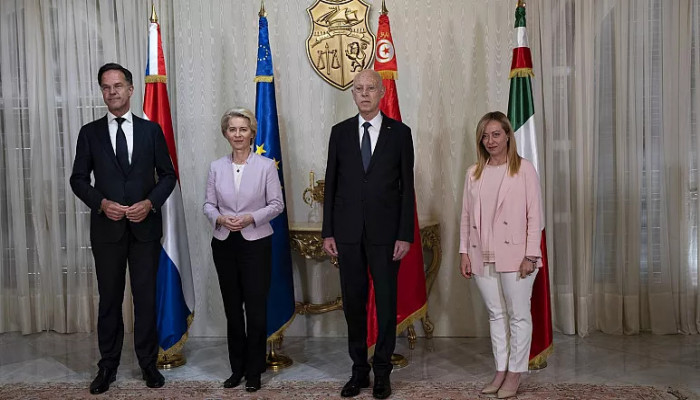
The main reason for the memorandum's signing was to lessen the number of migrant boats that leave Tunisian shores and travel to Italy. President Kais Saied, European Commission President Ursula von der Leyen, Italian Prime Minister Giorgia Meloni, and Dutch Prime Minister Mark Rutte were all present at the signing ceremony in mid-July.
"In times of geopolitical uncertainties, it is important to deepen cooperation with our strategic partners," von der Leyen said back then.
The deal sets up at least €150 million for budget support, €105 million for managing migration, €307.6 million for a transmission line of inexpensive renewable electricity, and €150 million for an optical fibre undersea connection. It also opens the door for €900 million in macro-financial assistance but only if Tunisia first succeeds in securing a loan from the International Monetary Fund.
"Are there further payments meant for Tunisia? The answer is yes, in the context of the implementation of the memorandum of understanding, which has some way to go," Mamer said when asked about the promised cash.
"There will come a point where, we hope, we will be in a position to disburse those funds to Tunisia. Quite clearly, we're not there yet."
Since its presentation, the memorandum has come under harsh criticism from the European Parliament and humanitarian organisations, who have raised concerns about alleged abuses against sub-Saharan migrants by the Tunisian government, including numerous instances of expulsions of groups of people to the Libyan border.
The European Ombudsman publicly questioned the Commission last month to see whether the document contained any extra measures to ensure complete observance of human rights.
Saied has drawn harsh criticism for his racialized perceptions of black Africans, whom he has characterised as being a "criminal plan to change the composition of the demographic landscape of Tunisia." Additional criticism was levelled at Saied after he refused admission to five members of the European Parliament and postponed a delegation from the European Commission's official visit a few days later.
Image source: Euronews
Disclaimer: The opinions expressed within this article are the personal opinions of the author. MyIndMakers is not responsible for the accuracy, completeness, suitability, or validity of any information on this article. All information is provided on an as-is basis. The information, facts or opinions appearing in the article do not reflect the views of MyindMakers and it does not assume any responsibility or liability for the same.



 Loading...please wait
Comments