



Trump’s ‘Divine War’ claim meets firm rejection from Pope
- In Reports
- 08:17 PM, Apr 13, 2026
- Myind Staff
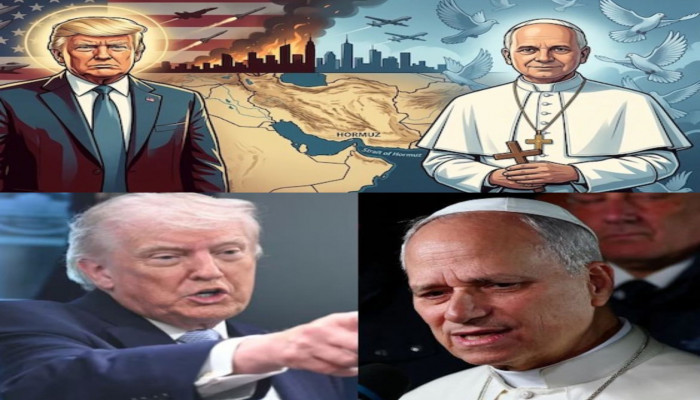
The ongoing conflict involving Iran has taken on a new dimension, moving beyond military and political debates into the realm of religion. US President Donald Trump has framed the war as one supported by divine will, while Pope Leo XIV has strongly rejected any suggestion that God supports violence. This sharp difference has created a rare and visible clash between political authority and religious leadership.
During the week, Trump once again stirred controversy by presenting himself as a figure chosen by God. He publicly suggested that the United States’ actions in the Iran war had divine backing. Speaking to reporters, he said, "I believe God supports the US in the war against Iran". This statement added a religious layer to an already tense geopolitical situation and drew strong reactions from the Vatican.
Trump’s messaging was also reflected on his social media platform, Truth Social. He shared an AI-generated image showing himself in a biblical-style robe, appearing to bless a sick man. The image portrayed him as a calm and powerful figure, with a sense of goodness radiating outward. The post seemed designed to reinforce his claim of divine support and to counter criticism from the Catholic Church.
The president also directly targeted the pope in his posts. He called him a "weak leader" and a "very liberal person". Trump further claimed that the pope wanted Iran to have a nuclear weapon, an accusation that the Vatican has clearly denied. These remarks intensified the disagreement and made the conflict more personal.
Senior members of Trump’s administration echoed his tone. Defence Secretary Pete Hegseth, who identifies as a born-again Christian, used religious imagery to describe a recent military event. He compared the rescue of fighter pilots to Jesus Christ’s resurrection and called it an "Easter-style miracle". Such statements added to the perception that the administration was framing the war in religious terms.
The Vatican’s response has been consistent and firm. The pope has repeatedly spoken against the war and against any attempt to justify violence through religion. In his Palm Sunday homily, he said God "does not listen to the prayers of those who wage war, but rejects them". He also described threats against the Iranian people as "truly unacceptable". These statements made it clear that the Church does not support the idea of a “holy war”.
The pope’s Easter Sunday message continued this stance. He urged, "Let those who have weapons, lay them down". This was widely seen as a direct response to the aggressive tone of US officials, even though Trump was not mentioned by name. The message highlighted the Church’s long-standing position that war cannot be justified in the name of God.
The disagreement also raises questions about the role of religion in politics, especially in a country like the United States, which is built on the principle of separation between Church and State. Trump’s approach adds a strong religious narrative to the conflict, which could influence both domestic and international opinions. It may also affect how allies and opponents view the US position.
This issue has political importance as well. There are around 1.4 billion Catholics worldwide, including over 70 million in the United States. Their views could play a role in upcoming elections. In the 2024 presidential election, Trump secured 55 per cent of Catholic votes, according to AP VoteCast. With rising criticism over the war, increasing fuel prices, and failed peace talks in Pakistan, maintaining this support could be crucial for his party in the November mid-term elections.
Tensions between the US government and the Vatican were also visible earlier this year. In January, Cardinal Christophe Pierre, the Vatican’s representative in the US, was called to the Pentagon for a meeting with Undersecretary of Defence for Policy Elbridge Colby. According to reports, the meeting was intense. Colby stated that the US "has the military power to do what it wants and the Catholic Church had better take its side". Another official reportedly referred to the 14th-century Avignon papacy, when political power challenged the authority of the pope.
After the meeting, both sides tried to ease tensions. The Pentagon said, "We have nothing but the highest regard and welcome continued dialogue with the Holy See." The Vatican also responded positively, saying it was "grateful for the opportunities to meet with government officials… to discuss areas of mutual concern." These statements suggested a willingness to maintain communication despite disagreements.
Despite these efforts, the core issue remains unresolved. The pope’s strongest statement came on April 10, when he said, "God does not bless any conflict". He added, "Anyone who is a disciple of Christ, the Prince of Peace, is never on the side of those who once wielded the sword and today drop bombs." This marked a clear rejection of attempts to link religion with military action.
Father Antonio Spadaro, a senior Vatican official, also clarified the Church’s position. He said, "The pope doesn't position himself as an adversary of Donald Trump. His critique does not concern a leader, but the principle that makes war possible… rejects the use of God's name to legitimise violence." This showed that the Vatican’s stance is based on principle rather than personal opposition.
Trump, however, continued his criticism. He stated, "I don't want a pope who criticises the President of the United States". His remarks extended beyond Iran and included comments about US actions in Venezuela, showing a broader frustration with religious criticism of his policies.
The situation now goes beyond the Iran conflict. It has opened a new front, where political and religious ideologies are in direct conflict. If the war continues to be presented as a ‘holy mission’ by the US leadership while the Vatican firmly rejects such claims, the divide may deepen further.
The coming months could be crucial. The outcome of the war, public opinion, and the mid-term elections will all shape how this conflict evolves. At the same time, the debate over whether religion should play a role in justifying war is likely to continue.



 Loading...please wait
Comments