




Trump’s China Impasse Brings Rubio to India
- In Foreign Policy
- 11:49 PM, May 23, 2026
- Ramaharitha Pusarla
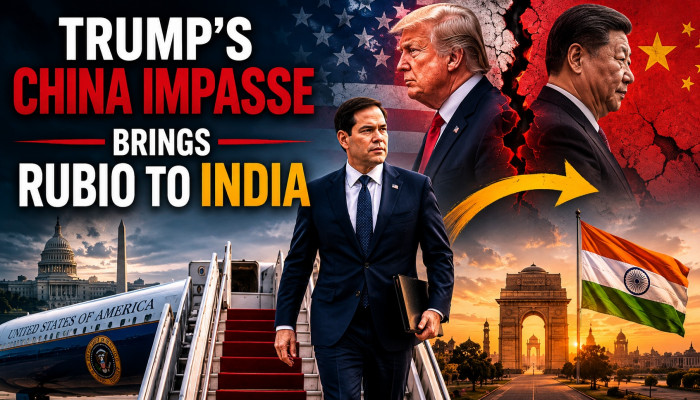
During his four-day India trip, from May 23-26, US Secretary Marco Rubio will visit Kolkata, Agra, Jaipur and New Delhi. Ahead of the trip, he described India as a ‘great partner’ and announced that the US is willing to supply as much oil as India wishes to buy. He also added that Venezuela’s oil is also up for grabs. This offer comes in the way of Venezuelan acting President Delcy Rodrigues scheduled visit to India the following week. Rubio replayed America’s “Operation Sindoor” style playbook by disclosing the Venezuelan leader’s visit to India even before both sides could officially confirm, stirring a political row in New Delhi.
Rubio will directly land in Kolkata. The US Consulate General is the United States’ second-oldest consulate. The last US Secretary to visit the Kolkata Consulate was Hillary Clinton in 2012. The BJP government has come to power in Bengal, defeating the TMC, which ruled for 15 years. Coincidentally, Rubio’s stopovers in Indian cities are all under the BJP-ruled governments. US South Asia envoy Sergei Gor recently attended Himanshu Biswa Sarma’s swearing-in ceremony. On May 21st, responding to Maharashtra Chief Minister Devendra Fadnavis’s tweet, he hinted at a big India-US collaboration in the nuclear sector.
Rubio’s choice of Kolkata touchdown and his visit to the Missionaries of Charity with a dubious record of child trafficking is viewed with disapproval. Read together, with US Congressman Chris Smith’s appeal to the US Secretary ahead of his visit to raise concerns over India’s proposed amendments to the Foreign Contribution Regulation Act (FCRA), Rubio’s visit is viewed with deep scepticism. FCRA is the umbilical cord connecting the Western churches to the active evangelical ecosystem in India. Rubio’s closed-door prayer at Mother Theresa’s residence strengthened conjectures of the organisation’s close links with the US administration.
Ahead of Rubio’s visit, the US approved a $428 million defence support package for India, which includes military support for Apache attack helicopters and M777A2 ultra-light howitzers. The package would include repairs, field support, spare parts, maintenance systems and advanced training. The US administration tried to showcase this defence package as a defence cooperation agreement. Implicitly, the timing suggests that Trump’s Chinese outreach has hit a dead end. Hence, immediately after Trump’s Beijing visit, the US State Department cleared India’s long-pending defence package to begin a conversation on the Indo-Pacific strategy.
India is getting to terms with the US administration’s blow hot and blow cold approach. New Delhi now believes that the onus of course correction is on the United States. It is quite evident from the absence of a notable official presence to receive Rubio at Kolkata.
Rubio’s agenda will include defence cooperation, critical minerals, supply chain stability and maritime security. Rubio is scheduled to meet PM Modi on May 23rd to lay the ground for a meeting with Trump on the sidelines of the G7 Summit in France. He will attend the Quad Foreign Ministers meeting at New Delhi on May 26th.
Quad 2.0, revived by Trump 1.0, is now hanging by a thread with trust deficit and uncertainty gnawing at its roots. Trump 1.0 went ballistic about China. But, Indo-Pacific security took a back seat with Trump's transactionalism and adversarial commentary against allies in his second term. The continuity of the Quad Leaders’ Summit stagnated in 2025. Quad now lacks focus. With no deliverables and the US’s self-imposed retreat from Indo-Pacific, the arrangement exists just in name. Mired in unpredictability and captive of Trump’s shifting postures and preoccupation with the Middle East, countries are reluctant to rely on the US partnership in the region. Also, Washington and Dhaka are getting ready to seal the Acquisition and Cross-Servicing Agreement (ACSA) (a logistics agreement similar to LEMOA) and the General Security of Military Information Agreement (GSOMIA) to access Bangladesh’s ports in the Bay of Bengal. The US presence will alter India’s primacy in its strategic backyard and heighten New Delhi’s suspicions of strategic encirclement. Until Washington commits to putting its weight and assures allies of its genuine interests in the Indo-Pacific, the Quad resurrected by Trump might wither away under his watch.
What makes Rubio’s visit more interesting is the date of announcement of his visit- May 20th, just days after Trump’s three-day State visit to China. Trump’s touted big visit to China, the first by a US President in nine years, ended without having a Joint Statement or any concrete agreement. While Trump announced that China agreed to buy $17 billion of US agricultural products and that Beijing had placed an order for 200 Boeing Aircraft, the Chinese side is yet to confirm.
Shockingly, Trump even acknowledged Xi’s observations that the United States was a declining nation, sparking a public debate. He, however, course-corrected with a post on Truth Social. But the damage was already done.

Any responsible head of the country would firmly denounce such statements, especially on foreign soil, coming from a rival country’s President. Consumed by political animosity, Trump chose to swallow such observations without any resistance. Trump’s validation of Xi’s statement as “100 % correct” is a massive moral victory for China.
A series of incidents - from Trump’s seat, to US officials dumping Chinese gifts, to Hegesth being barred from entering the venue without a badge have further exposed China’s deep-seated mistrust and entrenched suspicion. Ultimately, Trump’s visit to Beijing has firmly positioned China in the driver’s seat.
Trump’s guarded response- warning Taiwan ‘not to go independent’ and ‘9500 miles argument’ blunting the United States’ ambivalent policy bordered on kowtowing. It was a huge letdown from 2017, when Trump stated, “We will maintain our strong ties with Taiwan in accordance with our 'One China' policy, including our commitments under the Taiwan Relations Act to provide for Taiwan's legitimate defence needs and deter coercion”. In December 2016, he received a congratulatory message from Taipei as President-elect. He even passed the Taiwan Travel Act in 2018, encouraging visits between the US and Taiwan.
Trump’s Nixonian act of Chinese reset is a telling lesson for India. Trump’s jarring pivot to Pakistan, positioning it as a lynchpin for its South Asian policy and beyond and sudden recalibration of ties with China is reminiscent of the 70s. Cultivating India’s adversaries- Pakistan and China, Trump has been utterly unsympathetic to India. Trump’s labelling of India as “hell hole”, “tariff king”, “declining economy” and “currency manipulator”, especially in his second term, has been distasteful.
American hypocrisy of imposing the highest tariffs on India for importing Russian oil but exempting China from the same, while referring to India as a strategic ally, cannot be papered over. The Trump administration’s overt hostility- scrapping of H1 B visas and asking Greencard holders to return to their native country has exposed the structural faultlines of the India-US relationship.
Over the decades, leaders from both countries steadily built the relationship anchored in strategic convergences and democratic values. But Trump’s double standards are widening divergences. Thus far, countries have managed the differences with diplomatic niceties. Trump’s coercive and blunt diplomacy blew up the cover. The veneer is off.
For the better, this moment offered New Delhi an opportunity to recalibrate and prioritise collaboration in strategic areas of convergence. Energy security, defence cooperation, critical minerals, emerging technologies, and supply chain resilience stand out as vital sectors for India-US cooperation.
The old-world order has faded. A new multipolar world is reshaping. India is reorienting its partnership with the US while safeguarding strategic autonomy and preserving an independent foreign policy. Washington must recognise that a civilisational state like India with an immutable strategic consciousness will not bend under pressure or play a second fiddle. Instead, it will thoughtfully reconfigure its diplomatic calculus, placing national interests at the forefront.
Disclaimer: The opinions expressed within this article are the personal opinions of the author. MyIndMakers is not responsible for the accuracy, completeness, suitability, or validity of any information on this article. All information is provided on an as-is basis. The information, facts or opinions appearing in the article do not reflect the views of MyindMakers and it does not assume any responsibility or liability for the same.



 Loading...please wait
Comments