




Trump-Xi deal signals major reset China commit to buy $17 billion US trade products
- In Reports
- 06:02 PM, May 18, 2026
- Myind Staff
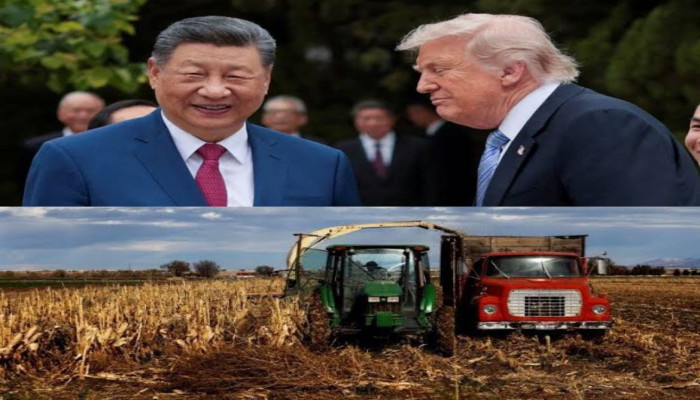
China has agreed to buy at least USD 17 billion worth of American agricultural products every year for the next three years after high-level talks between US President Donald Trump and Chinese President Xi Jinping in China. The White House said the agreement was reached during President Trump’s visit, marking the first trip by a U.S. president to China since 2017. In addition to soybean purchase agreements signed in October 2025, the current deal covers 2026, 2027 and 2028 imports.
The visit was presented as a major step towards improving ties between the world’s two largest economies. Both leaders agreed to work towards a constructive relationship focused on “strategic stability” based on fairness and reciprocity. The White House also confirmed that President Trump will host President Xi in Washington later this year. The two countries have additionally agreed to support each other as hosts of the G20 and APEC summits in 2026.
As part of the agreements, China regained market access for American beef by renewing expired registrations for more than 400 US beef facilities and approving new listings. China also promised to work with US regulators to remove all existing suspensions affecting American beef exports. In another important move, China resumed imports of poultry from US states that are officially recognised as free from highly pathogenic avian influenza.
The discussions were not limited to trade and economic matters. The two leaders also held talks on major global security concerns. Both sides agreed that Iran should not possess nuclear weapons. They also called for the reopening of the Strait of Hormuz and stressed that no country or organisation should be allowed to impose tolls in the region. The Strait remains one of the world’s most important routes for global energy shipments.
The United States and China further reaffirmed their shared commitment towards the denuclearisation of North Korea. The two countries underlined the need for coordinated international efforts to maintain stability and security in the region. The discussions reflected a broader attempt by both governments to cooperate on sensitive geopolitical issues despite ongoing differences in other areas.
To strengthen economic coordination, President Trump and President Xi announced the creation of two new institutions — the US-China Board of Trade and the US-China Board of Investment. According to the White House, the Board of Trade will manage bilateral trade involving non-sensitive goods. The Board of Investment will function as a government-to-government platform for discussions linked to investment issues and economic cooperation.
The White House described these institutions as the foundation of a “historic agreement” aimed at improving and streamlining economic ties between the two nations. The move is expected to create a more structured framework for handling trade and investment discussions in the future.
President Trump also secured several commitments from China aimed at boosting American industries, exports and jobs. China agreed to address US concerns related to supply chain shortages involving rare earths and critical minerals. These include materials such as yttrium, scandium, neodymium and indium, which are considered essential for advanced manufacturing and technology industries.
China further agreed to discuss restrictions related to the sale of rare earth production and processing equipment and technologies. The White House said these steps could open fresh opportunities for American industries that depend heavily on critical mineral supply chains.
In another major development, China approved an initial purchase of 200 Boeing aircraft for Chinese airlines. This is China’s first major commitment to purchase Boeing planes since 2017. The agreement is expected to support high-skilled manufacturing jobs in the United States and strengthen aerospace cooperation between the two countries for the long term. Chinese airlines are also expected to benefit from expanded access to American-made aircraft.
The White House described President Trump’s visit as a milestone moment that could help improve stability and confidence for businesses and consumers across the world. The agreements reached during the visit covered trade, investment, strategic cooperation and global security matters. Together, the announcements signalled a broader effort by Washington and Beijing to stabilise relations at a time of global economic uncertainty and geopolitical tensions.



 Loading...please wait
Comments