



Trump warns of bombing Iran into ‘Stone Age’, no clear timeline to end war
- In Reports
- 12:23 PM, Apr 02, 2026
- Myind Staff
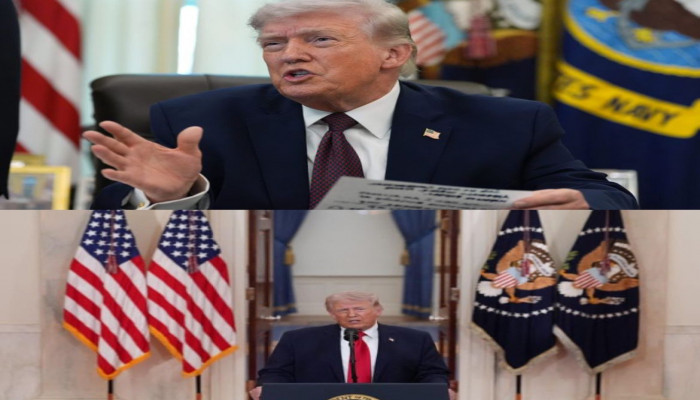
U.S. President Donald Trump said in a televised speech on Wednesday night that the American military had nearly achieved its objectives in Iran. However, he did not provide a clear timeline for ending the conflict, which has now entered its fifth week. In a strong warning, he also said the U.S. was prepared to bomb Iran back into the “Stone Ages.”
Speaking to a public that is increasingly concerned about the war, falling approval ratings, and pressure from allies, Trump claimed that U.S. forces had destroyed Iran’s navy and air force. He added that the country’s ballistic missile and nuclear programs had been severely damaged. Despite these claims, he did not outline a detailed plan to end the war. Instead, he stated that the U.S. would complete its mission “very fast.”
"We have all the cards," Trump said from the White House in his first primetime address since the U.S. and Israel launched the war on February 28. "They have none."
During his 19-minute speech, Trump did not address several key unresolved issues. These included the status of Iran’s enriched uranium and the closure of the Strait of Hormuz, a crucial route for global oil supplies. Iran has effectively shut down this passage, raising concerns worldwide. Trump said the strait would reopen “naturally” once the conflict ends.
The speech did little to reassure Americans or U.S. allies, who are already dealing with rising fuel prices and growing frustration. Financial markets reacted quickly. Stocks fell, the dollar strengthened, and oil prices increased, reflecting fears that the conflict could continue for a longer period.
Trump and his advisers have given different explanations and timelines about the war in recent weeks. While describing Iran as militarily weakened, Trump also warned that the U.S. would continue heavy attacks for another two to three weeks. He said that if Iran’s leadership failed to negotiate properly, the U.S. would target critical infrastructure, including electricity systems and oil facilities.
"We're going to hit them extremely hard over the next two to three weeks," Trump said. "We're going to bring them back to the Stone Age where they belong."
"In the meantime, discussions are ongoing," he added. "Yet if during this period of time, no deal is made, we have our eyes on key targets."
Even as Trump spoke, air raid sirens were heard in Doha and Tel Aviv. This showed that Iran still has the ability to launch attacks across the region despite suffering major losses. Just a day before the speech, Trump had told reporters that Iran did not need to agree to a deal for the war to come to an end, adding to the uncertainty around U.S. strategy.
Trump briefly acknowledged the rising cost of gasoline in the U.S., which has become a major concern for citizens. However, he blamed Iran for the price increase and insisted that costs would soon fall. He also said that countries heavily dependent on oil from the Gulf should take responsibility for reopening the Strait of Hormuz. While nations like Britain and France have expressed willingness to help, they have stated that action would only come after the fighting stops.
"They can do it easily," Trump said. "We will be helpful, but they should take the lead in protecting the oil that they so desperately depend on," he said.
Trump has also shown frustration with NATO allies for not stepping forward to secure the Strait. At one point, he even threatened to withdraw from the long-standing alliance. Although he had earlier mentioned discussing NATO in his speech, he did not bring it up during his address.
Public opinion in the United States is increasingly turning against the war. A Reuters/Ipsos survey conducted from Friday to Sunday showed that 60% of voters disapprove of the conflict, while only 35% support it. Around 66% of respondents said the U.S. should end its involvement quickly, even if it means not achieving all its goals.
At the same time, Trump’s next steps remain unclear. He has considered both increasing and reducing military action. His speech did not provide clarity, even for some of his close advisers. Officials in his administration have discussed bold plans, including seizing Iran’s remaining enriched uranium and carrying out ground operations to take control of strategic areas. These include parts of Iran’s coastline and Kharg Island, which is key to the country’s oil exports.
Meanwhile, thousands of additional U.S. troops are being sent to the Gulf region. This suggests that the administration is keeping all military options open. Despite the ongoing concerns, Trump urged Americans to view the conflict in a broader context. He compared it to past wars in Iraq, Vietnam, and Korea, which lasted much longer and required greater involvement.



 Loading...please wait
Comments