




Trump tried to ban voting machines citing baseless national security concerns: Report
- In Reports
- 01:12 PM, May 23, 2026
- Myind Staff
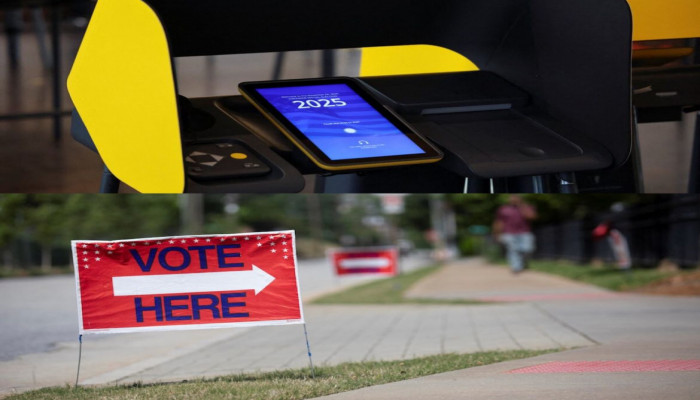
A senior official in U.S. President Donald Trump’s administration last year explored a plan to block voting machines used in more than half of American states. The effort was based on long-disputed election conspiracy theories and aimed at targeting machines made by Dominion Voting Systems, according to people familiar with the matter.
The proposal was pushed by White House adviser Kurt Olsen, a lawyer who has worked closely with Trump on claims of election fraud that have repeatedly been rejected by courts and investigators. Sources said Olsen wanted the Commerce Department to declare parts used in Dominion machines a national security threat. His larger goal was to replace machine voting systems with a nationwide system of hand-counted paper ballots.
The idea emerged during discussions among administration officials on how the federal government could gain more control over elections, which are usually managed by individual U.S. states under the Constitution. Trump had also publicly spoken about the possibility of federal control over elections.
Election security experts have warned that switching fully to hand-counted ballots could create more problems instead of solving them. Most U.S. voting systems already use paper records alongside machines, allowing votes to be checked through audits. Experts believe this system is more reliable and secure than fully manual counting.
According to sources, the plan advanced far enough that Commerce Department officials began examining possible legal grounds in September to move against Dominion machines. However, the effort later collapsed because Olsen and others involved could not provide evidence to support claims that the machines posed security risks.
The episode is part of a broader push by the Trump administration to increase federal involvement in elections. Earlier this month, a Reuters investigation found that administration officials and investigators in several states had sought confidential election records, requested access to voting equipment and reopened voter fraud cases that had already been dismissed by courts and bipartisan reviews.
At the same time, Trump and Republican allies are reportedly trying to redraw election districts ahead of schedule to gain an advantage in the upcoming congressional midterm elections. Sources said Olsen hoped to remove Dominion machines before those elections took place.
Others involved in discussions included Paul McNamara, a senior aide to Director of National Intelligence Tulsi Gabbard, and Brian Sikma, a White House assistant working on domestic policy issues. Olsen has reportedly worked closely with Gabbard’s office.
Sources said McNamara approached Commerce Department officials last summer to discuss whether Dominion’s chips and software could be labelled a national security risk. At that time, he led a task force under the Office of the Director of National Intelligence that was examining vulnerabilities in U.S. voting systems.
Reuters could not confirm whether Commerce Secretary Howard Lutnick knew about these discussions. A spokesperson for the department said Lutnick “did not engage in the topic at all.” The spokesperson also declined to comment on whether other officials in the department participated.
Olivia Coleman, a spokesperson for Gabbard’s office, said ODNI, including McNamara, “did not brief on nor coordinate a plan with the Department of Commerce to take actions to ban Dominion voting machines.”
Olsen, McNamara and Sikma did not respond to requests for comment. Democratic Senator Alex Padilla criticised Olsen after the report surfaced and called for his removal. Padilla described him as “a threat to democracy” in a post on X.
Democrats and election experts fear the administration may be preparing to challenge future election results if Republicans perform poorly in the midterms. They worry such actions could create confusion around voting systems and encourage new claims of election fraud without evidence.
The U.S. Election Assistance Commission reported last year that more than 98% of election jurisdictions already create paper records for every vote cast. Most voters either use machines that print paper receipts or fill out paper ballots that are counted electronically.
Alex Halderman, a computer science professor at the University of Michigan and an election security expert, said hand-counted ballots carry their own risks, including human counting mistakes and ballot-box stuffing. “Changing to hand counting would be chaotic,” he said, “and it might facilitate cheating.”
White House spokesperson Davis Ingle dismissed Reuters’ reporting and called it misinformation that was based on selective leaks.
Sources said Olsen’s team also tried to prove the long-running conspiracy theory that Dominion machines were connected to Venezuela and used to steal the 2020 election from Trump. Multiple investigations and lawsuits have found no evidence to support those allegations. In 2023, Fox News paid Dominion $787 million to settle a defamation lawsuit linked to false election fraud claims.
Dominion machines were used in at least 27 states during the 2024 elections. The company was later acquired by Liberty Vote USA, based in Colorado. In response to Reuters, Liberty Vote said, “Our total focus remains on working in partnership with our customers - the dedicated election officials across the nation who are utilising our election systems to deliver secure, accessible and transparent elections.”
Trump has continued repeating allegations against Dominion. On May 12, he reposted an old clip from the far-right network One America News falsely claiming Dominion machines deleted millions of votes.
In May 2025, Olsen helped lead a federal operation that seized Dominion machines used in Puerto Rico’s 2024 gubernatorial election. A later review by cybersecurity contractor Mojave Research Inc. found some vulnerabilities in the machines but discovered no evidence of Venezuelan code or hacking.
Sources said Olsen’s team dismantled some Puerto Rico machines, hoping to find components linked to countries considered foreign adversaries by the U.S. government. They reportedly found one Intel chip packaged in China, while other chips had been packaged in Japan, South Korea and Malaysia. Sources said Olsen’s report described the chips only as “East Asian,” which they believed was done to avoid highlighting the lack of evidence against the machines.
A White House meeting held in September included cyber experts from the National Security Council and members of Olsen’s team. Officials discussed whether Dominion equipment contained traces of Venezuelan software code. After the meeting, a political appointee at the Commerce Department asked another office to explore possible actions against voting machines over supply chain concerns. Sources said that the office reviewed the issue but ultimately took no action.



 Loading...please wait
Comments