



Trump threatens 50% tariffs on nations supplying arms to Iran
- In Reports
- 01:10 PM, Apr 09, 2026
- Myind Staff
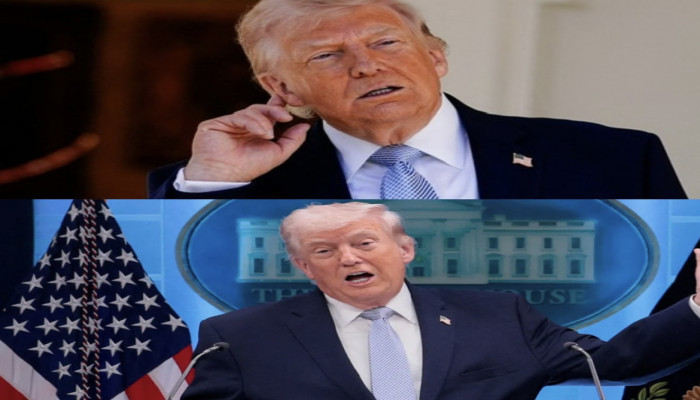
US President Donald Trump has warned that any country supplying military weapons to Iran will face immediate tariffs of 50 per cent on all goods exported to the United States. He made this announcement in a post on Truth Social, just hours after agreeing to a two-week ceasefire with Tehran. The statement, however, did not clarify the legal authority under which such tariffs would be imposed, raising serious questions among experts and analysts.
Trump’s proposal comes at a time when his earlier use of the International Emergency Economic Powers Act (IEEPA) to impose wide-ranging tariffs had already been struck down by the Supreme Court in February. Following that ruling, a lower court ordered refunds of nearly $166 billion collected through those tariffs over a year. The 1977 IEEPA law has long been used to justify financial sanctions against countries like Iran, Russia, and North Korea, but the court concluded that Trump exceeded his authority by applying it to global trade tariffs.
In his post, Trump stated, “A Country supplying Military Weapons to Iran will be immediately tariffed, on any and all goods sold to the United States of America, 50%, effective immediately. There will be no exclusions or exemptions! President DJT.” Despite the strong wording, experts argue that implementing such a policy is not straightforward under current legal frameworks.
Rachel Ziemba, an adjunct senior fellow at the Centre for a New American Security, highlighted the complexity of the situation. “It’s a lot more complicated to do that after IEEPA was struck down”, she told Al Jazeera. She added, “There’s no immediate policy lever and authorisation that is available for the US to do that. So they need either an act of Congress or need to adapt some other trade tool, and there isn’t really a national security-oriented trade tool.” Her remarks underline the lack of a clear mechanism for enforcing the proposed tariffs.
Trump did not specify which countries could be targeted by this measure. However, attention has turned toward China and Russia, both of which have been linked to supporting Iran’s military capabilities. These countries have reportedly provided missiles, air defence systems, and other technologies aimed at strengthening Iran’s deterrence against pressure from the US and Israel. Still, both Beijing and Moscow have denied supplying weapons recently, although some allegations against Russia continue.
Reports by Reuters suggest that Tehran has been considering purchasing advanced supersonic anti-ship cruise missiles from China. In another development earlier this year, officials from the Trump administration claimed that China’s leading semiconductor manufacturer had supplied chipmaking tools to Iran’s military. These developments have added to concerns about indirect support reaching Iran despite existing sanctions.
Josh Lipsky, vice president and chair of international economics at the Atlantic Council, interpreted Trump’s statement as primarily aimed at China. “This is a China-related threat, the way I read it. And China will read it that way,” he said. Despite this, Lipsky and others believe that immediate action is unlikely, especially with diplomatic considerations in play.
Trump is reportedly planning a visit to Beijing in mid-May to meet Chinese President Xi Jinping. Analysts argue that imposing steep tariffs at this stage could disrupt those talks. Ziemba noted that US tariffs on Chinese goods had already decreased following the court ruling, and introducing a new 50 per cent tariff could significantly raise costs for American importers and consumers.
She further described the announcement as more symbolic than practical. “This is kind of an empty threat, but shows that when push comes to shove, Trump comes back to tariffs”, she said. Her statement reflects a broader view among analysts that the proposal may be more about signalling strength than implementing policy.
Although immediate action appears unlikely, Trump does have access to alternative trade tools. One option is Section 301 tariffs, which address unfair trade practices and were widely used during his first term against China. However, expanding these tariffs would require a formal process, including public notice and review periods, before implementation.
Another possible route is Section 232 of the Trade Expansion Act of 1962. This provision allows tariffs on specific sectors for national security reasons. However, using this mechanism would involve a lengthy investigation and public consultation process, delaying any immediate enforcement.
Russia remains another potential focus, though its trade relationship with the US has weakened significantly since its invasion of Ukraine in 2022. Sanctions have reduced imports, yet US purchases from Russia still rose by 26.1 per cent in 2025, reaching $3.8 billion. These imports mainly include palladium used in automotive catalytic converters, fertilisers, and enriched uranium for nuclear reactors. The US Department of Commerce is already working on imposing tariffs on Russian palladium following an anti-dumping investigation.
Overall, while Trump’s announcement signals a tough stance on countries aiding Iran, legal and practical challenges make swift implementation unlikely. Experts believe the statement serves more as a warning than a policy ready for execution, especially given the geopolitical and economic consequences involved.



 Loading...please wait
Comments