



Trump shifts Iran war blame to Defence Secretary Hegseth
- In Reports
- 11:44 AM, Mar 24, 2026
- Myind Staff
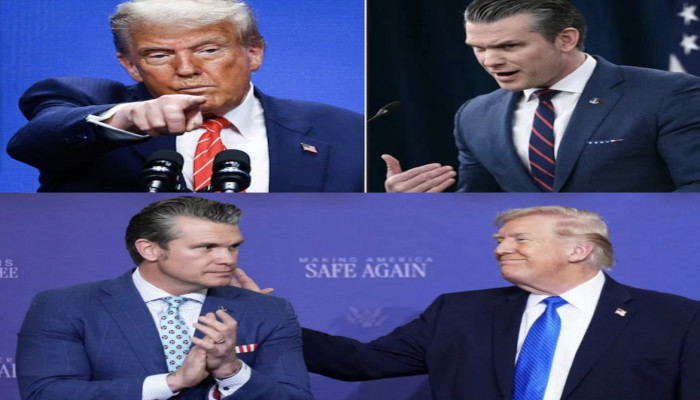
As the war involving Iran enters its fourth week, questions continue to grow about how and why the United States decided to engage in military action. Amid this uncertainty, President Donald Trump has presented a new version of events, suggesting that Defence Secretary Pete Hegseth was among the first to advocate for an offensive against Iran. His remarks, however, have added to an already complex and often contradictory narrative coming from within his administration.
Speaking at a roundtable event in the US state of Tennessee, Trump indicated that Hegseth played a key role in pushing for military action. “Pete, I think you were the first one to speak up, and you said, 'Let's do it because you can't let them have a nuclear weapon,'” Trump said, with Hegseth seated beside him. This statement has become the latest addition to a series of differing accounts about how the decision to go to war was made.
The question of why the US entered the conflict does not have a single, clear answer, even among those within the administration. Different officials have offered varying explanations, making it difficult to pinpoint a consistent justification. Some have argued that Israel was preparing to strike Iran regardless, leaving the US with little choice but to get involved. Others have claimed that Iran was dangerously close to deploying a nuclear weapon, which made immediate action necessary.
Trump himself provided a dramatic version of how the decision unfolded. Recalling conversations with key figures, he said, “I called Pete. I called General Kane. I called a lot of our great people,” he said. “We got a problem in the Middle East Or we can take a stop and make a little journey into the Middle East and eliminate a big problem.” While his words may have sounded informal, the implications of that decision have been far-reaching and serious, shaping a conflict that has now expanded across the region.
Despite the gravity of the situation, the administration’s account of events has not remained consistent. Just hours before attributing the push for war to Hegseth, Trump claimed that Iran’s retaliatory strikes across the Gulf had come as a complete surprise. “Look at the way they attacked, unexpectedly, all of those countries,” he said. “Nobody was even thinking about it.” However, this claim appears to conflict with reports suggesting that warnings about possible retaliation from Iran had been issued in advance but were not acted upon.
As the war continues, Hegseth has emerged as the most visible figure representing the administration’s military strategy. From the Pentagon, he has outlined key objectives, including dismantling Iran’s missile systems, curbing its drone production, and weakening its naval capabilities. He has also actively responded to media coverage, urging journalists to portray the military campaign in a more positive light, even as the conflict has already resulted in the deaths of 13 American service members and expanded into a broader regional crisis.
When asked about how long the operation might last, Hegseth avoided providing a clear timeline. “We wouldn’t want to set a definitive timeframe,” he said, adding that the effort was “very much on track”. His cautious response reflects the uncertainty surrounding the duration and outcome of the conflict.
Trump also acknowledged that Vice President JD Vance had shown less enthusiasm for the war compared to others in the administration. However, Vance has not publicly expressed any criticism, maintaining a more restrained stance in public discussions.
Behind closed doors, the situation appears even more divided. Reports suggest that figures such as Israeli Prime Minister Benjamin Netanyahu and media personality Rupert Murdoch were among those encouraging military action, while others within the administration advised caution. These internal disagreements highlight the lack of a unified approach and further complicate the narrative around the war.
The tensions within the administration have already led to consequences. Joe Kent, who previously headed the National Counterterrorism Centre, resigned last week, becoming the first senior official to step down in connection with the conflict. His resignation points to the seriousness of the divisions and the pressure surrounding the decision-making process.
Even as military operations continue, Trump has spoken about the possibility of negotiations with Iran. He suggested that talks could lead to an end to hostilities and the reopening of the strategically important Strait of Hormuz. “We’d like to make a deal,” he said. “If it goes well, we’re going to end up with settling this. Otherwise, we’ll just keep bombing our little hearts out.” He also mentioned that discussions involved a “top person” in Iran communicating with his son-in-law Jared Kushner and envoy Steve Witkoff.
However, Iran has firmly denied that any such talks are taking place, adding another layer of confusion to an already unclear situation. The contradiction between Trump’s statements and Iran’s response has raised further doubts about the accuracy of the administration’s claims.
Initially, Trump had set a Monday deadline for Iran to comply with US demands or face additional strikes. That deadline has now been extended by five days, indicating a possible shift in strategy or a delay in decision-making.
Overall, the narrative surrounding the war continues to shift, with new claims, denials, and conflicting accounts emerging frequently. From differing explanations about how the conflict began to uncertainty over its future, there is little clarity on key aspects of the situation. What remains constant is the growing sense of unpredictability—about the origins of the war, its direction, and ultimately, who bears responsibility for initiating it.



 Loading...please wait
Comments