




Trump says Netanyahu ‘doesn’t call the shots’ as Israel launches strikes on Iran
- In Reports
- 01:29 PM, Jun 08, 2026
- Myind Staff
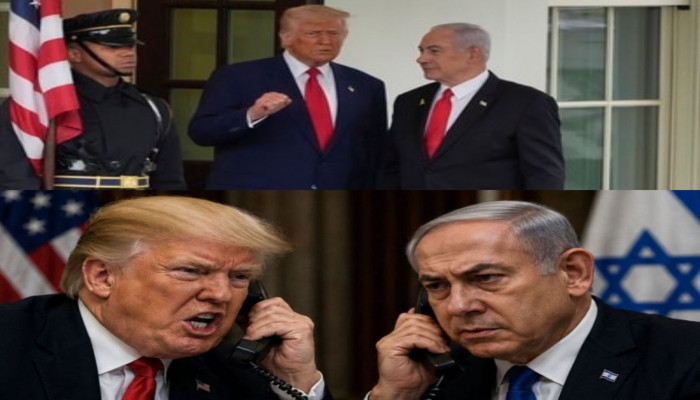
US President Donald Trump said Israeli Prime Minister Benjamin Netanyahu would have no option but to accept any agreement negotiated between Washington and Tehran. Trump made the remarks during a telephone interview with the Financial Times, stating that the United States would ultimately decide the course of negotiations with Iran.
“He won’t have any choice. He [Netanyahu] doesn’t call the shots. I call the shots. I call all the shots,” Trump said.
His comments came shortly after Iran launched a barrage of ballistic missiles towards Israel. The attack marked the most serious violation of the ceasefire that had been agreed upon in early April. Iran said the missile strike was in response to an Israeli attack in Beirut earlier on Sunday.
According to an Axios report, Trump urged Netanyahu not to retaliate immediately and instead allow more time for diplomatic efforts. The report, citing a senior US official and an Israeli source familiar with the matter, said Trump conveyed this message during a phone call with the Israeli leader. Before the call, Trump had also told Axios that he intended to ask Netanyahu not to respond militarily to Iran’s missile attack.
Despite those efforts, tensions between the two countries continued to rise. The Israeli military reported at least three waves of incoming Iranian missiles on Sunday. It said its air defence systems were “currently identifying and intercepting threats.” Later, the military announced that all the missiles fired by Iran had been successfully intercepted.
Iran’s military central command strongly condemned Israel’s latest strike on Beirut’s southern suburbs. It said the attack had “crossed all red lines” and demanded an end to Israel’s military campaign in Lebanon.
Mohammad Bagher Ghalibaf, Iran’s parliament speaker and the country’s chief negotiator in talks with the United States, accused Washington of supporting Israel’s actions. He claimed the United States had given a “green light” for the Beirut strike and warned that American and Israeli assets were now “legitimate targets.” However, a senior US official quoted by Axios rejected the accusation and said the Trump administration had not given a “green light” for the Israeli attack in Beirut.
Iran’s Islamic Revolutionary Guard Corps (IRGC) described its missile attacks on Israel as a warning. It said a broader response could follow if what it called “aggressions” continued. The IRGC warned that any future retaliation could target both Israeli and American interests. It also stated that it was willing to accept a ceasefire with the United States, provided it was “a ceasefire on all fronts”.
Hours after Trump’s remarks about Netanyahu and diplomacy, Israel carried out strikes inside Iran. Early on Monday, the Israeli Air Force launched attacks targeting military sites in central and western Iran. The operation came in response to the missile launches from Tehran and raised concerns that the region could once again be pushed towards a wider conflict.
Iranian state television reported explosions in several cities, including Isfahan, Karaj, Tabriz and Tehran. No immediate details were provided regarding the extent of the damage or possible casualties. A witness in Tehran told the Associated Press that at least one large explosion was heard west of the Iranian capital.
Following the strikes, Iran closed the airspace around Tehran’s Imam Khomeini International Airport, the country’s main international gateway. The move was seen as a precautionary measure amid fears of further military action.
The IRGC later claimed that Israel had used air-launched ballistic missiles during the attack. It did not provide additional details about the weapons allegedly used.
As the operation began, the Israeli military released a brief statement confirming the strikes. “A short while ago, the Israeli Air Force struck military targets belonging to the Iranian terror regime in western and central Iran,” it said.
The latest exchange of attacks has sharply increased tensions across the region. It has also raised fresh concerns about the possibility of a broader conflict involving Israel, Iran and other regional actors, despite ongoing diplomatic efforts by the United States.



 Loading...please wait
Comments