




Trump restricts birthright citizenship after SC quashes earlier executive order
- In Reports
- 02:38 PM, Aug 07, 2026
- Myind Staff
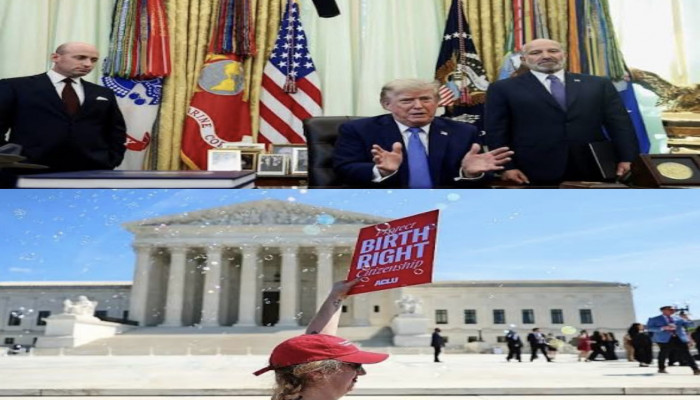
U.S. President Donald Trump has signed two executive orders aimed at restricting birthright citizenship, renewing his administration’s efforts to change who automatically receives U.S. citizenship at birth. The move comes despite a recent Supreme Court ruling that rejected his earlier attempt to limit the constitutional right. The new orders take a narrower approach and focus on specific groups of people.
Restricting birthright citizenship remains a major part of Trump’s broader immigration crackdown. The administration has also targeted what it describes as “birth tourism”. This refers to pregnant foreign nationals travelling to the United States to give birth so their children can obtain U.S. citizenship.
Trump had faced a setback on June 30, when the Supreme Court struck down his earlier executive order on birthright citizenship. That order sought to deny citizenship to a broad group of children born in the United States to parents who were either in the country illegally or were there temporarily. The court ruled that the policy was unconstitutional.
Following the Supreme Court decision, Trump called on Congress to take action on birthright citizenship. On Thursday, however, he chose to issue new executive orders instead. Executive orders allow a president to set government policy, but they do not carry the same legal weight as laws passed by Congress.
The Trump administration argues that the latest orders do not fall under the Supreme Court’s previous ruling. Officials say the new directives focus on what they describe as narrow and historical exceptions to birthright citizenship. The orders seek to expand the categories of people whose children would not automatically receive U.S. citizenship at birth.
The administration has also specifically targeted birth tourism. White House aide Stephen Miller said during the signing ceremony in the Oval Office, "That practice of birth tourism is, as of the signing of this order, hereby banned," The administration views the practice as a way for foreign nationals to use U.S. immigration and citizenship rules for their benefit.
The scale of birth tourism remains relatively small compared with the total number of births in the United States. The Centre for Immigration Studies, an organisation that supports lower levels of immigration, estimated in a 2020 analysis that between 20,000 and 25,000 mothers travelled to the United States for birth tourism during a year-long period between 2016 and 2017. The United States recorded around 3.6 million births in 2025.
Trump’s new executive orders also cover children born in the United States to foreign government employees. They seek to limit citizenship rights for children whose parents are classified as alien enemies. The orders could also have implications for people born in U.S. territories if Congress passes a proposed law that would end automatic citizenship in those territories.
Birthright citizenship is rooted in the 14th Amendment to the U.S. Constitution. It generally grants citizenship to people born on U.S. soil, with limited historical exceptions. Trump’s administration is now seeking to reinterpret those exceptions and apply them to additional groups.
The latest orders are expected to face legal challenges. Legal experts have questioned how much effect the directives can have after the Supreme Court’s recent ruling. They also remain uncertain about whether the administration’s narrower interpretation can survive further court scrutiny.
Immigrant rights groups have strongly opposed the new measures. They have accused the Trump administration of trying to get around the Supreme Court’s decision by changing the scope of its earlier policy. The American Civil Liberties Union said the new effort was likely to fail in court.
The orders mark another major attempt by Trump to reshape birthright citizenship through executive action. The administration maintains that its latest approach is legally different from the policy rejected by the Supreme Court. Critics argue that the new measures still challenge a long-standing constitutional principle. Their legal future will likely depend on how courts interpret the administration’s new limits and the constitutional protections surrounding citizenship at birth.



 Loading...please wait
Comments