



Trump renews criticism of Japan, South Korea, NATO allies for not offering naval support
- In Reports
- 01:53 PM, Apr 07, 2026
- Myind Staff
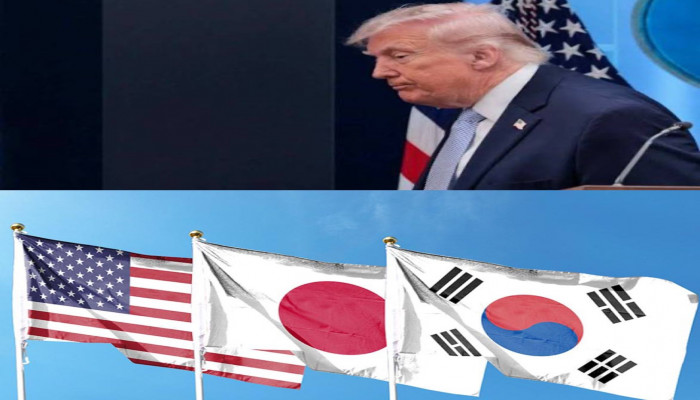
U.S. President Donald Trump on Monday renewed his criticism of key allies, including Japan, South Korea, Australia, and the NATO alliance, for not offering naval support to help reopen the Strait of Hormuz. His remarks come amid the ongoing U.S.-Israeli war against Iran, which has disrupted global oil flows and heightened tensions in the region.
Speaking at a press conference at the White House, Trump expressed frustration that Japan and South Korea had not stepped in to assist, despite the strong U.S. military presence in both countries. He pointed out that thousands of American troops are stationed there to protect them from North Korea, which he said possesses “a lot of nuclear weapons.” Trump questioned why these nations had not reciprocated by supporting U.S. efforts in the conflict.
He extended this criticism to NATO as well, once again calling the alliance a “paper tiger.” Trump suggested that countries benefiting from U.S. protection should contribute more actively in times of conflict. His comments reflected a broader push for burden-sharing among allies, especially during military operations involving U.S. interests.
In contrast, Trump praised several Middle Eastern nations, including Kuwait, Qatar, and Saudi Arabia. He described them as “good” partners who have supported the United States since the war began on February 28.
The president also issued a strong warning to Iran, stating that the United States has already secured a military advantage in the conflict. He made it clear that unless Iran agrees to U.S. terms, its key infrastructure could face massive destruction in a very short time. Trump has set a deadline of Tuesday at 8 p.m. in Washington for Iran to reopen the Strait of Hormuz, which remains largely blocked. The waterway is crucial for global oil transportation, and its closure has created instability in energy markets.
Emphasising the urgency, Trump said reopening the strait is a “very big priority.” He stressed the need for a deal that aligns with U.S. expectations. “We have to have a deal that's acceptable to me, and part of that deal is going to be we want free traffic of oil and everything,” he said.
He went on to outline the potential consequences if Iran fails to comply. “We have a plan, because of the power of our military, where every bridge in Iran will be decimated by 12 o'clock tomorrow night, where every power plant in Iran will be out of business, burning, exploding, and never to be used again.” These remarks underscored the seriousness of the U.S. position and the scale of possible military action.
During the briefing, Trump was joined by top officials, including Pentagon chief Pete Hegseth, Chairman of the Joint Chiefs of Staff Gen. Dan Caine, and CIA Director John Ratcliffe. Despite the strong rhetoric, Trump indicated that the U.S. would prefer not to carry out such destruction. He noted the long-term impact it would have on Iran’s recovery. “It will take them 100 years to rebuild right now. If we left today, it would take them 20 years to rebuild their country, and it would never be as good as it was,” he said. “The only way they're going to be able to rebuild their country is to utilise the genius of the United States of America.”
Earlier in the day, Iran signalled that it is seeking a permanent end to the conflict rather than a temporary cease-fire. According to the country’s official IRNA news agency, Tehran rejected a 15-point cease-fire proposal from Washington, which was reportedly delivered through Pakistan. Instead, Iran put forward its own 10-point plan aimed at ending regional hostilities and ensuring safe passage through the Strait of Hormuz.
At another event, Trump acknowledged Iran’s counterproposal, describing it as a “significant step,” but he made it clear that it does not yet meet U.S. expectations. The situation remains tense, with both sides holding firm positions while the deadline approaches.



 Loading...please wait
Comments