



Trump raises tariffs on South Korean goods over trade deal implementation delays
- In Reports
- 01:10 PM, Jan 27, 2026
- Myind Staff
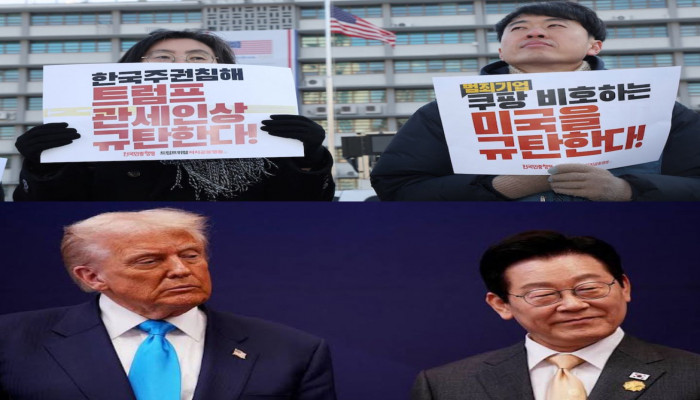
President Donald Trump has announced a major increase in tariffs on South Korean imports, accusing Seoul’s legislature of delaying the implementation of a trade deal agreed upon last year. The decision has surprised South Korean officials and added pressure on the already complex economic and security relationship between the two allies.
On Monday, Trump said the United States would raise tariffs on South Korean autos and other products. He blamed South Korea’s parliament for not approving the agreement that was reached in principle in July 2025. Referring to the deal, Trump wrote on social media, "President Lee and I reached a Great Deal for both Countries on July 30, 2025 and we reaffirmed these terms while I was in Korea on October 29, 2025."
He further announced that tariffs would be raised sharply, stating, "I am hereby increasing South Korean TARIFFS on Autos, Lumber, Pharma, and all other Reciprocal TARIFFS, from 15% to 25%." However, it was not immediately clear when the higher tariffs would come into effect.
The move has come as a shock to South Korea. Officials in Seoul said they were not formally notified about the tariff increase. South Korea’s presidential office, the Blue House, said the country’s industry minister, who is currently in Canada, would soon travel to the United States to meet U.S. Commerce Secretary Howard Lutnick. The Blue House also said South Korea’s presidential adviser would hold meetings with relevant ministries to discuss possible responses.
According to a source familiar with discussions between the two countries, Trump’s decision may have been influenced by recent South Korean regulatory actions against Coupang, a U.S.-listed e-commerce company. Coupang has criticised these measures, calling them unfair and discriminatory. The trade deal negotiations have also involved U.S. concerns over South Korea’s regulations affecting American tech firms.
Choi Seok-young, a former South Korean trade negotiator, described Trump’s statement as a pressure tactic. He said the message could be seen as “a political move in which the United States is exerting maximum pressure on South Korea in an effort to force concessions during the ongoing negotiations over non-tariff barriers.”
The announcement had an immediate impact on financial markets. South Korea’s benchmark KOSPI index initially fell by 1.19%, later recovering to trade 1.3% higher. Meanwhile, the South Korean won weakened by 0.5% against the U.S. dollar. Shares of Hyundai Motor and Kia initially dropped sharply but later recovered some of their losses. Hyundai Motor’s shares fell 4.8% before rebounding, while Kia’s shares dropped 6% before stabilising.
The White House and the Office of the U.S. Trade Representative did not immediately respond to requests for comment. South Korea’s ruling Democratic Party also declined to comment. The country’s parliament is scheduled to begin a new session on February 3, when lawmakers are expected to take up pending bills, including those related to the trade agreement.
Under the original agreement reached last year, South Korea had committed to invest $350 billion in the United States, mainly in strategic sectors. Of this amount, $200 billion was to be paid in cash in phased instalments, capped at $20 billion per year, to help maintain stability in the won currency. The agreement also reduced tariffs on South Korean autos and auto parts imported into the United States from 25% to 15%, aligning them with Japanese competitors. The 15% tariff rate took effect on November 1.
South Korea’s exports reached a record $709.4 billion in 2025, marking a 3.8% increase from the previous year. However, exports to the United States declined by 3.8% to $122.9 billion, making the U.S. the country’s second-largest market after China. Auto exports to the U.S., worth $30.2 billion, account for 25% of total exports to the American market, though they fell by 13.2% compared to 2024.
The tariff hike could significantly affect South Korea’s automobile industry, particularly Hyundai Motor and Kia. General Motors, which produces about 500,000 vehicles annually in South Korea and exports most of them to the U.S., also declined to comment on the situation.
Currency concerns are another major issue. South Korea’s Finance Minister Koo Yun-cheol said earlier this month that the government planned to implement the investment package as soon as possible. However, he noted that uncertainty over an upcoming U.S. Supreme Court ruling on Trump’s tariffs could influence the process. He also said the investment plan was unlikely to begin in the first half of 2026 due to the weak won.
The possibility of large currency outflows has worried South Korean authorities, especially as the won has fallen to levels not seen since the global financial crisis of 2007–2009. South Korea’s finance ministry said it would actively consult parliament on the U.S. investment bill, and Koo planned to seek lawmakers’ cooperation.
Josh Lipsky, chair of international economics at the Atlantic Council, said Trump’s move reflected frustration with the slow progress of the trade agreement. He added that it highlighted ongoing uncertainty about tariff policies, saying, “It's just another reminder that the markets were wrong to believe we were going to get into tariff stability in 2026.”
Trump’s broader trade policy has already disrupted global trade. Since beginning his second term in 2025, he has imposed tariffs on many countries, sometimes threatening increases and later delaying or reversing them. The latest decision involving South Korea underscores the continued volatility in global trade relations and the uncertain future of the U.S.–South Korea economic partnership.



 Loading...please wait
Comments