




Trump orders naval blockade of Venezuelan oil tankers, escalating pressure on Maduro
- In Reports
- 12:37 PM, Dec 17, 2025
- Myind Staff
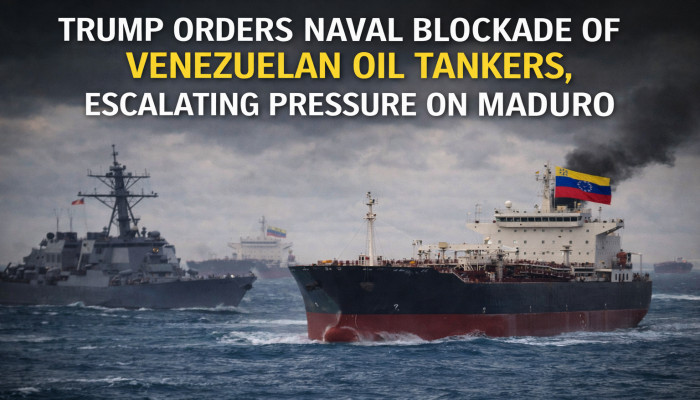
US President Donald Trump has dramatically escalated his confrontation with Venezuela by ordering a naval blockade of Venezuelan oil tankers, a move that sharply increases pressure on President Nicolás Maduro’s government. The decision marks one of the most aggressive steps taken by the United States against Venezuela and signals a major intensification of military involvement in South America.
Announcing the move late on Tuesday, Trump described the operation as a “total and complete” blockade of sanctioned oil vessels entering and leaving Venezuela. He also formally declared the Maduro government a “foreign terrorist organisation”, accusing it of using oil revenues to fund drug trafficking and organised crime.
According to US administration officials, the military campaign is intended to disrupt illegal activities, block oil revenues flowing to Caracas, and increase pressure on Maduro’s leadership. Officials indicated that the operation could also weaken Maduro’s hold on power.
“Shock like Nothing They’ve Ever Seen”
In a social media post, Trump emphasised the scale and intent of the blockade, saying:
“Venezuela is completely surrounded by the largest Armada ever assembled in the History of South America. It will only get bigger, and the shock to them will be like nothing they have ever seen before. Until such time as they return to the United States of America all of the Oil, Land, and other assets that they previously stole from us.”
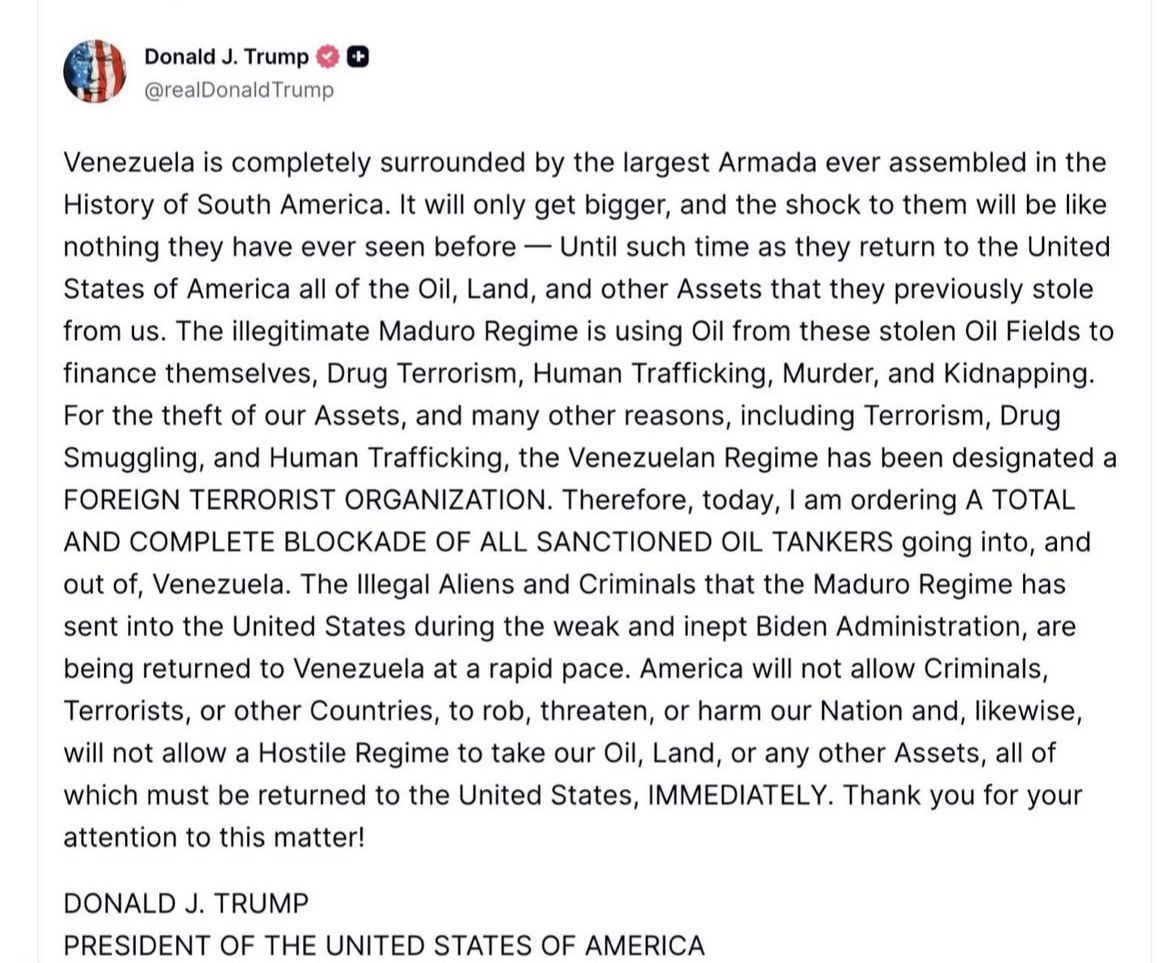
Trump warned that Venezuela would face unprecedented consequences, saying the blockade would bring a “shock like nothing they’ve ever seen.” He said the United States would significantly expand its military presence around Venezuela as part of what he described as a necessary response to criminal activity linked to the Maduro government.
The announcement followed weeks of rising tensions between Washington and Caracas, including increased naval deployments, aerial patrols, and the seizure of a Venezuelan oil tanker off the country’s coast. Trump’s order applies to all sanctioned oil vessels travelling to and from Venezuela, effectively formalising what oil traders say had already become a de facto embargo.
Last week, US forces seized an oil tanker carrying an estimated two million barrels of Venezuelan crude. Following that seizure, several tankers loaded with oil have remained in Venezuelan waters rather than risk interception by US forces.
Industry sources say shipping companies are increasingly unwilling to move Venezuelan oil due to fears of detention, strikes, or military confrontation. The blockade order has added further uncertainty to Venezuela’s oil exports, which are a crucial source of revenue for the country. The Trump administration has moved swiftly to back its decision with military force. According to officials, the United States has deployed thousands of troops and nearly a dozen warships into the Caribbean region, including an aircraft carrier.
The deployment also includes maritime patrol aircraft and helicopters capable of tracking shipping routes across the Caribbean and surrounding waters. While the White House has not provided specific details on how the blockade will be enforced, analysts believe the US Navy and Coast Guard will play a central role in intercepting vessels.
Administration officials confirmed that the military buildup is aimed at ensuring full enforcement of the blockade and preventing sanctioned tankers from entering or leaving Venezuelan ports.
Oil markets reacted cautiously to Trump’s announcement, with prices rising slightly amid concerns that Venezuelan oil exports could fall sharply. Venezuela produces around 1 million barrels of oil per day and exports all of it. Analysts warn that a prolonged blockade could remove close to one million barrels per day from the global oil supply. However, traders note that global supplies are stable now, limiting immediate price spikes.
The impact of the blockade has been compounded by a cyberattack earlier this week that disrupted systems at PDVSA, Venezuela’s state-owned oil company. The attack further slowed export operations, worsening the pressure on the country’s energy sector.
Economists caution that a sustained blockade could severely damage Venezuela’s economy by cutting off its ability to earn foreign currency. Such a scenario could lead to worsening shortages of food and medicine, deepening the country’s ongoing humanitarian crisis.
Venezuela’s government has strongly condemned the blockade, calling it illegal and accusing Washington of piracy and economic warfare. In an official statement, Caracas said Trump’s move violates international law and the principle of free navigation, and announced that Venezuela would raise the issue at the United Nations.
Speaking before Trump’s announcement, President Nicolás Maduro accused the United States of seeking to dominate Venezuela and seize its natural resources. He said Washington was attempting to “colonise Venezuela” to take control of the country’s oil, gas and mineral wealth, and vowed to defend Venezuela’s sovereignty.
Venezuelan officials have also accused Trinidad and Tobago of cooperating with US authorities during last week’s tanker seizure, further heightening regional tensions.
Washington has insisted that the military campaign is aimed at stopping drugs from reaching the United States. US officials claim that Venezuelan oil revenues are being used to support criminal networks involved in narcotics trafficking.
Since early September, US forces have carried out more than 20 strikes on boats in the Caribbean and eastern Pacific, according to official figures. These strikes have resulted in the deaths of at least 95 people.
The Pentagon has defended the operations, describing them as lawful and effective, despite growing scrutiny from lawmakers and concerns raised by human rights groups.
The blockade has raised concerns among neighbouring countries and international observers, who fear it could destabilise the region further. Critics warn that the move risks worsening Venezuela’s humanitarian crisis, while supporters argue that tougher action is necessary to curb organised crime and drug trafficking.
As the situation continues to unfold, global oil markets, regional governments, and humanitarian organisations are closely watching how the United States enforces the blockade and how Venezuela responds.
Trump’s decision represents a significant escalation in US-Venezuela relations, with potentially far-reaching consequences for regional security, global energy supplies, and the future of Venezuela’s economy.



 Loading...please wait
Comments