



Trump launches ‘Board of Peace’ at Davos, calls it a step toward global stability
- In Reports
- 06:56 PM, Jan 22, 2026
- Myind Staff
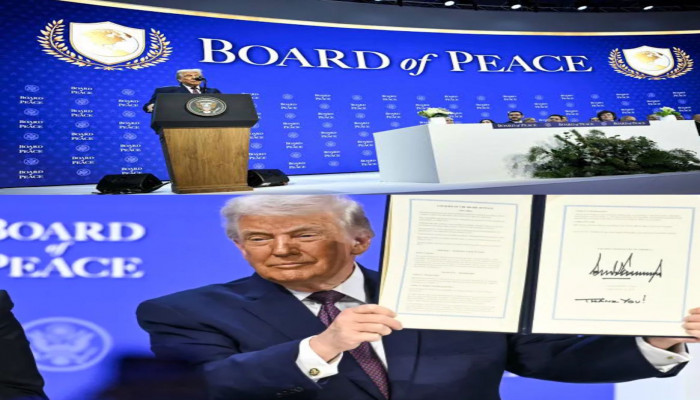
US President Donald Trump formally launched his ambitious “Board of Peace” initiative during a signing ceremony in Davos on Thursday, calling the moment a historic milestone and describing it as “a very exciting day, long in the making.”
Speaking before global leaders and officials, Trump expressed confidence in the board’s mission and its potential impact on global conflicts. “We’re going to have peace in the world,” he said, adding, “And we’re all stars.”
Reflecting on recent global tensions, Trump stated, “Just one year ago, the world was actually on fire, a lot of people didn’t know it.” However, he claimed that the situation has improved, saying that “many good things are happening” and that threats across the world “are really calming down.”
During the ceremony, Trump stood alongside leaders of the board’s founding member countries, including Argentine President Javier Milei and Hungarian Prime Minister Viktor Orbán. He praised his administration’s foreign policy record, claiming it had contributed to “settling eight wars,” and said that “a lot of progress” had been made toward ending Russia’s war in Ukraine.
Trump also acknowledged the presence of several heads of state at the event, thanking them for attending. “We are truly honoured by your presence today,” he said, describing them as “in most cases very popular leaders, in some cases not so popular.” He added humorously, “In this group, I like every single one of them.”
Trump has previously described the Board of Peace as potentially the “most prestigious board ever formed.” The initiative originated from his 20-point Gaza ceasefire plan, which was endorsed by the United Nations Security Council, but has since expanded far beyond its original purpose.
According to officials from the Trump administration, around 35 countries have committed to joining the board, while 60 nations have received invitations. Trump suggested that the board could one day take over functions traditionally carried out by the United Nations or even make the global body obsolete.
“We have a lot of great people that want to join,” Trump said during a meeting with Egyptian President Abdel-Fattah el-Sisi, whose country has confirmed its membership in the initiative.
However, Trump noted that some countries need parliamentary approval before officially joining, while others that were not invited have requested inclusion. He also defended his decision to invite Russia’s President Vladimir Putin, who said he was consulting with “strategic partners” regarding Moscow’s participation.
Trump explained his approach by saying he wanted “everybody” who was powerful and capable of “getting the job done” to be part of the board. This included controversial leaders such as Belarus’ Aliaksandr Lukashenko.
Despite growing interest, several European countries have declined to participate in the Board of Peace. Norway, Sweden, and France rejected the invitations, with French officials expressing concerns that the new body could replace the United Nations as the primary platform for conflict resolution. At the same time, France reiterated its support for the Gaza peace plan.
Slovenian Prime Minister Robert Golob also expressed hesitation, stating that “the time has not yet come to accept the invitation.” He cited concerns that the board’s mandate was too broad and could undermine the international order based on the UN Charter, according to the STA news agency.
Meanwhile, countries such as Canada, Ukraine, and China had not yet clarified their positions on joining the initiative. Israeli Prime Minister Benjamin Netanyahu agreed to participate on Wednesday.
The United Kingdom also declined to sign the treaty during Trump’s ceremony. British Foreign Secretary Yvette Cooper explained that the decision was influenced by concerns over Russia’s invitation, particularly the inclusion of President Putin.
According to a copy of the Board of Peace charter obtained by media outlets, countries seeking permanent membership are required to pay a contribution fee of $1 billion. Trump has been designated as the permanent chairman of the board, even after leaving office.
Non-paying members will receive a three-year mandate, making the board’s structure both exclusive and controversial in the international community.
Trump’s peace initiative comes shortly after his administration issued threats of military action against Iran earlier this month. These threats followed violent government crackdowns on large street protests, which resulted in thousands of deaths.
Trump indicated that no new strikes would take place after receiving assurances from Tehran that detained protesters would not be executed.
He also defended his hardline approach toward Iran, including strikes on nuclear facilities in June, arguing that such actions were necessary to achieve the Israel-Hamas ceasefire. Iran has long been a major supporter of Hamas, providing financial aid, weapons, training, and military assistance over the years.
“If we didn’t do that, there was no chance of making peace,” Trump said.
At the same time, Ukrainian President Volodymyr Zelenskyy arrived in Davos on Thursday morning. Trump expressed frustration with both Zelenskyy and Putin over the prolonged conflict in Ukraine, which has continued for nearly four years.
“I believe they’re at a point now where they can come together and get a deal done,” Trump said. “And if they don’t, they’re stupid — that goes for both of them.”
The launch of the Board of Peace marks a significant development in Trump’s foreign policy vision. While supporters view it as a bold step toward global stability, critics fear it could challenge existing international institutions and norms.
As nations continue to weigh their participation, the future of the initiative remains uncertain. Yet Trump’s message at Davos was clear: he sees the Board of Peace as a transformative force in global diplomacy and a new platform for resolving conflicts across the world.



 Loading...please wait
Comments