




Trump claims US sent guns to Iranian protesters through Kurdish channels
- In Reports
- 01:08 PM, Apr 06, 2026
- Myind Staff
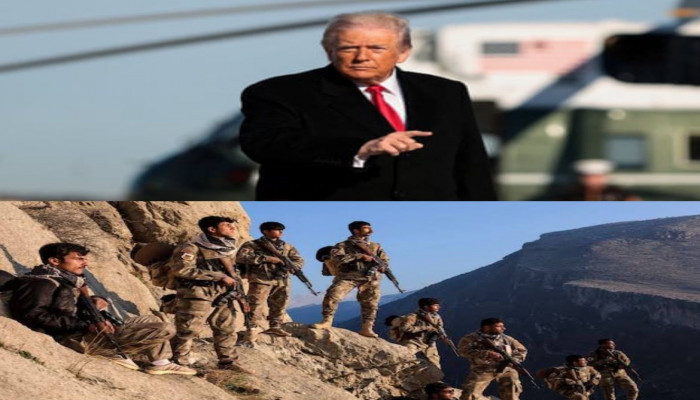
US President Donald Trump has said that the United States supplied weapons to anti-regime protesters in Iran during a period of unrest. His remarks came during an interaction with Fox News correspondent Try Yingst, where he spoke about the route through which the weapons were allegedly sent and raised doubts about whether they reached the intended recipients.
Speaking on the issue, Trump said, "We sent them a lot of guns. We sent them through the Kurds. And I think the Kurds kept them." He further added, "We sent guns to the protesters, a lot of them. And I think the Kurds took the guns." His statements suggest that the weapons may have been diverted and did not reach the protesters as planned. The comments come at a time when the region is already facing heightened conflict linked to tensions involving Iran.
The protests in Iran began on December 28, 2025, following a sharp collapse of the country’s currency. The economic crisis was driven by rising inflation, poor management of essential services, and declining living conditions. The initial protests started with shopkeepers in Tehran’s Grand Bazaar, who went on strike and shut their businesses. Their actions quickly triggered wider participation from the public.
As the protests spread, they turned into large-scale demonstrations across the country. People took to the streets demanding major political change and calling for an end to the Islamic Republic system. The unrest reflected deep dissatisfaction among citizens, who were struggling with economic hardship and governance issues. Over time, the demonstrations grew more intense and widespread.
On January 17, Iran’s Supreme Leader at the time, Ali Khamenei, addressed the situation in a public speech. He stated that "thousands of people" had been killed during the protests. The situation took a dramatic turn when he was later killed on February 28, further escalating uncertainty in the country.
International concern over the violence also increased. On January 16, Mai Sato, the United Nations Special Rapporteur on Iran, shared estimates of the death toll during a media interview. She said that at least 5,000 people had been killed. She also noted that based on information from medical sources, the number could be as high as 20,000. These figures highlighted the scale of the crisis and raised serious human rights concerns.
The Kurdish people, who were mentioned in Trump’s remarks, are an ethnic minority group spread across several countries in the Middle East. They do not have an independent nation of their own. Estimates suggest that the Kurdish population ranges between 25 million and 45 million people worldwide. Most Kurds live in a mountainous region that stretches across western Iran, eastern Turkey, northern Iraq, Syria, and parts of Armenia.
In Iran, Kurds make up nearly 10 percent of the population, although there are no official figures. Their relationship with the Iranian central government has been complex and often tense. The 1979 Islamic Revolution ousted Shah Mohammad Reza Pahlavi and established the Islamic Republic. Kurdish groups initially supported the new leadership. For a brief period, they even controlled some regions.
However, differences soon emerged. The Kurdish population in Iran is mostly Sunni Muslim, while the country’s leadership is dominated by Shia Muslims. This religious difference, along with demands for political autonomy and cultural rights, has led to repeated conflicts. Kurdish groups have long pushed for greater recognition of their language and identity, which has often brought them into confrontation with authorities in Tehran.
There have been several periods of armed resistance, especially during the 1980s and 1990s. These uprisings were met with strong military responses from the Iranian state. As a result, many Kurdish fighters and leaders were forced to leave Iran and moved to bases in northern Iraq. Despite this, large Kurdish communities have continued to live within Iran.
In 2004, a group called the Kurdistan Free Life Party, also known as PJAK, was formed. It launched an armed struggle against the Iranian government. Since then, the group has carried out attacks and ambushes on Iranian security forces, mainly from positions along the Iran-Iraq border. These activities have kept tensions alive in Kurdish-majority regions.
Trump’s claims about sending weapons through Kurdish channels add another layer to the already complicated situation.



 Loading...please wait
Comments