




Trump announces naval blockade of Strait of Hormuz
- In Reports
- 01:10 PM, Apr 13, 2026
- Myind Staff
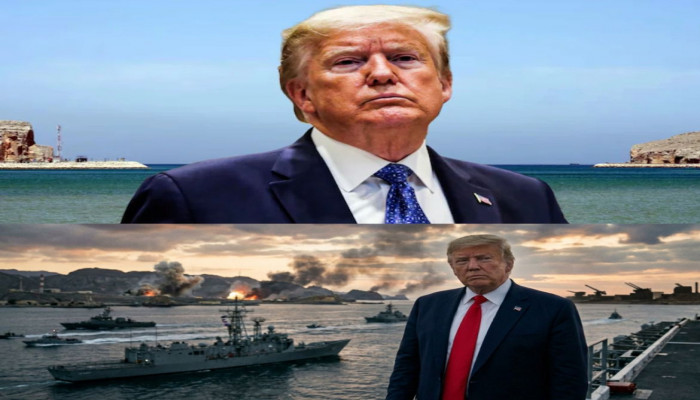
The idea that one country can dominate the global economic pressure tools is becoming less convincing. In today’s interconnected world, dependence works both ways. This reality is becoming clear for Donald Trump, whose recent actions suggest that the United States is struggling to maintain its earlier economic dominance. The global system is now more competitive and uncertain, where every strategic move carries risks.
Over the past year, the US has faced setbacks in its economic strategies. First, China responded to trade tensions by using its control over rare earth minerals. Then, Iran demonstrated its influence by disrupting activity in the Strait of Hormuz, a critical global oil route. These developments showed that other nations can counter US pressure effectively.
Now, following failed ceasefire talks with Iran in Pakistan, Trump has proposed another strong step. In a post on Truth Social, he announced plans to block ships passing through the Strait of Hormuz. He said the move targets vessels paying what he called “illegal tolls.” Soon after, the US military confirmed it would begin blocking ships connected to Iranian ports through the strait.
This action is believed to be aimed partly at limiting the use of the Chinese yuan in the oil trade. Such transactions challenge the long-standing petrodollar system and allow countries to bypass US sanctions. By taking this step, Washington is once again confronting both China and Iran, two nations that have shown they can resist US economic pressure.
Trump’s approach appears inconsistent. During his first term, he imposed strict sanctions on Iranian oil. In his second term, he lifted those sanctions to release about 140 million barrels of oil into global markets to stabilise prices. Now, he is again tightening control by attempting a naval blockade, even as a temporary waiver on Iranian oil is about to expire.
This contradiction reflects a larger shift. The US no longer has full control over key economic tools like currency systems, technology, and raw materials. Events like the COVID-19 pandemic, the Ukraine war, and worsening US-China relations have weakened trust in global trade systems. As a result, countries including the US, India, China, and those in Europe are focusing more on domestic production to reduce dependence on others.
Speaking to The Washington Post, Edward Fishman explained that the global economy was designed in a more cooperative time. Today, rising geopolitical tensions are reshaping it into something more competitive. His observation highlights how economic warfare is becoming more complex.
Using trade dependence as a weapon is not new. The 1973 Arab oil embargo is a clear example. However, global trade now makes up a much larger share of the world economy. This gives countries more opportunities to use economic links as strategic tools.
Trump has often criticised globalisation and claimed the US is largely self-reliant. In reality, the country still depends on imports from partners like Canada. It is also vulnerable to global oil price changes, especially those linked to chokepoints like the Strait of Hormuz.
US officials have recognised these risks. Secretary of State Marco Rubio has raised concerns about dependence on China. He stressed the importance of diversifying supply chains. After China restricted rare earth exports, US carmakers had to stop production due to shortages. This forced the government to invest in domestic mining and alternative sources, including deals with Pakistan.
Despite these efforts, the US was unprepared for sudden disruptions. When China restricted rare earth exports and tensions rose in the Strait of Hormuz, oil prices surged past $140 per barrel. The impact spread quickly across industries.
Senator Ron Wyden pointed out that the Treasury Department had not properly studied the energy market risks before the Iran conflict. Sriprakash Kothari, nominated for a senior Treasury role, admitted he was unaware of any such analysis.
Experts believe the US must adjust its approach. Henry Farrell said, “It turns out that the United States does not have all the choke points. We are in a world where the US simply cannot get away with the stuff that it thought it could.” His statement reflects a major shift in global power dynamics.
Trump has downplayed Iran’s control over the strait, calling it a temporary issue. However, disruptions have already left thousands of ships stranded. Iran has managed traffic selectively, which has proven effective. Sanctions expert Nicholas Mulder noted that Iran’s strength lies in controlling the flow rather than fully blocking it.
The economic impact has been significant. Rising fuel costs have increased prices for goods like fertilisers, plastics, and food. Mohammed Abbas of Fresh Del Monte said fuel costs have raised operational expenses by about 30 per cent. Damage to facilities in Saudi Arabia may delay production for up to a year, adding further strain.
Higher diesel prices have also increased transport costs, especially in regions like Central America. Fertiliser supplies have been delayed, with reserves expected to last only until June. After that, prices may rise sharply due to global competition.
Abbas warned that continued disruptions could lead to inflation, food shortages in developing countries, and a deeper global slowdown. In response, many countries are exploring alternatives. South Korea is investing in renewable energy, while Gulf nations are planning pipelines to bypass the Strait of Hormuz.
The situation highlights a clear message. Economic power is no longer concentrated in one country. Global interdependence means that every action has consequences. For the US, this marks the end of uncontested dominance and the beginning of a more complex and uncertain global order.



 Loading...please wait
Comments