




Trump administration revokes key climate regulations, ends vehicle emission standards
- In Reports
- 01:01 PM, Feb 13, 2026
- Myind Staff
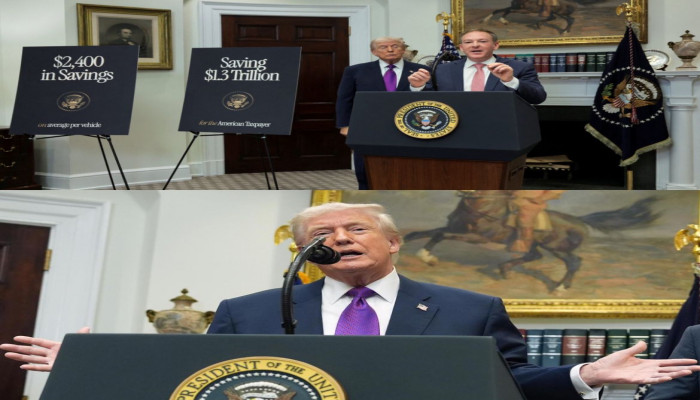
On Thursday, Trump administration announced a major rollback of U.S. climate regulation by repealing the scientific finding that greenhouse gas emissions endanger human health. Along with this, the government also eliminated federal tailpipe emissions standards for cars and trucks.
This move is being described as the most sweeping climate policy reversal under Trump so far, following a series of regulatory cuts and actions aimed at supporting fossil fuel development and slowing down the expansion of clean energy.
Speaking at the announcement, Trump said, "Under the process just completed by the EPA, we are officially terminating the so-called endangerment finding, a disastrous Obama-era policy that severely damaged the American auto industry and drove up prices for American consumers." He added that it was the biggest deregulatory action in U.S. history.
The Environmental Protection Agency (EPA), in a press release, said that the endangerment finding was based on what it called an incorrect interpretation of federal clean air laws. According to the EPA, these laws were meant to protect Americans from pollutants that cause harm through local or regional exposure, not through warming the global climate.
The agency stated, "This flawed legal theory took the agency outside the scope of its statutory authority in multiple respects."
Trump made the announcement alongside EPA Administrator Lee Zeldin and White House budget director Russ Vought. Vought has long pushed for the removal of the finding and was also described as a key architect of the conservative policy blueprint Project 2025.
Trump has repeatedly said he believes climate change is a "con job" and has withdrawn the United States from the Paris Agreement. This withdrawal leaves the world’s largest historic contributor to global warming outside international climate efforts. Trump has also signed legislation ending Biden-era tax credits meant to speed up the growth of electric vehicles and renewable energy.
Former President Barack Obama criticised the decision in a post on X. Obama said that without the endangerment finding, "we’ll be less safe, less healthy and less able to fight climate change — all so the fossil fuel industry can make even more money."
EPA Administrator Lee Zeldin described the decision as a major strike against federal climate regulation. He said the administration was challenging what he called the most significant climate policy of the past 15 years, something the agency avoided during Trump’s first term because industries were concerned about uncertainty.
Zeldin said, "Referred to by some as the holy grail of federal regulatory overreach, the 2009 Obama EPA endangerment finding is now eliminated."
The endangerment finding was adopted in 2009. It led the EPA to act under the Clean Air Act of 1963 to limit emissions of carbon dioxide, methane, and four other heat-trapping air pollutants from vehicles, power plants, and other industries.
This finding was introduced after the Supreme Court ruled in 2007, in the Massachusetts vs. EPA case, that the agency has the authority to regulate carbon dioxide and other greenhouse gas emissions under the Clean Air Act.
Repealing the finding would remove regulatory requirements to measure, report, certify, and comply with federal greenhouse gas emissions standards for cars. However, the change may not immediately apply to stationary sources such as power plants.
According to EPA figures, both the transportation sector and the power sector each contribute about a quarter of U.S. greenhouse gas output.
The EPA claimed the repeal and the ending of vehicle emission standards would save U.S. taxpayers $1.3 trillion. However, the previous administration had argued that the rules would actually benefit consumers through lower fuel costs and other long-term savings.
The Alliance for Automotive Innovation, which represents major automakers, did not openly support the repeal. However, it stated that "automotive emissions regulations finalised in the previous administration are extremely challenging for automakers to achieve given the current marketplace demand for EVs."
The Environmental Defence Fund criticised the rollback, saying it would cost Americans more in the long run. EDF President Fred Krupp said, "Administrator Lee Zeldin has directed EPA to stop protecting the American people from the pollution that's causing worse storms, floods, and skyrocketing insurance costs." He added, "This action will only lead to more of this pollution, and that will lead to higher costs and real harms for American families."
Under former President Joe Biden, the EPA aimed to cut passenger vehicle fleetwide tailpipe emissions by nearly 50% by 2032 compared with projected 2027 levels. The agency had also forecast that between 35% and 56% of new vehicles sold between 2030 and 2032 would need to be electric.
At that time, the EPA estimated the rules would provide net benefits of $99 billion annually through 2055. This included $46 billion in reduced fuel costs and $16 billion in reduced maintenance and repair costs. Consumers were expected to save around $6,000 over the lifetime of new vehicles due to lower fuel and maintenance expenses.
The coal industry welcomed Thursday’s announcement, saying it could help prevent the shutdown of older coal-fired power plants. America’s Power President and CEO Michelle Bloodworth said, “Utilities have announced plans to retire more than 55,000 megawatts of coal-fired generation over the next five years. Reversing these retirement decisions could help offset the need to build new, more expensive electricity sources and prevent the loss of reliability attributes, such as fuel security, that the coal fleet provides.”
Although many industry groups support the repeal of strict vehicle emissions standards, some have been cautious about supporting the removal of the endangerment finding because it could create major legal uncertainty.
Legal experts said the reversal could trigger more lawsuits, including “public nuisance” cases. Such cases had been blocked after a 2011 Supreme Court ruling which said greenhouse gas regulation should be handled by the EPA instead of the courts.
University of Maryland environmental law professor Robert Percival said, "This may be another classic case where overreach by the Trump administration comes back to bite it."
Environmental groups strongly criticised the repeal and warned it could harm climate policy efforts. They said any future administration trying to regulate greenhouse gases may have to reinstate the endangerment finding, which could become politically and legally difficult.
Still, environmental groups said they believe courts will continue supporting the EPA’s authority to regulate greenhouse gases under the Clean Air Act.
Groups such as the Natural Resources Defence Council and Earthjustice have already said they will challenge the reversal in court. This could start a legal fight that may last for years and possibly reach the Supreme Court.
NRDC senior attorney David Doniger said, "There'll be a lawsuit brought almost immediately, and we'll see in them in court. And we will win."



 Loading...please wait
Comments