




Trump administration not seen extending USMCA as 10-year countdown begins
- In Reports
- 01:35 PM, Jul 01, 2026
- Myind Staff
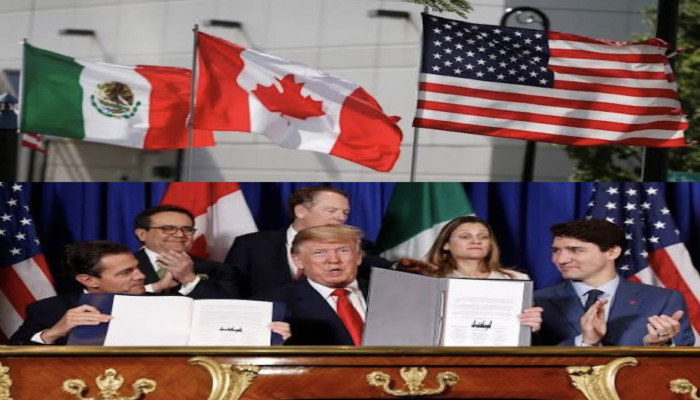
The administration of U.S. President Donald Trump is expected to formally announce on Wednesday that it will not extend the U.S.-Mexico-Canada Agreement (USMCA). This decision will begin a 10-year countdown that could eventually end North America's 32-year-old free trade framework if the three countries fail to agree on changes to the agreement.
The announcement will also trigger the six-year review process required under the agreement's "sunset clause." Trump's first administration introduced this clause during the USMCA negotiations. The review will not immediately change the ongoing discussions between the three countries. However, it will officially start negotiations on major revisions. The United States wants stronger rules to increase U.S. and regional content in North American vehicle production. It also wants trade protections that prevent Chinese goods from benefiting under USMCA rules.
Trade representatives from the United States, Mexico, and Canada are expected to hold a virtual meeting on Wednesday. During the meeting, they will state whether they want to extend the agreement for another 16 years.
A spokesperson for U.S. Trade Representative Jamieson Greer said he has not made any formal announcement about his plans for USMCA. At the same time, Greer has already scheduled a third round of trade talks with Mexico during the week of July 20. This move shows that the United States plans to continue negotiations over possible changes to the agreement.
Greta Peisch, a former USTR general counsel who now serves as a trade partner at Wiley Rein in Washington, said, "We expect July 1st to come and go, and for the United States to not confirm its wish to extend."
Peisch also said it remains uncertain "whether the U.S. says exactly what it's looking for in a public way" in a statement expected after the meeting.
Mexico's Economy Minister Marcelo Ebrard said on Tuesday that he does not expect the three-country trade agreement to end. Mexican President Claudia Sheinbaum also said she had signed a letter calling for the USMCA to receive a 16-year extension.
Canadian Prime Minister Mark Carney said he expects a "constructive exchange" among the three countries, although he does not expect any agreements to be signed immediately.
"The priority is to get a new deal," Carney said. "We're ready to negotiate an improvement of this agreement."
Trump has already weakened the duty-free benefits offered under USMCA. He imposed tariffs of 25% on Canadian and Mexican automobiles and auto parts. He also placed 50% tariffs on steel and aluminium imports from both countries. Canada responded with retaliatory measures.
Canada has not yet joined formal negotiations with the United States. However, Carney said technical discussions on aluminium, steel, automobiles, and softwood lumber have already produced some improvements.
"So we're ready to continue those discussions but that will take time, which we've known for a while," Carney added.
If the three countries fail to agree on changes to the agreement, USMCA will remain under annual review for the next 10 years. The agreement would then expire on July 1, 2036, if no extension takes place.
The review process under the sunset clause is separate from another provision that allows any of the three countries to leave the agreement. If President Trump or the leaders of Mexico or Canada choose to use that clause, their country can withdraw from the pact after six months.
Trump's first administration negotiated USMCA to replace the North American Free Trade Agreement (NAFTA), which came into effect in 1994. When USMCA launched in 2020, Trump described it as "the fairest, most balanced and beneficial trade agreement we have ever signed into law."
Later, Trump changed his position after the U.S. goods trade deficit with Mexico continued to grow. Many companies had shifted their supply chains away from China following the tariffs the United States imposed on Chinese imports. Trump has repeatedly said that he does not want to renew USMCA. Instead, he prefers the tariff system already placed on automobiles, steel, and aluminium imported from Mexico and Canada.
At present, the United States is holding formal negotiations only with Mexico. Canada remains outside these talks as both countries continue to face several trade disputes. These issues include Canada's protected dairy market and decisions by some Canadian provinces to remove American liquor from store shelves.
Although Greer has not scheduled formal negotiations with Canada, he has continued regular discussions with Canadian Trade Minister Dominic LeBlanc.
North American automobile manufacturers have urged the Trump administration to preserve USMCA as a three-country agreement. They argue that vehicle parts often cross the U.S., Canadian, and Mexican borders several times before companies complete final vehicle assembly.
Matt Blunt, president of the American Automotive Policy Council, which represents Ford, General Motors, and Stellantis, called for a quick and lasting agreement that gives companies greater investment certainty and fair competition.
"North American economic integration enables enormous competitive benefits for the region, and American Automakers are encouraged by ongoing negotiations with the U.S., Mexico and Canada," Blunt said in a statement. "U.S. automakers currently face a disadvantage versus imports from countries whose exports face a flat 15 per cent tariff and are not subject to comparable rules of origin."
During negotiations with Mexico, the United States has proposed that all vehicles built in North America should contain at least 50% U.S.-specific content. According to sources familiar with the talks, this proposal would raise the total regional content requirement to 82% for vehicles to qualify for U.S. trade benefits. Greer has also said that vehicles assembled in Mexico and Canada would still likely face some level of tariffs.
A Mexican official said that both countries have discussed introducing a universal global tariff of 15% on automobiles. The official added that vehicles made in Mexico and Canada could receive a lower tariff if both countries agree to stricter rules of origin.
The same official said that Mexico and the United States largely agree on the main challenges facing USMCA. These include the steady decline in U.S. manufacturing jobs, lower U.S. content in vehicles as more Asian-made parts enter supply chains, and growing concerns about transhipment.
"Mexico and the U.S. are in agreement about the goals. What we are discussing is how to reach them," the official added.



 Loading...please wait
Comments