




Top Indonesian financial regulators resign following $80 billion stock market rout
- In Reports
- 07:44 PM, Feb 01, 2026
- Myind Staff
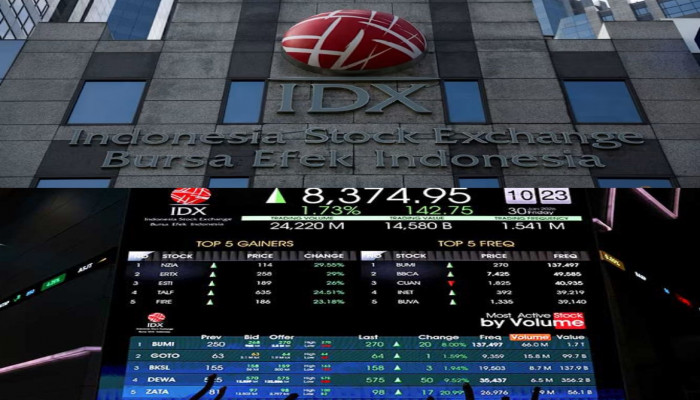
Indonesia’s financial markets were shaken this week after the heads of the country’s main financial regulator and stock exchange resigned following a massive $80 billion stock market sell-off. The sudden exits came amid growing concerns over transparency, governance, and the risk of Indonesia’s stock market losing its emerging-market status.
On Friday, Indonesia’s Financial Services Authority, known as OJK, announced that its chief Mahendra Siregar, had stepped down along with three senior officials. These included Deputy Chief Mirza Adityaswara, Inarno Djajadi—who oversaw capital markets, financial derivatives, and carbon-exchange supervision—and Deputy Commissioner I.B. Aditya Jayaantara, who was responsible for issuer oversight, transaction supervision, and special investigations. On the same day, Indonesia Stock Exchange (IDX) chief Iman Rachman also resigned.
The resignations followed a sharp two-day fall in Jakarta stocks earlier in the week, triggered partly by a warning from MSCI, a global index provider. MSCI said it may downgrade Indonesian equities to “frontier” market status, a move that could reduce foreign investment. The warning led to the steepest two-day decline in the Jakarta Composite Index since April, wiping out around $80 billion in market value and increasing pressure on authorities to restore investor confidence.
Just hours before their resignations, senior OJK officials had told reporters that they would lead efforts to address MSCI’s concerns. They urged investors not to panic and said talks with MSCI were ongoing. OJK later said that the departures would not affect the regulator’s operations.
Indonesia’s chief economic minister, Airlangga Hartarto, sought to reassure markets by promising major reforms. He said authorities were committed to strengthening the stock market and insisted that the country’s economic fundamentals remained strong. Proposed measures include doubling the minimum free-float requirement for listed companies to 15%, allowing pension and insurance funds to increase their capital market investments to 20% of their portfolios from the current 8%, and closely checking affiliations of shareholders with ownership below 5%.
“The government guarantees protection for all investors by maintaining good governance and transparency,” Airlangga said.
Earlier in the day, Inarno Djajadi had also commented on the situation, saying that Iman Rachman’s resignation from the IDX would not disrupt exchange operations. He added that OJK aimed to resolve MSCI’s concerns by May. “We remind all investors to remain calm and rational when making investment decisions,” Inarno said. However, hours later, after markets closed on Friday, he resigned along with OJK chief Siregar.
Market reaction showed some signs of stabilisation after authorities announced the proposed reforms. The benchmark Jakarta Composite Index (.JKSE) had dropped more than 8% over Wednesday and Thursday but managed to close 1.18% higher on Friday. The rupiah, however, remained under pressure and was last trading at 16,790 per U.S. dollar, close to its weakest-ever level of 16,985 recorded last week.
Market participants said the resignations were seen as a move to take responsibility for the loss of confidence. “Someone had to take responsibility for the loss of confidence,” said Mohit Mirpuri, portfolio manager at SGMC Capital in Singapore, referring to Iman Rachman. He added, “The bigger picture is a reset and an opportunity for the exchange to emerge stronger with clearer standards and governance.”
Beyond governance concerns, foreign investors have also been pulling money out due to worries about President Prabowo Subianto’s economic policies. These include concerns over a widening fiscal deficit and greater state involvement in financial markets. Investor confidence has also been affected by the recent appointment of Prabowo’s nephew, Thomas Djiwandono, to the central bank, as well as the dismissal last year of former finance minister Sri Mulyani Indrawati, who was widely respected by markets.
Regulators said communication with MSCI had been positive so far and that they were waiting for feedback on the proposed reforms. MSCI has given Indonesia until May to show progress, after which it will reassess the country’s status. This review could result in a lower weighting for Indonesia in MSCI’s emerging market index or, in a worst-case scenario, a downgrade to frontier market status.
“Policymakers want to fix this,” said Paul Dmitriev, senior analyst and co-portfolio manager at Global X ETFs. “The government has every incentive to fix these issues as systemic outflows would be substantial and could materially impact the market.”
Exchange data showed that foreign investors sold a net $645 million worth of shares during the two-day sell-off. Overall, foreign investors have sold about $1 billion worth of Indonesian shares so far in 2025.



 Loading...please wait
Comments