

To Lam reappointed as Vietnam’s top leader for a five-year term
- In Reports
- 06:00 PM, Jan 23, 2026
- Myind Staff
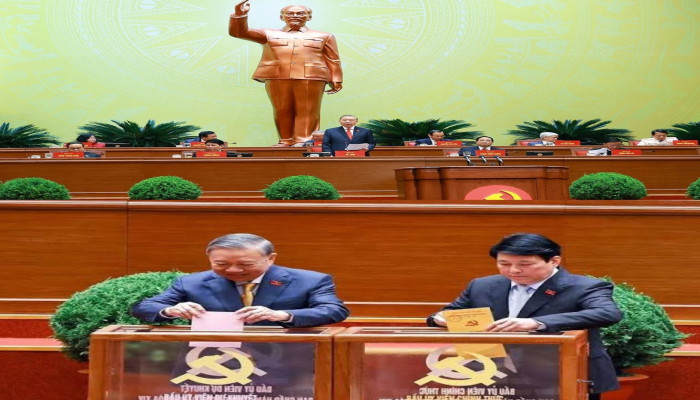
Vietnam’s top leader To Lam was reappointed on Friday as head of the ruling Communist Party for the next five years after a unanimous vote by its central committee. Following his re-election, he pledged to accelerate economic growth in the export-driven nation and strengthen the political system based on performance and integrity.
In Vietnam’s one-party political system, Lam was re-elected to the most powerful position in the country by all 180 party officials from a newly formed central committee. This decision came at the end of the party congress, which is held every five years to set major goals and decide leadership positions.
Before the vote, Lam promised ambitious economic targets, including two-digit growth. After his re-election, he told the congress that he wanted a system built on “integrity, talent, courage, and competence,” where performance would be measured by real and visible results.
The Communist Party also adopted a resolution at the end of the congress that aims for at least 10% annual economic growth throughout the decade. The party also announced the appointment of 19 members of the Politburo, its top decision-making body.
Lam leads the list of Politburo members published on the government website. He is followed by the current head of parliament, Tran Thanh Man, party leader Tran Cam Tu, and former central bank governor Le Minh Hung, who is seen as a possible candidate for prime minister. Lower on the list is Defence Minister Phan Van Giang, who is widely viewed as the second-most powerful person in the country. Meanwhile, incumbent Prime Minister Pham Minh Chinh and President Luong Cuong are not included on the list.
During his earlier period as party chief since mid-2024, Lam led a phase of fast economic growth supported by sweeping reforms. These reforms helped him gain strong support but also attracted criticism. Tens of thousands of civil servants lost their jobs as he pushed for faster decision-making and reduced bureaucracy.
Aware of the dissatisfaction caused by these reforms, Lam worked early to secure support from rival groups within the party, including the influential military. Officials familiar with the process said he carefully built alliances to strengthen his political position.
Concerns also emerged over Lam’s plans to strengthen private conglomerates, which some feared could weaken state-owned enterprises. In response, Lam issued a directive before the party congress emphasising the “leading role” of state enterprises. These enterprises include the army-controlled telecom and defence giant Viettel.
Le Hong Hiep, a senior fellow at the ISEAS Yusof Ishak Institute, said Lam is known for careful planning and strategic moves. He noted that Lam, who previously served as state security minister, had skillfully navigated his way to the top of Vietnam’s political system in 2024, when his predecessor Nguyen Phu Trong was facing long-term health issues.
In his speech after being re-elected, Lam said he would maintain unity within the party. He is also seeking to become Vietnam’s president, and a decision on this is expected to be announced later.
Lam’s re-election as party chief has been seen as a positive signal for foreign investors. Hiep said the decision sends a reassuring message because political stability is highly valued by investors.
However, Hiep also warned that Lam’s attempt to combine the two top roles in the country could bring challenges. He said that such a system, similar to the model under China’s leader Xi Jinping, “could pose risks to Vietnam’s political system,” which has traditionally relied on collective leadership and internal checks and balances.
Soon after Lam’s election, Xi Jinping sent a congratulatory message, describing China and Vietnam as a “community with a shared future.”
Earlier in the week, Lam addressed delegates at the congress in a red-carpeted conference hall beneath a large statue of party founder Ho Chi Minh. He promised that Vietnam would achieve annual economic growth above 10% throughout the decade, even before the party officially approved the resolution.
This target is far higher than the World Bank’s forecast, which predicts average annual growth of around 6.5% for this year and next year.
Lam aims to achieve this ambitious goal by transforming Vietnam’s economic model. For decades, the country’s growth has depended largely on cheap labour and exports. Lam now wants Vietnam to become a high-middle-income economy by 2030 through greater innovation and improved efficiency.
His vision reflects a broader effort to modernise Vietnam’s economy while maintaining political stability and party unity. As he begins his new term, Lam faces the challenge of balancing rapid economic reforms with social stability, party cohesion, and the traditional role of state enterprises.
With his renewed mandate and ambitious plans, Lam’s leadership is expected to shape Vietnam’s political and economic direction over the next five years.



 Loading...please wait
Comments