




Thousands rally in Washington to defend voting rights as civil liberties face new threats
- In Reports
- 02:42 PM, Aug 29, 2026
- Myind Staff
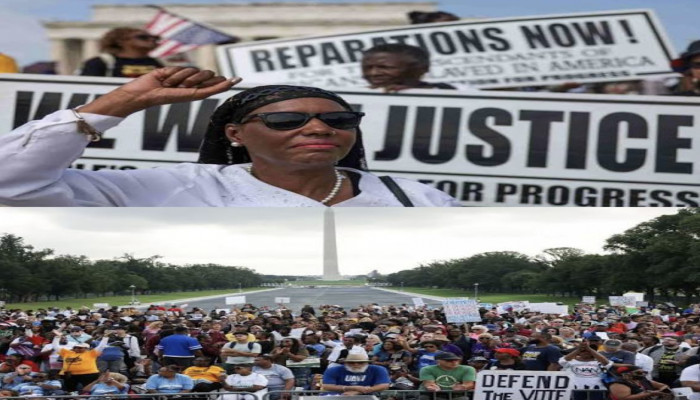
Thousands of people gathered in Washington on Friday to defend voting rights and civil liberties. The march came more than six decades after Martin Luther King Jr. delivered his famous “I Have a Dream” speech from the steps of the Lincoln Memorial. Civil rights leaders returned to the same site to warn that many of the freedoms King fought for remain under threat.
The event, called “March on Washington 2026: Defend the Vote,” brought several thousand people to the National Mall. Union members, students, members of Black Greek-letter organisations and people of different ages joined the demonstration. Many travelled from different parts of the United States to take part in the march.
Civil rights leaders said the fight for equality remains unfinished. They repeated many of the demands that King raised more than 60 years ago. Organisers said the march sought to highlight growing concerns over voting rights and other civil liberties.
The march followed a Supreme Court decision this year that weakened a key provision of the Voting Rights Act. The ruling triggered several redistricting battles across the southern United States. Republican-led state governments moved quickly to redraw congressional maps. In some states, officials began the process within days. The changes are aimed at shaping congressional districts ahead of the midterm elections in November.
Marc Morial, president and CEO of the civil rights organisation National Urban League, said the movement faces strong opposition but must continue bringing people together.
“We know in this fight we're fighting powerful forces, but this is why we rally today,” said Marc Morial, president and CEO of the civil rights organisation National Urban League. “This is why we seek to bring Americans together of goodwill from all races, from all sections of the country to push back as forcefully as we can.”
Al Sharpton’s National Action Network and Martin Luther King III and Arndrea Waters King’s Drum Major Institute organised the event. More than 90 community organisations also supported the march. The groups included the National Association for the Advancement of Colored People (NAACP) and the National Urban League.
King III said the demonstration was not only about remembering his father’s historic speech. He said the current political climate required people to take action to protect democracy and voting rights.
“Defending the vote means defending the foundation of our democracy,” said King III in a statement. “Sixty-three years after my father stood at the Lincoln Memorial, we are called to march again, not only in remembrance, but in action.”
Organisers said the march aimed to “confront the systemic rollback of civil rights at this critical moment.” They pointed to President Donald Trump’s efforts to restrict mail-in voting and reduce anti-discrimination protections across the federal government. They also raised concerns over changes to the broader understanding and scope of civil rights.
Sharpton also warned supporters that voting rights remain central to protecting other freedoms. He said weakening the right to vote could put other rights at risk.
“We stand on the same ground because the work is not finished,” Sharpton wrote in a letter to supporters. “The right to vote, the very foundation of our power, is being chipped away in statehouse after statehouse. When the vote is weakened, every other right grows fragile with it.”
The programme began at 9 a.m. ET and featured several prominent political figures. Speakers included independent U.S. Senator Bernie Sanders of Vermont, Democratic Representative Alexandria Ocasio-Cortez of New York and House Minority Leader Hakeem Jeffries.
Jeffries used his remarks to highlight economic and political challenges facing Black Americans. He pointed to rising Black unemployment, falling Black homeownership and concerns over political representation across the South.
“Black unemployment is up, Black homeownership is down and Black political representation is under assault with Jim Crow-like tactics all throughout the South — challenging times,” Jeffries said, referring to the system of state and local laws that enforced racial segregation in the American South until the 1960s.
The gathering reflected renewed concerns among civil rights groups over voting access, political representation and federal protections. Organisers said the march was a continuation of the movement that began decades ago. They urged Americans to remain active in defending voting rights and equality.



 Loading...please wait
Comments