




The Unresolved Question of Indian Citizenship
- In Reports
- 05:54 PM, Jul 03, 2026
- Bidhayak Das Purkayastha
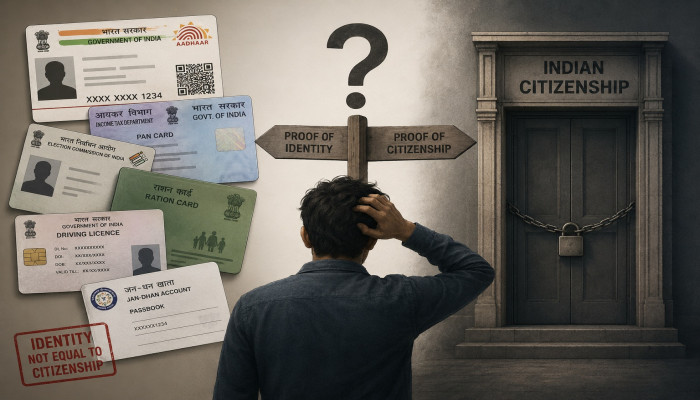
Who is a citizen of India? The question appears deceptively simple. Yet beneath it lies one of the most fundamental constitutional issues confronting the Republic today. Is citizenship established by birth, by possession of official documents, by recognition from the State, or by a legal status that exists independently of any single document? These questions have acquired renewed significance following the recent controversy surrounding Indian passports, which has once again exposed the gap between popular perception and the legal framework governing citizenship.
For most Indians, the answer seems obvious. A person holding an Indian passport, voting in elections, paying taxes, or possessing an Aadhaar card is naturally regarded as an Indian citizen. These documents have become symbols of belonging and participation in the life of the nation. Yet the law presents a more complex picture. Courts, government authorities, and statutory provisions have repeatedly clarified that while such documents may constitute important evidence, none of them, by itself, is recognised as the sole and conclusive proof of Indian citizenship.
This distinction is far more than a technical legal nuance. It raises a larger constitutional question about the relationship between the individual and the State. In every modern democracy, citizenship is the legal foundation upon which political rights, constitutional protections, and civic responsibilities rest. It determines who belongs to the political community and who enjoys the full protection of the Constitution. If uncertainty persists regarding the legal proof of citizenship, the uncertainty extends to the very relationship between the citizen and the Republic.
The framers of the Constitution were acutely aware of the complexity of this issue. When India became independent in 1947, citizenship was not merely a legal concept; it was inseparable from the upheaval of Partition. Millions crossed newly drawn borders amid unprecedented violence and displacement. Families were divided, homes abandoned, and identities questioned. Determining who belonged to the newly independent Indian State became one of the most difficult constitutional challenges of the time.
It was against this extraordinary historical background that the Constitution addressed the question of citizenship. Articles 5 to 11 laid down the principles governing citizenship at the commencement of the Constitution. These provisions, however, were never intended to function as a permanent citizenship code. Rather, they provided a transitional framework designed to address the immediate consequences of Partition while leaving Parliament free to enact a comprehensive and enduring law for the future.
Parliament exercised that authority by enacting the Citizenship Act, 1955. The Act established the principal modes through which Indian citizenship may be acquired: by birth, descent, registration, naturalisation, and incorporation of territory. Over the decades, the legislation has been amended several times in response to changing demographic, political, and security concerns, but its central purpose has remained unchanged—to define who is, and who may become, a citizen of India.
Yet the statutory framework contains an intriguing paradox.
Individuals who acquire citizenship through registration or naturalisation ordinarily receive formal Certificates of Citizenship issued by the competent authority. Their legal status is documented through an official instrument expressly certifying their citizenship. In contrast, the overwhelming majority of Indians—those who are citizens by birth—receive no comparable certificate. Their citizenship exists as a matter of law, but there is no universally issued document that expressly certifies that legal status.
This distinction often goes unnoticed because, in everyday life, Indians rely upon a variety of government-issued documents to establish their identity. Birth certificates, passports, voter identity cards, Aadhaar numbers, Permanent Account Numbers (PAN), ration cards, and driving licences collectively create a comprehensive administrative record of an individual's existence. Together, they facilitate access to education, healthcare, banking, taxation, travel, elections, and countless other interactions with the State.
However, identity and citizenship are not synonymous. A document may establish who a person is without conclusively determining what his or her legal relationship with the State actually is. This distinction, although fundamental in constitutional law, is frequently overlooked in public discourse.
The consequence is a peculiar constitutional paradox. India possesses one of the world's most sophisticated systems of identity verification. Through biometric authentication, digital databases, tax records, electoral rolls, and numerous administrative registries, the State has an unprecedented capacity to identify individuals with remarkable precision. Yet despite this extensive administrative architecture, there remains no single, universally recognised document that conclusively establishes citizenship for the vast majority of Indians.
The recent passport controversy has therefore done more than provoke a debate about one particular document. It has reopened a much deeper constitutional conversation about legal certainty, the nature of citizenship, and the obligations of a democratic State towards those who claim membership within it. Ultimately, the issue is not whether a passport, an Aadhaar card, or any other document should be regarded as sufficient proof of citizenship. The more fundamental question is whether a modern constitutional democracy can continue to leave its citizens uncertain about the legal instrument through which their citizenship is finally and unequivocally recognised.
The persistence of this uncertainty is particularly striking because contemporary India is one of the most extensively documented societies in the world. An ordinary citizen may possess a birth certificate, an Aadhaar number, a Permanent Account Number (PAN), an Electoral Photo Identity Card (EPIC), a passport, a ration card and a driving licence. The State can authenticate biometric data, maintain tax records, identify electoral participation and verify financial transactions with remarkable efficiency. From an administrative standpoint, few governments possess such an elaborate infrastructure for identifying individuals.
Yet this abundance of documentation has not translated into legal certainty regarding citizenship.
The reason lies in a distinction that is often overlooked in public discourse: identity and citizenship are related, but they are not identical. Administrative documents are issued for specific statutory purposes. They establish identity, facilitate access to public services, regulate taxation, enable voting or permit international travel. None of these objectives, however, is synonymous with certifying citizenship as a matter of law.
The Aadhaar framework illustrates this distinction most clearly. Aadhaar serves as a biometric identity system designed to improve the delivery of public services and welfare benefits. It authenticates identity, not nationality. Possession of an Aadhaar number neither confers citizenship nor constitutes legal proof of it.
The same principle applies to the PAN, which exists primarily for tax administration under the Income-tax Act. It establishes an individual's fiscal identity, enabling the State to regulate taxation and financial transactions. It was never intended to determine the political membership of the Republic.
Nor does the Electoral Photo Identity Card conclusively settle the issue. While enrolment in the electoral roll ordinarily presupposes citizenship, the card itself is evidence of registration as an elector rather than a statutory certificate of citizenship. Electoral rolls are administrative records maintained for the conduct of elections. Their existence cannot substitute for an independent legal determination of citizenship whenever that status becomes disputed.
Perhaps the greatest public misunderstanding concerns the Indian passport.
For generations, possession of an Indian passport has been regarded as the ultimate confirmation of Indian citizenship. The assumption appears intuitive. After all, passports are issued exclusively by sovereign states, carry the national emblem, and identify their holders before foreign governments. To the ordinary citizen, no official document appears more authoritative.
Legally, however, the position is more nuanced.
The Passports Act, 1967 was enacted to regulate the issuance of passports and other travel documents. Its principal purpose is to facilitate and regulate international travel rather than to determine citizenship. Before issuing a passport, the competent authority necessarily examines documents relating to an applicant's citizenship and identity. That verification process is an essential administrative safeguard. Nevertheless, neither the Act nor the Passport Rules declare that the passport itself constitutes the sole and conclusive proof of Indian citizenship.
This distinction has occasionally generated public controversy whenever courts or government authorities have reiterated the established legal position. Such observations are sometimes misunderstood as representing a change in policy. In reality, they merely restate what has always been implicit in the statutory framework. The legal status of the passport has remained consistent: it is a highly significant governmental document and powerful evidence supporting a claim of citizenship, but it is not elevated by law to the status of irrefutable proof in every conceivable circumstance.
The same legal principle is reflected in the broader framework of the Citizenship Act, 1955. The Act specifies the modes through which citizenship may be acquired, retained or terminated. Yet it does not require the issuance of a formal certificate to every citizen by birth. Consequently, the legal determination of citizenship may depend upon a cumulative assessment of relevant evidence, including birth records, family lineage, historical residence, official registers and other documentary material, depending upon the facts of a particular case.
Indian courts have consistently treated citizenship as a question of legal status to be determined on the basis of applicable law and evidence rather than by the mere production of a single document. Different disputes may involve different factual circumstances, and no universal rule has been established declaring that one document alone must prevail in every case. A passport, birth certificate or electoral record may each possess considerable evidentiary value, but their legal significance depends upon the context in which the question arises.
It is precisely this legal complexity that has produced widespread public confusion. Most citizens reasonably assume that a document issued by the State should conclusively establish the legal status upon which it is based. When governments issue passports, conduct elections, assign biometric identities and collect taxes, people naturally infer that the State has already settled the question of citizenship. The law, however, draws finer distinctions between administrative functions and constitutional status.
This divergence between public expectation and legal doctrine lies at the heart of the present debate. The issue is not that the law is internally inconsistent; rather, it is that the administrative practices of the modern State create an expectation of certainty that the legal framework does not always fulfil.
That gap becomes even more apparent when the State itself insists that various official documents are not conclusive proof of citizenship. Successive governments have clarified that Aadhaar is not proof of citizenship. The same position has been taken with respect to PAN and other identity documents. Courts have likewise recognised that a passport, despite its evidentiary significance, cannot automatically be treated as conclusive proof in every legal context.
The consequence is a constitutional dilemma. Citizens are repeatedly informed which documents do not constitute definitive proof of citizenship, yet they are seldom told what, if anything, does. A modern constitutional democracy cannot indefinitely rely upon negative definitions. If the State identifies the limits of every existing document, it must also articulate, with equal clarity, the legal standard by which citizenship is ultimately established.
It is at this point that the experience of Assam's National Register of Citizens assumes profound constitutional significance. For the first time in independent India, an unprecedented administrative and judicial exercise sought to verify citizenship through a comprehensive examination of documentary evidence. The expectations that surrounded that process—and the questions it ultimately left unanswered—have become central to understanding India's unfinished citizenship debate.
The National Register of Citizens (NRC) in Assam occupies a unique place in India's constitutional history. Never before had independent India undertaken a citizenship verification exercise on such a scale. Millions of residents were required to establish their claims through an exhaustive scrutiny of documentary evidence, including legacy data, electoral rolls, land records, birth certificates and family lineage. The process unfolded over several years under the supervision of the judiciary and culminated in the publication of the final NRC in 2019.
For those whose names appeared in the register, the expectation was both natural and compelling. Having undergone one of the most rigorous citizenship verification processes ever conducted in the country, they reasonably believed that the question of their citizenship had finally been settled.
Yet that expectation has remained unfulfilled.
An often-overlooked aspect of the legal framework is the Citizenship (Registration of Citizens and Issue of National Identity Cards) Rules, 2003. The title of the Rules is revealing. It envisages not merely the registration of citizens but also the issuance of National Identity Cards. The legislative intent appears unmistakable: once citizenship has been verified through an authorised process, it should be formally acknowledged through a nationally recognised document.
That promise, however, has never been fully realised.
It is true that the final NRC has not yet been formally notified by the Government, and the entire process remains entangled in administrative and legal complexities. Nevertheless, the larger constitutional question survives irrespective of the fate of the NRC itself. If an elaborate verification exercise does not culminate in a definitive legal recognition of citizenship, what purpose does the exercise ultimately serve? Verification without certification leaves the underlying uncertainty unresolved.
The significance of the Assam experience, therefore, extends far beyond the State's borders. It illustrates a structural dilemma within India's citizenship framework. The State has demonstrated that it possesses the institutional capacity to undertake an extensive verification of citizenship where circumstances demand it. Yet it has not established a universally applicable mechanism through which citizens, once their status is accepted, receive an enduring and unequivocal legal affirmation of that status.
This uncertainty becomes particularly consequential in a constitutional democracy.
Political philosopher famously described citizenship as "the right to have rights." Writing in the aftermath of the Second World War, Arendt observed that individuals deprived of citizenship often found themselves stripped not merely of political participation but of the legal framework within which every other right could be claimed. Citizenship, in her formulation, is not simply one right among many; it is the condition that makes all other rights meaningful and enforceable.
Although Arendt developed her theory in the context of stateless persons, its constitutional relevance extends well beyond that historical experience. Every democratic society depends upon a clear and stable understanding of who belongs to its political community. Voting rights, equality before the law, freedom of expression, access to public institutions and the protection of constitutional liberties all presuppose an identifiable legal relationship between the individual and the State. That relationship is citizenship.
For this reason, citizenship cannot be reduced to an administrative formality. It is the legal foundation of democratic participation and constitutional governance. Equally, certainty regarding citizenship is not a matter of bureaucratic convenience; it is an essential attribute of the rule of law. Citizens should not remain perpetually uncertain about the legal basis upon which they belong to the Republic.
The contemporary Indian State possesses extraordinary technological and administrative capabilities. It administers the world's largest biometric identity programme, maintains sophisticated digital databases, regulates financial transactions, oversees electoral participation and delivers public services through an increasingly integrated digital infrastructure. In terms of identifying individuals, few states possess comparable institutional capacity.
Paradoxically, however, this remarkable administrative sophistication coexists with an unresolved constitutional ambiguity. The State can establish an individual's identity with exceptional precision, yet it has not created a universally accepted legal instrument that conclusively affirms citizenship for the overwhelming majority of those who are citizens by birth.
This paradox lies at the heart of the present debate.
The issue is not whether existing identity documents possess evidentiary value. Clearly, they do. Nor is it whether citizenship disputes should always be resolved through a single document. Constitutional systems often require the consideration of multiple forms of evidence depending upon the circumstances of each case. The more fundamental question is whether a democratic republic owes its citizens greater legal certainty than presently exists.
Successive governments have repeatedly clarified that Aadhaar is not proof of citizenship, that PAN is not proof of citizenship, that voter identity cards are not conclusive proof of citizenship, and that a passport, although highly significant, is not the sole legal proof of citizenship. Those clarifications may accurately reflect the existing legal framework. Yet they leave unanswered the question that naturally follows: What, then, constitutes the definitive legal recognition of Indian citizenship?
A constitutional democracy cannot indefinitely define citizenship by exclusion alone. It cannot merely identify which documents are insufficient while remaining silent on what ultimately is sufficient. Legal certainty is itself a constitutional value. It strengthens public confidence, reduces avoidable disputes and reinforces the relationship of trust between the citizen and the State.
Nearly eight decades after Independence, India has built one of the world's most sophisticated systems of governance, identification and public administration. Yet the constitutional journey of citizenship remains unfinished. The debates surrounding passports, the experience of the Assam NRC, the unrealised promise embodied in the 2003 Rules and the continuing uncertainty surrounding documentary proof all point towards the same conclusion: the legal architecture of citizenship still awaits a universally accepted framework capable of providing clarity, consistency and finality.
Ultimately, the question is not simply one of administrative efficiency or documentary procedure. It concerns the very character of the Republic and the relationship it seeks to maintain with those who constitute it. In a modern constitutional democracy, the State's responsibility extends beyond identifying individuals. It must also ensure that every citizen can rely upon a transparent, durable and legally certain recognition of citizenship. Until that assurance is secured, the constitutional story of Indian citizenship will remain, in an important sense, unfinished.



 Loading...please wait
Comments