




The Thucydides Trap: China’s Covert Colonialism and the Cold Conflict
- In Military & Strategic Affairs
- 12:59 PM, May 21, 2026
- Viren S Doshi
Overview
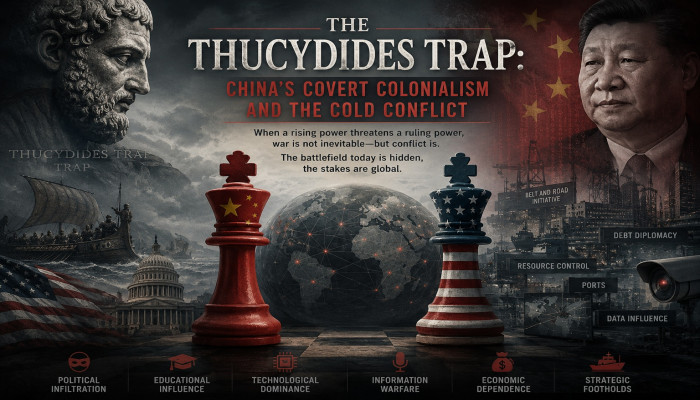
Xi Jinping, the Communist Supremo ruling over China, was eloquent about avoiding the Thucydides Trap last week when Donald Trump visited China. The Thucydides Trap is a political theory stating that when a rising power threatens to displace an established ruling power, the resulting structural stress makes violent conflict the rule rather than the exception. Popularised by Harvard political scientist Graham Allison in his 2017 book “Destined for War: Can America and China Escape Thucydides’s Trap?”, the concept draws on the ancient Greek historian Thucydides, who attributed the Peloponnesian War (431–404 BCE) to “the rise of Athens and the fear that this instilled in Sparta.”
Actually, invoking the Thucydides Trap by CCP (Chinese Communist Party) and its dictatorial leadership is in itself a psyop to corner the democratic and open America First USA, which is a victim of Leftist-Jihadi onslaughts even in its home turf, as the inimical forces take undue advantage of its openness and democracy. So, the question is – “The Thucydides Trap: Why China’s Covert Colonialism continues Cold War with the “America First” US government without regime change and democracy in China or without a leftist government in the United States’.
Let us take a look at this doctrine called Thucydides Trap and how it is going to be difficult for the Expansionist CCP to avoid and overcome this trap until and unless the USA gets rid of its “America First Administration” led by Real Red Republicans, substituted by Leftist and Liberal Pro-Jihadi Blue “Democrats” led “Deep State Driven Administration” in the White House.
Concept and Historical Context
The Structural Catalyst: It is not necessarily outright aggression but the psychological fear and anxiety generated by the shift in the balance of power that forces both sides into confrontation.
Historical Precedent: Allison’s research at the Harvard Belfer Centre examined 16 historical instances over the past 500 years where an emerging power rivalled an established hegemon. Twelve of these sixteen cases resulted in war.
Notable Examples: These include the rise of the German Empire challenging the British Empire (leading to World War I) and rising imperial Japan challenging the United States in the Pacific (contributing to World War II in the Pacific Theatre).
Relevance to CCP-Occupied China
The theory is applied most frequently to contemporary United States – CCP-Occupied China relations, by the Communists and Leftists as a Power Game and as an agenda-driven narrative.
CCP-Occupied China’s rapid economic, technological, and military expansion; based on blatant ruthless undemocratic means and methods; creates severe friction with the established United States-led open and democratic free world “global order”. While Allison notes that conflict is not inevitable — citing the Cold War United States – Soviet Union rivalry as a peaceful (though tense) competition — the structural pressures in the current case are compounded by the Chinese Communist Party’s (CCP) unique hegemonic characteristics.
It is not possible for the CCP to avoid the Thucydides Trap without drastic internal change. The CCP’s expansionist trends, lack of democratic accountability, systemic corruption, intellectual property (IP) theft, influence over international multilateral institutions, debt-trap Belt and Road Initiative (BRI), support for FATF black and grey listed rogue regimes, Jihadi and other terrorism proxies, supply-chain as well as resource monopolisation, and manufacturing dominance - all these form a pattern of revisionist behaviour incompatible with the existing free world order. These are not temporary policies but core features of the authoritarian regime. “Managed competition” offers only temporary delays, not resolution.
Addressing Factors that Avoid the Trap
Mutually Assured Destruction (MAD): Both nations possess nuclear arsenals. The United States maintains thousands of warheads, while CCP-Occupied China has rapidly expanded to approximately 600 warheads as of 2025–2026 (with projections toward 1,000+ by 2030).
Nuclear deterrence raises the bar for direct conflict, but doesn’t prevent grey-zone aggression, proxy support, internal meddling in democratic United States. Conventional flashpoints trigger these proxy war tactics. History shows nuclear powers can still clash indirectly or miscalculate.
Deep Economic Interdependence: Bilateral goods trade reached around $415 billion in 2025 (United States exports to CCP-Occupied China ~$106 billion, imports ~$308 billion), with a large United States deficit.
War would devastate supply chains. Yet this interdependence is asymmetrical and weaponised by the CCP through subsidies, dumping, and coercion. Decoupling and “friend-shoring” efforts already reduce the weightage of this restraint over time.
Diplomacy and Shared Challenges: High-level talks and issues like climate or artificial intelligence exist, but the CCP’s bad-faith engagement (e.g., influence in World Health Organisation [WHO], World Trade Organisation [WTO]) undermines trust. Shared challenges have not curbed aggression.
These factors buy time but do not resolve fundamental incompatibilities and ultimately even worsen the situation.
High-Risk Triggers
Key flashpoints include Taiwan (forced reunification by the CCP or declaration of independence by Taiwanese dispensation), the South China Sea (naval incidents), and technology/cyber domains. These risks intensify due to CCP behaviour.
Fortunately or unfortunately, even severe actions against CCP proxies and allies have not drawn CCP into conflict - for example, recent actions against the dictatorial regime in Venezuela or Jihadi Ayatollah regime in Iran.
CCP-Specific Factors Making Avoidance Unlikely
1. Expansionist Trends: The CCP asserts claims in the South China Sea (militarised artificial islands and other islands), Taiwan, Himalayan borders with India (Aksai Chin, Sakshgam Valley, Arunachal Pradesh), and beyond. Historical usurpation (Tibet, Xinjiang/East Turkestan, Inner Mongolia, etc.) and recent Hong Kong absorption show a pattern. Counter-strategies like Quad, AUKUS, and Freedom of Navigation Operations (FONOPs) raise costs, but the CCP’s opportunism (advancing when targets seem weak) persists. Firm deterrence has sometimes paused actions, yet the regime’s revisionism continues.
2. Lack of Democracy: Authoritarian decision-making enables rapid, unaccountable aggression without domestic debate. The Cold War United States–Soviet analogy fails here: the CCP’s ideological Leninist system and national rejuvenation narrative drive zero-sum competition more aggressively than Soviet pragmatism.
3. Intellectual Property Theft and Economic Misconduct: State-sponsored theft costs the United States economy $225–600 billion annually (some estimates higher, up to $600–800 billion, including broader impacts).
This erodes trust and technological edges. Sanctions and export controls (e.g., semiconductors) respond, but the systemic, CCP-directed nature makes it a persistent feature, fuelling resentment and decoupling pressures.
4. Domestic Corruption: Widespread corruption, including in the People’s Liberation Army (PLA) with high-profile purges, weakens capabilities and breeds risk-aversion. However, it also signals institutional fragility that could lead to desperate external actions to bolster regime legitimacy.
5. Influence Over International Organisations: The CCP’s placement of officials and leverage in the United Nations (UN), WTO, and WHO etc. distorts global norms. Counter-efforts via G7 alternatives help, but institutional capture advances CCP interests without military cost.
6. Belt and Road Initiative (BRI): Launched in 2013, the BRI has involved hundreds of billions in projects, creating dependencies. While debt issues, defaults, and backlashes have scaled back some ambitions, 2025 saw record engagement in some metrics, extending influence through infrastructure and resources.
This “debt-trap” soft power advances strategic footholds.
7 and 8. Support for FATF-Listed States and Terrorism: Ties to North Korea, Iran, Myanmar, Pakistan (including shielding at UN and indirect support for jihadist elements from Pakistan) destabilise regions. The CCP uses these as buffers but risks escalation. Domestic extremism concerns in Xinjiang create some alignment on stability, yet selective support continues.
9 and 10. Monopolisation of Supply Chains/Critical Minerals and Gigantic Manufacturing Scale: Dominance in rare earths, batteries, pharmaceuticals, and overcapacity dumping (e.g., solar, EVs) threatens competitors. “De-risking” via friend-shoring and tariffs (CHIPS Act, etc.) counters this, but the scale enables economic coercion short of war.
11. Economic Warfare and De-Dollarisation: Efforts to internationalise the Renminbi (RMB) and shift from the United States dollar act as non-kinetic tools. Dollar dominance persists due to rule of law and markets, channelling rivalry into economics.
12. Fake Narrative War: Disinformation via state media and apps and agents, as well as leftist and woke politics, seeks to divide the West and other democracies and project inevitability. Counters include restrictions (e.g., on TikTok) and independent journalism, keeping it below kinetic thresholds.
13. Territorial History: Absorbed regions (Tibet, etc.) are treated as fait accompli. Active claims face pushback (India border infrastructure, United States–Japan treaties on Senkaku), forcing grey-zone tactics. Yet the pattern signals endless revisionism.
Conclusion
Drastic CCP Change Is Required - The CCP’s authoritarian structure, ideological drive, moral and governance failures, and revisionist goals make it structurally incompatible with a stable rules-based order. While nuclear weapons, economic ties, and deterrence can delay hot war—redirecting conflict into grey zones—these do not eliminate the trap.
Historical precedents (12 of 16 cases ending in war) and the CCP’s behaviour suggest high risk.
“Managed competition” is a euphemism for prolonged tension. Without fundamental CCP transformation—greater transparency, reduced aggression, genuine reciprocity, and accountability—escalation remains probable. The Earth may be vast, but the Expansionist Communist Colonialist CCP’s zero-sum worldview leaves insufficient or no room for peaceful coexistence under current conditions. Peace depends on strength, resolve, and the CCP’s willingness (or forced necessity) to change.
Disclaimer: The opinions expressed within this article are the personal opinions of the author. MyIndMakers is not responsible for the accuracy, completeness, suitability, or validity of any information on this article. All information is provided on an as-is basis. The information, facts or opinions appearing in the article do not reflect the views of MyindMakers and it does not assume any responsibility or liability for the same.



 Loading...please wait
Comments